
Environmental Manager vs Sustainability Manager: Responsibilities and Skills
An Environmental Manager focuses primarily on controlling and improving the environmental impact of an organisation’s activities, while a Sustainability Manager takes a broader approach by developing strategies that balance environmental performance with social responsibility, resource efficiency and long-term organisational objectives.
Although these roles have overlapping responsibilities, their priorities, management approaches and professional skills can differ.
Environmental Managers typically concentrate on environmental compliance, pollution prevention, environmental management systems, waste control and environmental risk management. Sustainability Managers generally focus on sustainability strategies, carbon reduction, responsible resource consumption, ESG performance and integrating sustainable practices into business decisions.
However, job titles are not standardised across every industry. Some organisations combine both positions, while larger organisations assign separate responsibilities to environmental compliance, sustainability strategy and ESG reporting.
What is Enviromental Manager?
An Environmental Manager is a professional who specialises in environmental management and the protection of natural resources within an organisation. The field combines environmental science, management principles and regulatory knowledge to support environmentally responsible business operations.
Key areas of environmental management include:
- Environmental protection and conservation.
- Environmental legislation and standards.
- Pollution prevention and control.
- Natural resource management.
- Environmental sustainability.
- Environmental management systems.
- Waste management principles.
Importance of Environmental Management
Environmental management is important because it helps organisations protect natural resources, reduce pollution and minimise harmful environmental impacts. It also supports responsible business practices, regulatory compliance and long-term environmental sustainability.
Key benefits include:
- Environmental Protection: Helps preserve ecosystems, biodiversity and natural resources.
- Pollution Reduction: Promotes measures to minimise air, water and soil pollution.
- Resource Conservation: Encourages efficient use of energy, water and raw materials.
- Legal Compliance: Supports adherence to applicable environmental laws and standards.
- Waste Reduction: Promotes recycling, reuse and responsible waste management.
- Sustainable Development: Encourages environmentally responsible decisions and long-term sustainability.
- Organisational Improvement: Strengthens environmental performance and supports responsible operations.
What is Sustainability Manager?
A Sustainability Manager is a professional who focuses on integrating sustainable practices into an organisation’s strategies, operations and long-term planning. The role connects environmental protection, responsible resource use and organisational development to support a more sustainable future.
Key areas of sustainability management include:
- Environmental and social sustainability.
- Carbon reduction and climate action.
- ESG (Environmental, Social and Governance) principles.
- Sustainable resource management.
- Energy efficiency and renewable energy.
- Circular economy and waste reduction.
- Sustainable business practices.
Importance of Sustainability Management
Sustainability management is important because it helps organisations balance environmental protection, responsible resource consumption and long-term business performance. It encourages sustainable decision-making, reduces environmental impacts and supports responsible practices that benefit both present and future generations.
Key benefits include:
- Environmental Protection: Encourages the responsible use of natural resources and reduces environmental damage.
- Carbon Reduction: Supports efforts to minimise greenhouse gas emissions and address climate change.
- Resource Efficiency: Promotes efficient use of energy, water and raw materials.
- Waste Minimisation: Encourages recycling, reuse and circular economy practices.
- Business Resilience: Helps organisations prepare for environmental and sustainability-related challenges.
- ESG Performance: Supports stronger environmental, social and governance practices.
- Long-Term Sustainability: Integrates responsible practices into organisational planning and decision-making.
Environmental Manager: Role and Responsibilities
An Environmental Manager is responsible for monitoring, managing and improving an organisation’s environmental performance. The role focuses on identifying environmental risks, establishing effective controls, supporting compliance activities and ensuring that environmental management procedures are properly implemented.
Environmental Managers commonly work in construction, manufacturing, energy, infrastructure, engineering, waste management and industrial operations. Their responsibilities help organisations minimise environmental impacts, maintain effective management systems and improve operational practices.
Key Responsibilities of an Environmental Manager
- Environmental Compliance and Regulatory Management: Identify applicable environmental obligations, maintain compliance records, review permits, coordinate inspections and support communication with relevant authorities.
- Environmental Management Systems (EMS): Develop, implement and monitor environmental policies, objectives, operational controls, internal audits and corrective actions in line with recognised frameworks such as ISO 14001.
- Environmental Risk Assessment: Identify activities that may cause environmental harm and evaluate potential impacts, including air emissions, wastewater discharge, soil contamination, chemical storage, noise pollution and biodiversity disturbance.
- Waste Management and Pollution Prevention: Establish waste segregation procedures, monitor disposal practices, improve recycling processes and implement measures to prevent environmental pollution.
- Environmental Monitoring and Reporting: Review environmental performance data, coordinate monitoring activities, prepare reports, identify non-conformities and recommend improvements.
- Employee Awareness and Environmental Training: Communicate environmental procedures, explain operational controls and help employees understand their environmental responsibilities.
These responsibilities are commonly reflected in environmental management job profiles and organisational practices.
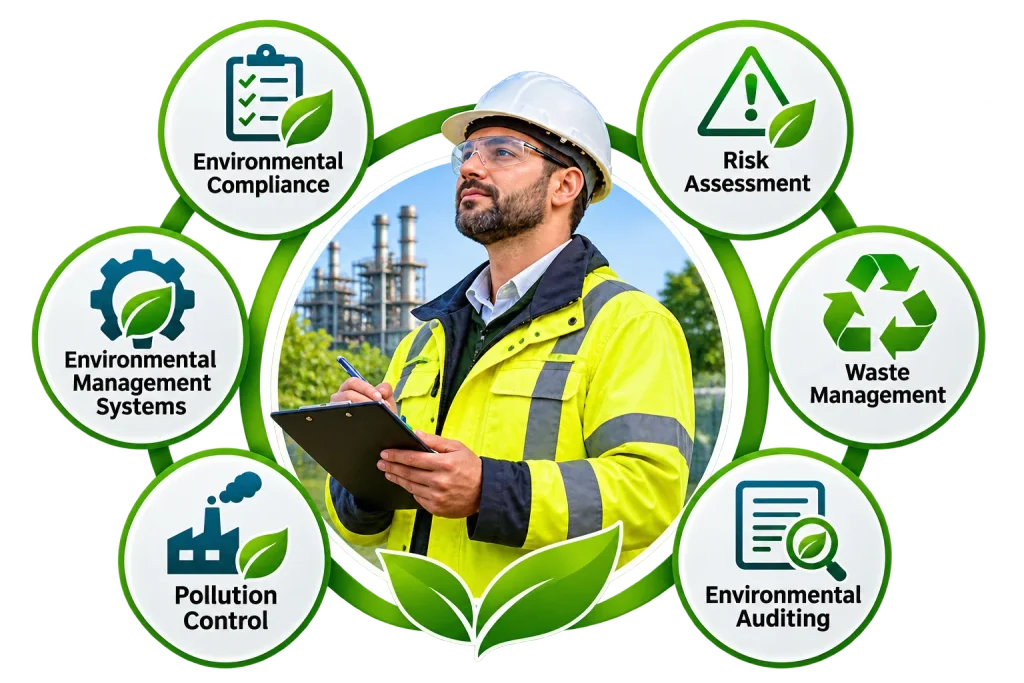
Important Skills Required for an Environmental Manager
- Environmental legislation and compliance awareness.
- Environmental risk assessment and impact evaluation.
- ISO 14001 Environmental Management Systems knowledge.
- Environmental auditing and inspection.
- Waste management and pollution control.
- Environmental monitoring and data interpretation.
- Technical report writing and documentation.
- Problem-solving and corrective action management.
- Communication and stakeholder coordination.
- Project management and leadership.
Sustainability Manager: Role and Responsibilities
A Sustainability Manager develops and coordinates strategies that help organisations improve environmental, social and long-term operational performance. The role involves integrating sustainability objectives into business planning and decision-making rather than focusing solely on environmental controls.
Sustainability Managers often collaborate with different departments, including procurement, finance, operations, human resources and corporate strategy. Their work supports responsible resource use, carbon reduction, ESG performance and continuous organisational improvement.
Key Responsibilities of a Sustainability Manager
- Developing Sustainability Strategies: Create organisational sustainability plans, establish priorities and coordinate initiatives that support environmental and wider sustainability objectives.
- Carbon Management and Emissions Reduction: Measure greenhouse gas emissions, identify reduction opportunities, establish carbon targets and monitor progress towards climate objectives.
- ESG Management and Reporting: Coordinate Environmental, Social and Governance (ESG) information, review performance indicators and support the preparation of sustainability reports and disclosures.
- Sustainable Resource Management: Identify opportunities to improve energy efficiency, conserve water, reduce material consumption, minimise waste and promote responsible procurement.
- Stakeholder Engagement: Work with employees, suppliers, customers, senior management and external stakeholders to integrate sustainability priorities into organisational activities.
- Monitoring Sustainability Performance: Establish performance indicators, analyse sustainability data, evaluate initiatives and communicate progress towards organisational targets.
Sustainability management can include energy and utilities planning, performance benchmarking, environmental compliance, project evaluation and stakeholder coordination.
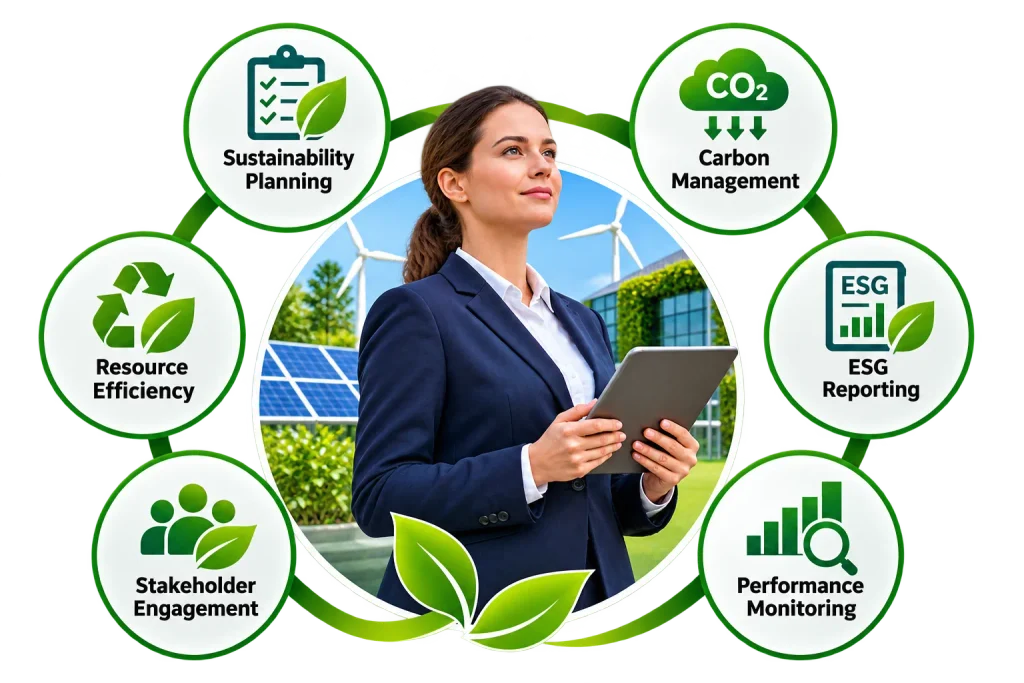
Important Skills Required for a Sustainability Manager
- Sustainability strategy development.
- ESG principles and reporting awareness.
- Carbon accounting and emissions management.
- Sustainable procurement.
- Resource efficiency and circular economy principles.
- Climate risk assessment.
- Data analysis and performance measurement.
- Business planning and strategic thinking.
- Stakeholder engagement.
- Leadership and change management.
Environmental Manager vs Sustainability Manager: Key Differences
The main difference concerns the scope of responsibility. Environmental Managers generally concentrate on environmental impacts, operational controls and compliance, whereas Sustainability Managers coordinate broader sustainability objectives across organisational functions.
| Comparison area | Environmental Manager | Sustainability Manager |
|---|---|---|
| Main focus | Environmental protection and performance | Wider organisational sustainability |
| Primary objective | Control environmental impacts and risks | Integrate sustainability into business strategy |
| Compliance | Strong focus on environmental obligations | Considers compliance alongside wider sustainability goals |
| Environmental systems | EMS development and monitoring | May oversee or contribute to EMS initiatives |
| Pollution control | Direct operational focus | Supports pollution reduction strategies |
| Carbon management | Monitors relevant emissions and controls | Develops wider carbon reduction programmes |
| ESG | May provide environmental performance data | Often coordinates broader ESG activities |
| Resource management | Focuses on environmental resource controls | Integrates resource efficiency into business strategy |
| Reporting | Environmental monitoring and compliance reports | Sustainability performance and ESG reports |
| Stakeholders | Operations, technical teams and regulators | Senior management, finance, procurement, suppliers and stakeholders |
Important distinction: These are typical areas of emphasis rather than fixed professional boundaries. An Environmental Manager may lead sustainability initiatives, and a Sustainability Manager may have direct responsibility for environmental compliance.
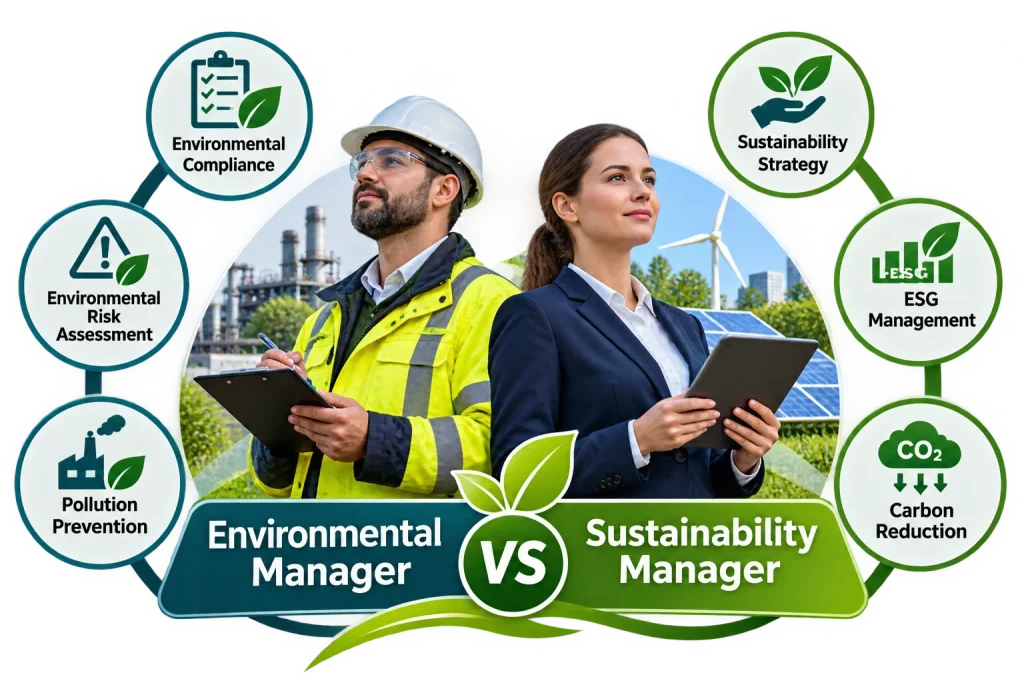
Where Do These Professionals Work?
Environmental Managers and Sustainability Managers work across various industries, including manufacturing, construction, energy and corporate services. Their responsibilities vary according to organisational objectives, operational activities, environmental risks and sustainability priorities.
Key sectors and responsibilities include:
Manufacturing and Industrial Operations
- Environmental Managers monitor emissions, wastewater, waste disposal and environmental controls.
- Sustainability Managers coordinate energy efficiency, responsible sourcing and carbon reduction initiatives.
Construction and Infrastructure
- Environmental Managers oversee site environmental plans, pollution prevention and environmental inspections.
- Sustainability Managers promote sustainable construction, material efficiency and low-carbon project strategies.
Energy and Utilities
- Environmental Managers manage environmental risks, monitoring activities and operational controls.
- Sustainability Managers support renewable energy initiatives, energy efficiency and emissions reduction programmes.
Corporate and Professional Services
- Sustainability Managers integrate sustainability objectives into corporate planning, procurement and ESG reporting.
- Environmental Managers maintain environmental management systems and improve operational environmental performance.
Which Role is Better for Your Professional Experience?
Choosing between environmental management and sustainability management depends on professional interests, existing skills and long-term career objectives. Neither position is universally better because both contribute to organisational environmental performance and responsible business practices.
Environmental Manager may suit professionals who:
- Prefer technical environmental work and operational management.
- Have an interest in environmental protection and pollution prevention.
- Want to work with environmental audits and management systems.
- Enjoy identifying environmental risks and implementing corrective actions.
- Have experience in environmental engineering, environmental science or industrial operations.
- Prefer monitoring environmental performance and compliance activities.
Sustainability Manager may suit professionals who:
- Enjoy strategic planning and organisational development.
- Have an interest in climate action and carbon reduction.
- Want to coordinate sustainability projects across departments.
- Are interested in ESG reporting and corporate responsibility.
- Enjoy stakeholder engagement and organisational change.
- Prefer integrating sustainability into business decisions.
Which professional skills can help someone move between the roles?
Professionals can develop transferable skills to move between environmental management and sustainability management.
For example, an Environmental Manager can strengthen knowledge of ESG reporting, carbon accounting, sustainable procurement and strategic planning. Similarly, a Sustainability Manager can develop technical knowledge of environmental auditing, impact assessment, environmental compliance and environmental management systems.
The most effective approach is to identify the competencies required for the intended role and build relevant practical experience.
Skills Development and Professional Learning in Environmental Management
Both career paths require a combination of technical understanding, analytical ability, leadership and practical decision-making. As environmental challenges become increasingly connected to organisational strategy, professionals benefit from developing knowledge across environmental management and sustainability disciplines.
Important areas of professional development include:
- Environmental Management Systems: Understanding how organisations establish environmental policies, identify environmental aspects and impacts, monitor performance and implement continual improvement.
- Environmental Impact Assessment: Developing knowledge of how proposed projects are evaluated for potential environmental consequences and how mitigation measures are identified.
- Environmental Resource Management: Understanding approaches to improving energy and water efficiency, reducing waste and managing natural resources responsibly.
- Pollution Control: Developing knowledge of pollution prevention, environmental monitoring and operational control measures.
- Environmental Compliance: Understanding how organisations identify applicable environmental obligations and maintain appropriate compliance procedures.
- Environmental Leadership: Strengthening the ability to coordinate teams, manage environmental projects and integrate environmental considerations into organisational decisions.
Practical Example: How Both Roles Work Together
Consider a manufacturing organisation that wants to reduce its environmental impact and improve sustainability performance.
The Environmental Manager and Sustainability Manager may collaborate on the same improvement project, but their contributions can differ.
| Project activity | Environmental Manager’s contribution | Sustainability Manager’s contribution |
|---|---|---|
| Waste reduction | Reviews waste streams and disposal controls | Develops organisation-wide waste reduction objectives |
| Energy efficiency | Reviews environmental implications and relevant operational data | Coordinates energy efficiency initiatives |
| Water conservation | Monitors water-related environmental impacts | Establishes water efficiency targets and improvement programmes |
| Carbon reduction | Provides operational emissions information | Coordinates carbon reduction strategy |
| Environmental reporting | Prepares environmental performance records | Integrates relevant results into sustainability reporting |
| Employee awareness | Communicates environmental procedures | Promotes wider sustainability awareness and engagement |
Example scenario: A manufacturing company discovers that its production operations generate significant material waste and consume substantial energy.
The Environmental Manager investigates waste handling procedures, identifies environmental risks and recommends operational controls. The Sustainability Manager coordinates a wider resource efficiency programme involving production, procurement and senior management.
Together, they can establish measurable improvement objectives, allocate responsibilities and review performance.
This illustrates why environmental management and sustainability management should be viewed as complementary professional disciplines rather than competing roles.
Conclusion
Environmental Managers and Sustainability Managers play important but distinct roles in improving organisational environmental performance. Environmental Managers primarily focus on environmental compliance, risk management, pollution control and environmental management systems, while Sustainability Managers develop broader strategies covering carbon reduction, resource efficiency, ESG performance and long-term sustainability goals. Although their responsibilities differ, both roles contribute to responsible business practices and environmental improvement.
Choosing between these careers depends on professional experience, interests and strengths. Individuals interested in compliance, environmental monitoring and operational controls may prefer Environmental Management, while those focused on sustainability strategy, climate action and ESG management may find Sustainability Management more suitable. Developing advanced environmental management knowledge through the OTHM Level 7 International Postgraduate Diploma in Environmental Management can help learners strengthen relevant professional understanding and capabilities.