
ISO 14001 Environmental Management System: A Practical Guide for Organisations
An ISO 14001 Environmental Management System (EMS) provides organisations with a structured approach to identifying, managing and reducing the environmental impacts of their activities, products and services. As environmental responsibilities become increasingly important across global industries, organisations need effective systems to control pollution, manage resources, improve environmental performance and fulfil applicable compliance obligations.
ISO 14001 is an internationally recognised environmental management standard that helps businesses establish measurable environmental objectives and integrate sustainability into everyday operations. It applies to organisations of different sizes and sectors, including construction, manufacturing, healthcare, engineering, logistics, education and service industries.
Understanding ISO 14001 requirements is valuable for both organisations and individuals pursuing careers in environmental management. This practical guide explains the standard, its principal requirements, EMS implementation, environmental risk assessment, internal auditing and continual improvement. It also explores how professional environmental management education can help learners develop the knowledge required to support sustainable organisational practices.
What is ISO 14001 Environmental Management System?
ISO 14001 is an international standard that specifies requirements for establishing, implementing, maintaining and continually improving an Environmental Management System.
An Environmental Management System is a coordinated framework of policies, procedures, responsibilities and operational controls that an organisation uses to manage its environmental responsibilities.
The purpose of an ISO 14001 Environmental Management System is to help organisations:
- Identify environmental aspects associated with their activities.
- Assess potential and actual environmental impacts.
- Establish environmental objectives and measurable targets.
- Manage environmental risks and opportunities.
- Identify and address applicable compliance obligations.
- Monitor environmental performance.
- Improve resource efficiency and pollution prevention.
- Strengthen environmental accountability throughout the organisation.
The current edition, ISO 14001:2026, builds on the established environmental management framework while providing clearer requirements and improved usability. It supports organisations in connecting environmental protection with operational performance and business resilience.
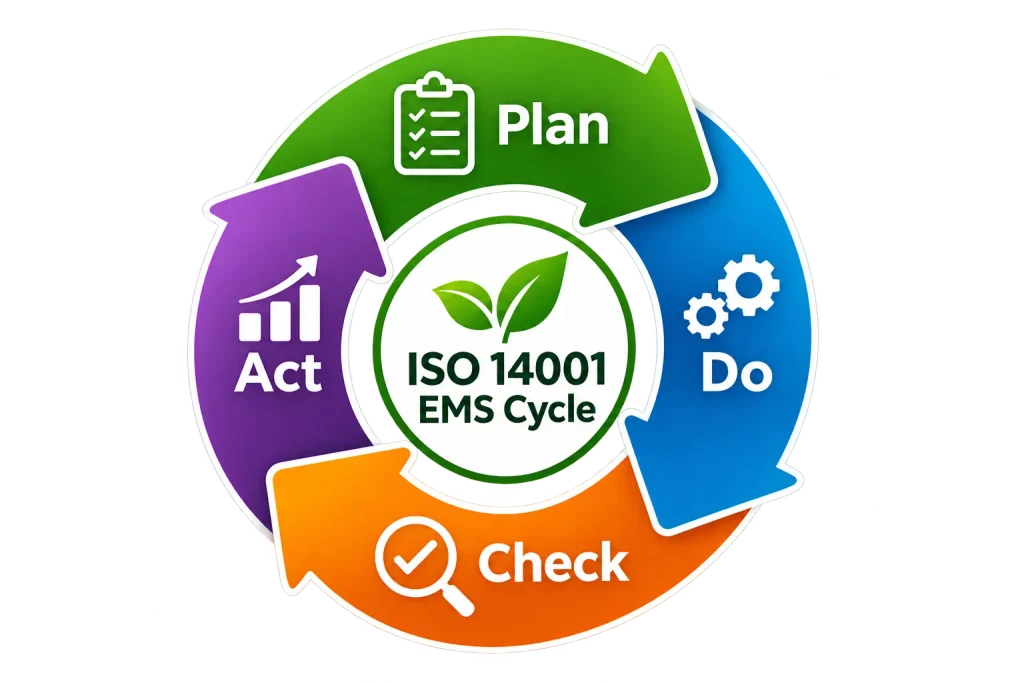
What is the Difference Between EMS and ISO 14001?
An Environmental Management System is the management framework an organisation establishes to control its environmental responsibilities. ISO 14001 is the international standard that provides the requirements against which that system can be developed and assessed.
| Environmental Management System (EMS) | ISO 14001 |
|---|---|
| A management framework used by an organisation. | An international environmental management standard. |
| Contains policies, procedures and operational controls. | Specifies requirements for an effective EMS. |
| Can be developed without external certification. | Can be used as the basis for independent certification. |
| Focuses on managing environmental impacts. | Provides a structured approach to managing and improving environmental performance. |
| Is tailored to organisational activities. | Provides requirements applicable across different industries. |
An organisation can operate an EMS without obtaining ISO 14001 certification. Certification is a separate process involving an independent certification body.
Why is ISO 14001 Important for Organisations?
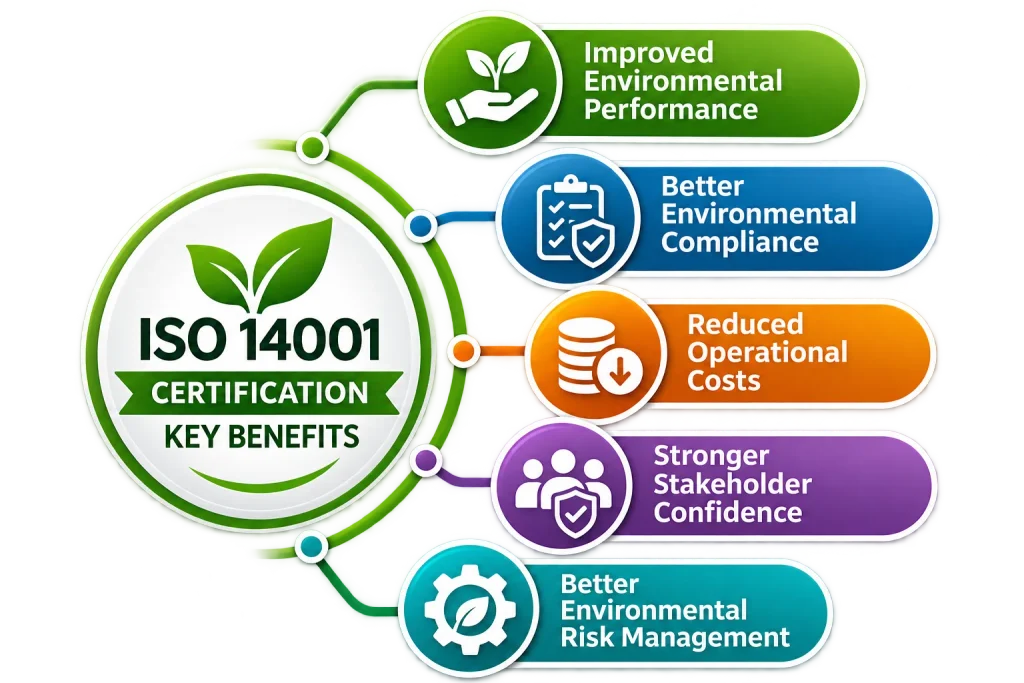
ISO 14001 helps organisations move from informal environmental practices towards a structured and measurable Environmental Management System (EMS). It supports businesses in managing issues such as waste, energy consumption, water pollution and emissions.
An effective EMS helps organisations improve environmental performance, strengthen operational controls and manage environmental responsibilities.
Improved Environmental Performance
Organisations can identify activities that harm the environment and introduce suitable measures to reduce their impacts.
Key improvement areas include:
- Reducing production waste.
- Improving material utilisation.
- Controlling harmful emissions.
Better Environmental Compliance
An EMS helps organisations identify applicable environmental obligations, assign responsibilities and monitor compliance. However, ISO 14001 certification does not automatically guarantee legal compliance.
Important compliance activities include:
- Identifying relevant requirements.
- Monitoring compliance obligations.
- Maintaining appropriate records.
Reduced Operational Costs
Improving resource efficiency helps organisations reduce unnecessary expenditure and improve operational performance.
Cost-saving opportunities include:
- Reducing electricity and water consumption.
- Minimising raw material wastage.
- Improving waste segregation.
- Maintaining equipment efficiently.
Stronger Stakeholder Confidence
An effective EMS demonstrates an organisation’s commitment to responsible environmental management. This can strengthen confidence among customers, suppliers, investors and business partners.
Organisations can demonstrate this commitment through:
- Clear environmental policies and objectives.
- Documented environmental responsibilities.
- Regular performance monitoring.
Better Environmental Risk Management
ISO 14001 encourages organisations to identify environmental risks and opportunities before they develop into significant problems. This supports better planning, decision-making and accountability.
Key risk management activities include:
- Identifying potential environmental risks.
- Introducing appropriate control measures.
- Reviewing risks and improvement opportunities.
What are the Main ISO 14001 Requirements?
ISO 14001:2026 establishes requirements for developing and maintaining an effective Environmental Management System. Organisations should consult the official edition for the complete normative requirements.
The following table summarises the principal management areas that organisations need to address.
| Management area | Main organisational responsibility |
|---|---|
| Organisational context | Understand internal and external issues affecting the EMS. |
| Leadership | Establish environmental direction and accountability. |
| Planning | Identify environmental aspects, risks and opportunities. |
| Support | Provide resources, competence, awareness and communication. |
| Operation | Implement environmental operational controls. |
| Performance evaluation | Monitor, measure, analyse and evaluate performance. |
| Improvement | Address nonconformities and continually improve the EMS. |
These areas provide a useful learning framework. The exact requirements and clause wording should always be checked against ISO 14001:2026.
Understanding Organisational Context
An organisation must understand the internal and external issues that may affect its environmental management objectives.
These may include:
- Industry-specific environmental challenges.
- Climate-related conditions.
- Availability of natural resources.
- Customer environmental expectations.
- Supplier environmental performance.
- Operational and technological changes.
- Relevant legal and regulatory obligations.
The organisation should also identify interested parties and understand their relevant environmental expectations.
Environmental Leadership and Commitment
Senior management is responsible for providing direction, resources and support for an effective Environmental Management System (EMS). Environmental management should involve all employees and departments.
Key leadership responsibilities include:
- Establishing environmental policies and objectives.
- Providing adequate resources.
- Assigning roles and responsibilities.
- Integrating environmental management into daily operations.
Environmental Planning
Environmental planning involves identifying environmental aspects, assessing risks and opportunities, and setting measurable objectives. For example, a construction company may need to manage:
- Dust emissions and construction waste.
- Noise and fuel consumption.
- Water usage and resource efficiency.
Support and Competence
Employees need the right knowledge, skills and awareness to manage their environmental responsibilities. Organisations should provide suitable support to ensure effective EMS implementation.
Key support measures include:
- Providing relevant employee training.
- Ensuring adequate resources.
- Improving environmental awareness.
- Establishing effective communication.
Operational Control
Operational controls ensure that activities with significant environmental impacts are performed under appropriate conditions.
Examples include:
- Waste handling and segregation procedures.
- Chemical storage and spill prevention.
- Energy management procedures.
- Water discharge controls.
- Equipment maintenance.
- Contractor environmental requirements.
- Emergency preparedness arrangements.
Performance Evaluation
Organisations should regularly assess whether their Environmental Management System (EMS) is working effectively. This helps identify performance gaps and ensure environmental objectives are being achieved.
Key evaluation activities include:
- Monitoring environmental performance.
- Conducting internal audits.
- Carrying out management reviews.
Continual Improvement
An EMS should continuously improve as organisational activities and environmental conditions change. Organisations should address weaknesses and strengthen their environmental performance.
Key improvement actions include:
- Investigating nonconformities.
- Implementing corrective actions.
- Identifying improvement opportunities.
How to Implement an ISO 14001 Environmental Management System
Implementing an EMS requires a planned approach involving senior management, employees, operational departments and other relevant stakeholders.
Organisations should adapt their implementation activities to their size, industry, environmental risks and available resources.
The following steps provide a practical implementation roadmap.
Step 1: Obtain Management Commitment
Senior management should establish a clear commitment to environmental protection and provide the resources required to implement the system.
This includes:
- Appointing an environmental management representative or responsible team.
- Defining organisational environmental priorities.
- Allocating financial and human resources.
- Establishing responsibilities and reporting arrangements.
- Communicating environmental expectations to employees.
Without management commitment, environmental procedures may exist only on paper and fail to influence daily operations.
Step 2: Understand Organisational Activities
Organisations should review their activities, products, services and processes to understand their potential environmental effects. This helps identify areas that require environmental management and control.
Key areas to consider include:
- Raw material and energy consumption.
- Chemical handling and production waste.
- Air emissions and wastewater.
- Resource use and operational processes.
This review provides the foundation for identifying environmental aspects and impacts.
Step 3: Identify Environmental Aspects and Impacts
An environmental aspect is an element of an organisation’s activities, products or services that can interact with the environment.
An environmental impact is a change to the environment resulting from an environmental aspect.
| Activity | Environmental aspect | Potential environmental impact |
|---|---|---|
| Manufacturing | Energy consumption | Greenhouse gas emissions |
| Construction | Dust generation | Air pollution |
| Chemical storage | Chemical leakage | Soil and water contamination |
| Transportation | Fuel consumption | Air emissions |
| Office operations | Paper consumption | Resource depletion and waste |
| Waste disposal | Improper waste handling | Land and water pollution |
Organisations should assess the significance of their environmental aspects using appropriate criteria, such as severity, frequency, scale, legal obligations and likelihood.
Step 4: Identify Compliance Obligations
Organisations must determine the environmental legal requirements and other obligations relevant to their activities.
These may involve environmental permits, waste management requirements, discharge controls, emissions conditions and contractual environmental commitments.
A compliance register can help organisations record:
- Applicable requirements.
- Relevant operational activities.
- Responsible departments.
- Compliance monitoring arrangements.
- Evidence of compliance.
- Review dates and corrective actions.
Legal requirements differ between countries and locations. An organisation operating in the UK must consider the requirements applicable to its particular UK nation and activities, while a Pakistani organisation must consider the relevant federal and provincial framework.
Step 5: Establish Environmental Policy and Objectives
An environmental policy communicates the organisation’s environmental commitments and provides direction for its EMS.
Environmental objectives should translate these commitments into measurable improvement activities.
Examples include:
- Reducing electricity consumption by an internally established target.
- Improving waste segregation across operational departments.
- Reducing water consumption through improved equipment.
- Increasing the proportion of materials reused or recycled.
- Improving environmental training participation.
Objectives should be realistic, measurable where practicable, assigned to responsible individuals and reviewed periodically.
Step 6: Develop Environmental Procedures and Controls
Organisations should establish clear procedures to manage significant environmental aspects and operational risks. These procedures must be practical, easy to understand and accessible to relevant employees.
Common environmental procedures and controls include:
- Chemical handling instructions.
- Waste management procedures.
- Emergency response arrangements.
- Equipment inspection checklists.
- Contractor environmental requirements.
Step 7: Provide Employee Training and Awareness
Employees must understand how their work can affect the environment and what actions are expected of them.
Training may cover:
- Environmental awareness.
- Waste segregation.
- Pollution prevention.
- Emergency spill response.
- Efficient energy and water consumption.
- Environmental reporting procedures.
- Operational environmental controls.
Training effectiveness should be evaluated rather than measured only by attendance.
Step 8: Monitor and Measure Environmental Performance
Organisations should regularly monitor environmental performance using suitable indicators and reliable data. This helps management evaluate progress and determine whether environmental objectives are being achieved.
Common environmental performance indicators include:
- Electricity and water consumption.
- Waste generation.
- Fuel usage.
- Environmental incidents.
- Progress towards environmental objectives.
Step 9: Conduct Internal Environmental Audits
Internal environmental audits evaluate whether the Environmental Management System (EMS) is properly implemented and meets planned arrangements and applicable ISO 14001 requirements. Audits should be conducted by competent and sufficiently objective auditors.
Key audit activities include:
- Reviewing EMS implementation and procedures.
- Checking compliance with ISO 14001 requirements.
- Identifying nonconformities and improvement opportunities.
- Documenting and communicating audit findings.
- Following up with appropriate corrective actions.
Step 10: Conduct Management Review and Continual Improvement
Senior management should review the EMS at planned intervals to determine its continuing suitability, adequacy and effectiveness.
The review should consider environmental performance, audit results, compliance evaluation, changing circumstances, risks, opportunities and improvement requirements.
ISO 14001 implementation roadmap
- Management commitment and leadership
- Organisational context and environmental review
- Environmental aspects and impacts assessment
- Compliance obligations and environmental objectives
- Operational controls and employee training
- Environmental monitoring and measurement
- Internal auditing and corrective actions
- Management review and continual improvement
Practical sequence for developing an environmental management system. Activities may overlap and should be adapted to organisational circumstances.
What are Environmental Aspects and Impacts?
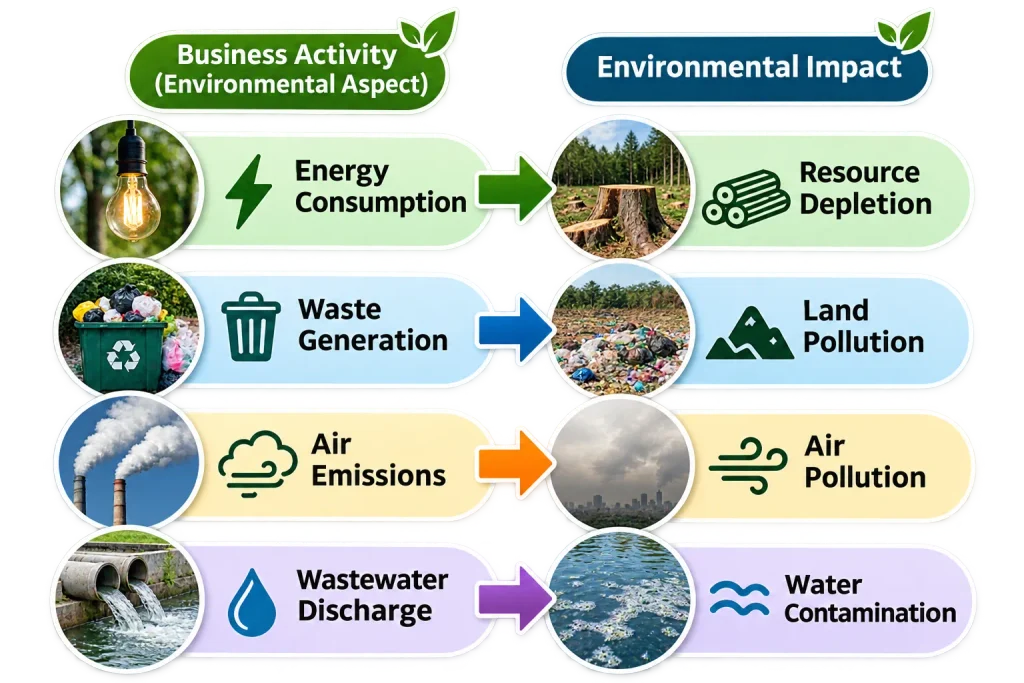
Environmental aspects and impacts help organisations understand how their activities interact with the natural environment. Identifying them enables businesses to recognise potential environmental risks and introduce suitable control measures.
Organisations should consider routine and non-routine activities, as well as possible emergency situations.
Environmental Aspects
Environmental aspects are activities or conditions that can interact with or affect the environment. Common examples include:
- Fuel and electricity consumption.
- Water usage and wastewater discharge.
- Waste generation and chemical storage.
- Air emissions and transportation activities.
- Land use, packaging and material consumption.
Environmental Impacts
Environmental impacts are the changes to the environment resulting from these activities. Examples include:
- Air pollution and greenhouse gas emissions.
- Water contamination and soil degradation.
- Natural resource depletion.
- Damage to ecosystems and biodiversity.
How to Assess Environmental Significance
Organisations can use a documented assessment method to determine which environmental aspects require priority attention.
| Assessment criterion | Consideration |
|---|---|
| Severity | How serious could the environmental impact be? |
| Frequency | How often does the activity occur? |
| Scale | How extensive could the impact become? |
| Legal relevance | Are specific compliance obligations involved? |
| Likelihood | How likely is the impact to occur? |
| Existing controls | Are current prevention measures effective? |
A significant environmental aspect should receive appropriate management attention, operational controls and monitoring.
Environmental Risk Assessment Under ISO 14001
Environmental risk assessment helps organisations identify potential situations that could negatively affect the environment and determine suitable control measures.
It supports preventive decision-making by encouraging organisations to consider environmental issues before incidents occur.
Common Environmental Risks
| Environmental risk | Possible consequence | Recommended control |
|---|---|---|
| Chemical leakage | Soil and groundwater contamination | Bunded storage and regular inspections |
| Excessive energy use | Increased emissions and operating costs | Energy monitoring and efficiency measures |
| Improper waste disposal | Land and water pollution | Waste segregation and authorised disposal arrangements |
| Water leakage | Resource wastage | Routine inspections and maintenance |
| Fuel spills | Soil and water contamination | Spill kits and emergency response procedures |
| Uncontrolled dust | Poor local air quality | Dust suppression and suitable site controls |
Example of an Environmental Risk Assessment
A construction organisation identifies diesel and fuel storage as a potential environmental risk due to the possibility of leakage. To minimise this risk, the environmental management team introduces suitable preventive measures.
Key control measures include:
- Safe fuel storage arrangements.
- Secondary containment systems.
- Regular inspection schedules.
- Spill-response equipment.
- Employee training on spill prevention.
The organisation monitors these controls through site inspections and environmental performance reviews. This demonstrates how environmental risk assessment supports practical planning and effective operational management.
ISO 14001 Environmental Management System Audits
An Environmental Management System (EMS) audit is a systematic evaluation of an organisation’s environmental management practices. It helps determine whether the EMS is effectively implemented and meets the relevant ISO 14001 requirements and assessment criteria.
Auditing enables organisations to identify weaknesses, check the effectiveness of operational controls and recognise opportunities for continuous improvement. Different types of environmental audits focus on specific areas of organisational performance.
Types of Environmental Audits
Organisations may conduct different types of environmental audits depending on their objectives and assessment requirements:
- Internal Audit: Conducted on behalf of the organisation to evaluate its EMS, identify nonconformities and highlight opportunities for improvement.
- External Certification Audit: Performed by an independent certification body to assess whether the organisation’s EMS conforms to the applicable ISO 14001 requirements.
- Compliance Audit: Evaluates whether the organisation meets its applicable environmental legal requirements, permit conditions and other obligations.
- Supplier Environmental Audit: Reviews relevant environmental practices and performance within the organisation’s supply chain.
How to Prepare for an EMS Audit
Effective audit preparation requires organisations to ensure that relevant documentation, employees and operational activities are ready for assessment. Records should be accurate, up to date and reflect how environmental management procedures are implemented in practice.
Organisations can use the following checklist to prepare for an EMS audit:
- Current environmental policy.
- Environmental aspects and impacts register.
- Environmental risk assessment.
- Compliance obligations register.
- Environmental objectives and action plans.
- Operational procedures.
- Employee training records.
- Environmental monitoring results.
- Internal audit reports.
- Corrective action records.
- Management review records.
- Relevant emergency response arrangements.
An effective EMS audit should evaluate actual environmental practices and operational performance rather than focusing only on the availability of documents. This helps organisations identify gaps, strengthen environmental controls and support continual improvement.
What is the Difference Between ISO 14001 Implementation and Certification?
Implementing ISO 14001 means developing and operating an EMS that meets the standard’s requirements. Certification is an independent conformity assessment carried out by a certification body.
| Implementation | Certification |
|---|---|
| Establishes the organisation’s EMS. | Independently assesses the EMS. |
| Includes policies, procedures and controls. | Includes formal audit activities. |
| Can be undertaken without certification. | Requires assessment against the applicable standard. |
| Focuses on managing environmental responsibilities. | Provides external evidence of conformity. |
| Requires continuing operational commitment. | Requires ongoing maintenance and surveillance under the certification scheme. |
Typical ISO 14001 Certification Process
- Define the scope of the EMS.
- Establish and implement the environmental management system.
- Evaluate compliance obligations and environmental performance.
- Conduct internal audits.
- Complete management review.
- Select an appropriate certification body.
- Undergo the certification assessment.
- Address any identified nonconformities.
- Maintain the EMS and undergo subsequent surveillance and recertification assessments as applicable.
Organisations should verify the certification body’s accreditation and the scope of its certification services before engaging it.
ISO 14001:2026 – What Organisations Should Know About the New Edition
ISO 14001:2026 is the current fourth edition of the environmental management standard, published on 15 April 2026.
The updated edition builds on the established EMS framework and introduces clearer structure and improved usability. It also reflects contemporary environmental priorities, including climate-related concerns, biodiversity and resource efficiency.
Organisations previously certified to ISO 14001:2015 should not assume that their existing systems automatically meet the new edition.
They should:
- Obtain the official ISO 14001:2026 requirements.
- Review their existing EMS against the new edition.
- Identify changes required in documentation and operational practices.
- Review environmental risks and opportunities.
- Update relevant training and audit arrangements.
- Agree transition arrangements with their certification body.
- Complete the required transition assessment within the applicable timeframe.
Benefits of ISO 14001 for Different Industries
ISO 14001 is not limited to manufacturing or heavy industry. Organisations across different sectors can use an EMS to manage their environmental responsibilities.
| Industry | Environmental management priorities | Potential benefits |
|---|---|---|
| Construction | Dust, noise, waste and fuel consumption | Better site controls and reduced environmental risks |
| Manufacturing | Emissions, chemicals, energy and production waste | Improved resource efficiency and pollution prevention |
| Healthcare | Clinical waste, water and energy consumption | Better environmental controls and waste management |
| Logistics | Fuel usage, vehicle emissions and packaging | Improved transport efficiency |
| Hospitality | Water, electricity, food waste and cleaning chemicals | Reduced resource wastage |
| Education | Energy, paper, water and general waste | Improved environmental awareness |
| Agriculture | Water usage, soil management and chemical handling | More responsible resource management |
Benefits for Small and Medium-Sized Enterprises
Small and medium-sized enterprises (SMEs) can benefit from a proportionate EMS that reflects their operational activities and environmental risks.
They can introduce straightforward procedures for waste management, energy monitoring, pollution prevention and employee awareness without necessarily creating an unnecessarily complicated management structure.
Benefits for Large Organisations
Large organisations often have complex operations, multiple sites, extensive supply chains and greater environmental management responsibilities.
ISO 14001 provides a consistent framework for coordinating environmental objectives, responsibilities, monitoring arrangements and operational controls across different departments and locations.
Challenges Organisations May Face During EMS Implementation
Although ISO 14001 provides a structured approach to environmental management, implementing an effective system can involve practical challenges.
| Common challenge | Why it occurs | Recommended solution |
|---|---|---|
| Limited management commitment | Environmental responsibilities are not prioritised | Establish leadership accountability and measurable objectives |
| Lack of employee awareness | Staff do not understand environmental procedures | Provide relevant training and workplace communication |
| Inadequate documentation | Responsibilities and controls are not clearly recorded | Develop controlled procedures and records |
| Limited resources | Financial and technical resources are insufficient | Prioritise significant environmental risks |
| Poor environmental monitoring | Performance indicators are not established | Introduce suitable monitoring and reporting arrangements |
| Weak supplier engagement | Environmental expectations are not communicated | Include relevant environmental requirements in procurement |
| Ineffective corrective actions | Identified problems are not properly investigated | Identify root causes and monitor corrective action effectiveness |
An effective EMS requires ongoing management involvement rather than a one-time certification exercise.
Environmental Performance Indicators for ISO 14001
Environmental performance indicators help organisations measure whether their environmental management activities are producing the intended results.
They should be relevant to significant environmental aspects and organisational objectives.
| Environmental indicator | What it measures | Example measurement |
|---|---|---|
| Electricity consumption | Energy efficiency | kWh per month |
| Water consumption | Water resource efficiency | Cubic metres per month |
| Waste generation | Waste management performance | Tonnes of waste generated |
| Recycling rate | Material recovery | Percentage of waste recycled |
| Fuel consumption | Transport and operational efficiency | Litres per month |
| Environmental incidents | Pollution and incident management | Number of incidents |
| Carbon emissions | Greenhouse gas performance | Tonnes of CO₂ equivalent |
Organisations should establish their own baselines, targets, measurement boundaries and reporting frequency.
For example, a company could monitor electricity consumption per unit of production rather than only measuring its total monthly electricity bill. This provides a more meaningful indication of operational efficiency when production volumes change.
Two Practical ISO 14001 Implementation Scenarios
Scenario 1: Environmental Management in a Manufacturing Facility
A manufacturing organisation identifies excessive electricity consumption, chemical waste and wastewater discharge as significant environmental aspects.
The environmental management team conducts an initial assessment and establishes improvement objectives.
The organisation then:
- Introduces energy consumption monitoring.
- Improves chemical storage and handling arrangements.
- Develops waste segregation procedures.
- Establishes wastewater monitoring arrangements.
- Trains employees in environmental responsibilities.
- Conducts periodic internal environmental audits.
The organisation reviews the collected information to determine whether its controls are effective and whether further improvements are required.
Expected management value: Better control of environmental risks, improved resource efficiency and more reliable environmental performance information.
Scenario 2: Environmental Management on a Construction Site
A construction contractor identifies dust emissions, construction waste, fuel storage and water consumption as priority environmental concerns.
The project manager works with the environmental team to introduce site-specific procedures.
These include:
- Dust suppression arrangements.
- Designated waste storage areas.
- Appropriate fuel storage and spill controls.
- Water conservation measures.
- Environmental inspections.
- Emergency response procedures.
- Contractor and employee awareness sessions.
The project team reviews environmental inspection findings and addresses any identified weaknesses.
Expected management value: Improved environmental control, reduced pollution risks and stronger coordination between contractors and site management.
How Does ISO 14001 Support Sustainable Development?
ISO 14001 supports sustainable development by encouraging organisations to integrate environmental responsibilities into their daily operations, business planning and long-term strategies. It helps businesses understand how their activities affect natural resources, ecosystems and surrounding communities while promoting responsible resource utilisation and environmental protection.
An effective Environmental Management System (EMS) enables organisations to identify environmental risks, establish improvement objectives and introduce practical controls. ISO 14001 contributes to sustainable development in several important areas:
- Climate Action: Identify energy consumption and emissions-related impacts and establish appropriate environmental improvement objectives.
- Responsible Consumption and Production: Reduce waste, improve material efficiency and promote responsible production practices.
- Water and Resource Conservation: Monitor water and material consumption to identify unnecessary usage and improve resource efficiency.
- Biodiversity Protection: Assess the potential effects of organisational activities on ecosystems and environmentally sensitive areas.
- Pollution Prevention: Introduce effective operational controls to minimise harmful releases into the air, water and soil.
However, implementing an EMS does not automatically guarantee sustainable development. Achieving meaningful environmental improvements requires effective implementation, measurable objectives, regular performance monitoring and continuous organisational commitment.
Conclusion
ISO 14001 Environmental Management System provides organisations with a structured approach to managing environmental responsibilities, reducing environmental risks and improving sustainability. Through effective planning, environmental monitoring, operational controls and continual improvement, organisations can strengthen environmental performance and develop more responsible business practices.
For individuals seeking to enhance their knowledge and professional skills, the OTHM Level 7 International Postgraduate Diploma in Environmental Management provides an opportunity to develop advanced understanding of environmental management, sustainability practices, environmental compliance and organisational environmental responsibilities. This qualification supports learners in building the knowledge and competencies required to contribute effectively to environmental management across different industries.