
Environmental Management vs Environmental Science: Key Differences and Career Paths
Environmental challenges such as climate change, air and water pollution, biodiversity loss, deforestation and natural resource depletion have increased the demand for professionals with environmental knowledge and practical problem-solving skills. As governments, industries and organisations work towards sustainable development, two important academic and professional disciplines have become increasingly relevant: environmental management and environmental science.
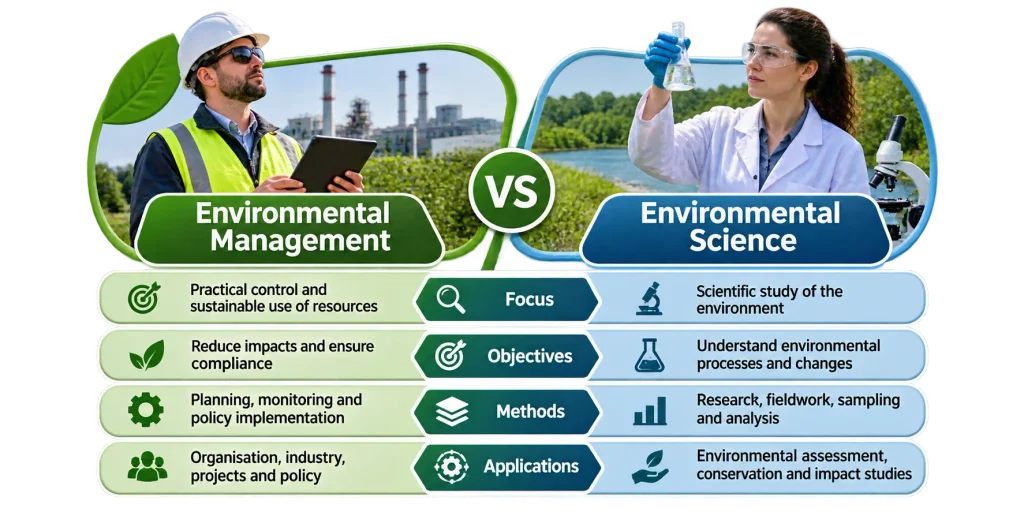
Although these fields share similar objectives, they have different areas of focus. Environmental science primarily investigates how natural systems function, how human activities affect the environment and what scientific methods can be used to understand environmental problems. Environmental management focuses on applying knowledge, policies, strategies and management systems to prevent environmental damage and improve environmental performance.
Understanding environmental management vs environmental science can help learners select an appropriate academic pathway and identify career opportunities that match their interests and professional ambitions.
Both disciplines contribute to environmental protection, but they approach challenges from different perspectives. Environmental science provides the scientific evidence needed to understand environmental conditions, while environmental management translates that understanding into organisational policies, practical controls, compliance procedures and sustainability strategies.
This guide explains their key differences, educational focus, professional responsibilities, career opportunities and relevance in Pakistan, the UK and international employment markets.
What is Environmental Science?
Environmental science is an interdisciplinary scientific field that examines the natural environment, environmental processes and the relationship between human activities and ecological systems. It combines subjects such as biology, chemistry, ecology, geology, physics and environmental geography to investigate environmental conditions and identify solutions to environmental problems.
The primary purpose of environmental science is to understand how the environment works, identify the causes of environmental degradation and provide scientific evidence that supports environmental protection.
Key Areas of Environmental Science
Environmental science covers several scientific and research-based areas:
- Ecology and Biodiversity: Examines relationships between organisms, ecosystems and their natural surroundings.
- Climate Science: Investigates climate patterns, global warming, greenhouse gas emissions and climate change.
- Environmental Chemistry: Studies chemical substances, contaminants and pollutants in air, water and soil.
- Soil Science: Examines soil composition, fertility, erosion, contamination and land degradation.
- Water Science: Investigates water quality, aquatic ecosystems, groundwater resources and water pollution.
- Environmental Biology: Explores the effects of environmental changes on plants, animals and microorganisms.
- Environmental Monitoring: Uses scientific techniques to collect and analyse environmental data.
- Environmental Impact Assessment: Examines the potential environmental consequences of proposed development projects.
What Do Environmental Scientists Study?
Environmental scientists investigate environmental conditions through laboratory testing, field research, scientific modelling and data analysis.
For example, an environmental scientist working on water pollution might:
- Collect water samples from rivers, lakes or industrial discharge points.
- Analyse samples to identify chemical and biological contaminants.
- Compare the results with applicable environmental quality standards.
- Investigate potential sources of contamination.
- Prepare scientific reports explaining environmental risks.
- Recommend evidence-based measures to reduce pollution.
These activities help governments, researchers, industries and environmental organisations understand environmental problems and make informed decisions.
According to the University of British Columbia, environmental science education develops skills in field sampling, data analysis, contaminant assessment, environmental modelling, GIS and technical reporting.
What is Environmental Management?
Environmental management is the systematic process of planning, implementing and monitoring activities that protect the environment while supporting responsible organisational and economic development. It applies environmental knowledge through practical strategies, policies, management systems and operational controls.
Its main objectives are to reduce environmental risks, improve environmental performance, maintain regulatory compliance and promote sustainable resource use. It is particularly important in industries such as construction, manufacturing, energy, agriculture, transportation and healthcare.
Key Areas of Environmental Management
Environmental management involves several interconnected professional disciplines.
- Environmental Policy and Governance: Developing policies, procedures and responsibilities to support environmental protection.
- Environmental Management Systems (EMS): Establishing structured systems to identify, manage and monitor environmental impacts.
- ISO 14001 Implementation: Applying an internationally recognised framework for environmental management systems.
- Environmental Compliance: Ensuring organisational activities meet applicable environmental legislation and regulatory requirements.
- Pollution Prevention and Control: Implementing measures to minimise air, water and soil pollution.
- Environmental Risk Management: Identifying environmental hazards, assessing risks and establishing preventive controls.
- Sustainable Resource Management: Improving the responsible use of water, energy, land and raw materials.
- Environmental Impact Assessment: Evaluating potential environmental impacts and planning appropriate mitigation measures.
What Do Environmental Managers Do?
Environmental managers work with organisational leaders, technical teams, employees, contractors and regulatory authorities to ensure that environmental responsibilities are incorporated into everyday operations.
For example, an environmental manager working at a construction company may:
- Review environmental risks associated with construction activities.
- Develop an environmental management plan.
- Establish procedures for waste segregation and disposal.
- Monitor dust, noise, water consumption and pollution risks.
- Coordinate environmental inspections and audits.
- Ensure that environmental approval conditions are implemented.
- Train employees and contractors on environmental responsibilities.
- Evaluate environmental performance and recommend improvements.
The purpose is not simply to identify environmental problems but to establish practical systems that prevent, control and minimise their effects.
The International Organization for Standardization describes ISO 14001 as a framework that helps organisations establish environmental management systems and continually improve environmental performance. Its April 2026 edition is ISO 14001:2026.
Environmental Management vs Environmental Science: Key Differences
Environmental management and environmental science share a common objective of protecting the natural environment. However, their academic focus, professional responsibilities, working methods and career opportunities are different.
The main distinction is that environmental science focuses on understanding environmental processes through scientific investigation, whereas environmental management focuses on controlling environmental impacts through organised planning and implementation.
Comparison Table
| Comparison area | Environmental Science | Environmental Management |
|---|---|---|
| Primary focus | Scientific understanding of environmental systems | Managing environmental impacts and performance |
| Main objective | Investigate environmental problems | Prevent, control and reduce environmental problems |
| Academic approach | Natural and applied sciences | Science, management, policy and governance |
| Main subjects | Biology, chemistry, ecology and geology | Environmental policy, EMS, compliance and sustainability |
| Research methods | Laboratory testing, fieldwork and modelling | Audits, risk assessments, inspections and performance reviews |
| Main responsibilities | Environmental research and scientific analysis | Environmental planning and organisational implementation |
| Technical skills | Sampling, GIS, data analysis and scientific reporting | Environmental auditing, compliance and management planning |
| Work environment | Laboratories, research centres, field sites and offices | Industrial sites, construction projects, offices and government organisations |
| Main professional objective | Generate reliable environmental evidence | Translate environmental knowledge into effective action |
| Career direction | Scientific and technical positions | Management, consultancy and sustainability positions |
Difference in Academic Focus
Environmental science programmes focus mainly on scientific principles, technical investigation and understanding environmental processes. Learners study ecosystems, environmental chemistry, climate systems, biodiversity, pollution and scientific research methods.
Environmental management programmes combine environmental knowledge with organisational and strategic management principles. Their academic focus commonly includes:
- Environmental policies and regulatory frameworks.
- Environmental management systems.
- Resource efficiency and conservation.
- Sustainability planning.
- Environmental decision-making and policy analysis.
The distinction is not absolute, as environmental science may include management subjects, while environmental management also requires scientific understanding. Environmental management is an interdisciplinary field that can combine natural sciences, social sciences, economics and policy analysis.
Difference in Professional Responsibilities
Environmental scientists primarily investigate environmental conditions and provide technical evidence, while environmental managers use scientific findings and regulatory requirements to develop and implement environmental controls.
For example, when a manufacturing facility experiences water contamination:
- Environmental Scientist: Collects samples, identifies pollutants and assesses contamination levels.
- Environmental Manager: Reviews the findings, examines compliance responsibilities, coordinates corrective actions and monitors pollution control measures.
Both professionals contribute to environmental protection, but their responsibilities differ. Environmental scientists focus on understanding environmental problems, whereas environmental managers focus on controlling impacts and improving organisational environmental performance.
Environmental Management vs Environmental Science: Which Skills Are Required?
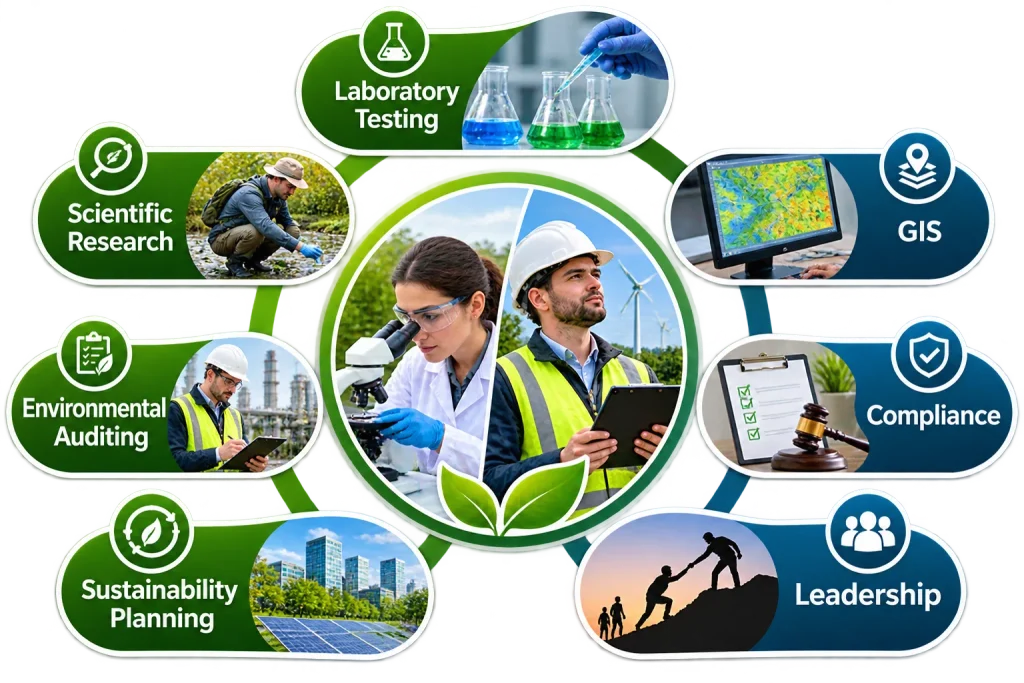
Environmental management and environmental science both require environmental awareness, analytical thinking and an understanding of environmental challenges. However, each discipline focuses on different professional responsibilities and therefore requires a distinct combination of technical, scientific and organisational skills.
Environmental science places greater emphasis on scientific investigation, research and the analysis of environmental conditions. Environmental management, on the other hand, focuses on applying environmental knowledge to organisational planning, regulatory compliance, sustainability strategies and environmental performance improvement.
Skills Required for Environmental Science
Environmental science professionals need strong scientific, research and analytical abilities to investigate environmental processes, assess ecological conditions and understand the causes of environmental degradation. These skills support accurate research, environmental monitoring and evidence-based conclusions.
Important skills for environmental science include:
- Scientific Research and Investigation: Conducting environmental studies and investigating ecological and pollution-related issues.
- Laboratory Testing and Sample Collection: Collecting and examining soil, water and air samples to identify environmental conditions.
- Environmental Monitoring: Measuring and evaluating changes in environmental quality.
- Data Interpretation and Statistical Analysis: Analysing scientific information and identifying environmental trends.
- Geographic Information Systems (GIS): Using spatial data and mapping technologies to assess environmental conditions.
- Environmental Modelling: Applying scientific models to understand and predict environmental changes.
- Ecosystem and Biodiversity Assessment: Examining habitats, species and ecological relationships.
- Scientific Report Writing: Presenting research findings and technical information clearly.
- Critical Thinking and Problem-Solving: Evaluating environmental evidence and identifying possible explanations for environmental problems.
Skills Required for Environmental Management
Environmental management professionals require a combination of environmental knowledge, organisational capabilities and management skills. These competencies help professionals develop environmental policies, manage operational risks, improve sustainability performance and support compliance with relevant requirements.
Key skills required for environmental management include:
- Environmental Planning and Policy Development: Establishing environmental objectives, policies and improvement strategies.
- Environmental Risk Assessment: Identifying environmental hazards and evaluating potential impacts on organisational activities.
- Environmental Auditing and Inspections: Reviewing environmental procedures and assessing management system performance.
- ISO 14001 Environmental Management Systems: Understanding and applying environmental management system principles.
- Environmental Legislation and Compliance: Interpreting applicable environmental requirements and supporting organisational compliance.
- Sustainability Strategy Development: Planning initiatives to reduce environmental impacts and improve sustainability.
- Waste and Resource Management: Improving waste handling, recycling and efficient resource utilisation.
- Environmental Impact Mitigation: Developing measures to prevent, control or minimise environmental damage.
- Stakeholder Communication: Coordinating with employees, regulators, contractors and other interested parties.
- Project Management and Leadership: Managing environmental initiatives, allocating resources and coordinating improvement activities.
Overall, environmental science skills are primarily centred on scientific investigation and understanding environmental processes, whereas environmental management skills focus on planning, decision-making and controlling environmental performance. Both disciplines complement each other and contribute to effective environmental protection and sustainable development.evelopment and implementation of environmental management strategies across different organisations.
Career Opportunities in Environmental Science
An environmental science degree provides an academic foundation for careers involving scientific investigation, environmental monitoring, research and ecological protection. Professionals in this field apply scientific knowledge to understand environmental conditions, investigate pollution, study ecosystems and support the conservation of natural resources.
Environmental science professionals can work across government agencies, environmental consultancies, research institutions, universities, conservation organisations and private industries. Career opportunities may involve fieldwork, laboratory analysis, scientific research, environmental data interpretation and the preparation of technical reports.
Popular Career Opportunities in Environmental Science
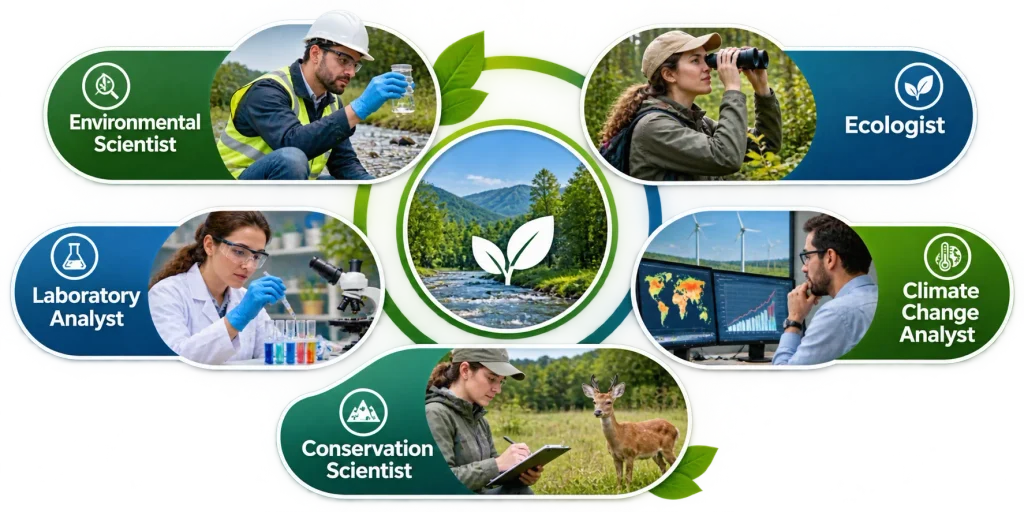
Environmental science offers several career paths for individuals interested in applying scientific methods to environmental challenges. Common professional roles include:
- Environmental Scientist: Investigates environmental conditions, analyses pollution levels, conducts field research and prepares technical reports to support environmental protection.
- Ecologist: Studies relationships between living organisms and their environments, including biodiversity, habitat conditions, ecosystem changes and conservation requirements.
- Environmental Researcher: Conducts scientific investigations into climate change, pollution, water quality, soil degradation and ecosystem protection.
- Environmental Laboratory Analyst: Examines environmental samples to identify pollutants, contaminants and other substances that may affect environmental quality.
- Climate Change Analyst: Evaluates climate-related information, examines environmental trends and supports research into climate mitigation and adaptation.
- Environmental Monitoring Officer: Collects and analyses environmental data to assess air quality, water quality, soil conditions and other environmental indicators.
- Conservation Scientist: Supports the protection and sustainable management of forests, wildlife habitats, biodiversity and natural resources.
Skills and Additional Professional Requirements
Environmental science careers often require a combination of scientific knowledge, practical abilities and specialist technical skills. Depending on the role and employer, additional education, professional training or relevant workplace experience may be necessary.
Important professional capabilities include:
- Environmental sampling and monitoring techniques.
- Scientific research and data analysis.
- Laboratory testing and interpretation of results.
- Biodiversity and ecosystem assessment.
- Environmental reporting and technical documentation.
- Climate change and pollution research.
- Conservation planning and natural resource management.
The UK National Careers Service also highlights environmental consultancy as an area of work involving sustainability, recycling, waste management, flood risk and climate change. These opportunities demonstrate the range of professional applications available to individuals with environmental science knowledge.
Career Opportunities in Environmental Management
An environmental management career offers opportunities for professionals interested in sustainability leadership, environmental compliance, organisational performance and the implementation of environmental policies. These roles focus on helping organisations manage their environmental responsibilities, reduce negative impacts and improve sustainable operational practices.
Environmental management professionals work across a wide range of industries, including construction, manufacturing, oil and gas, renewable energy, infrastructure, agriculture and environmental consultancy. Career responsibilities vary depending on the sector, organisational needs and level of professional experience.
Popular Career Opportunities in Environmental Management
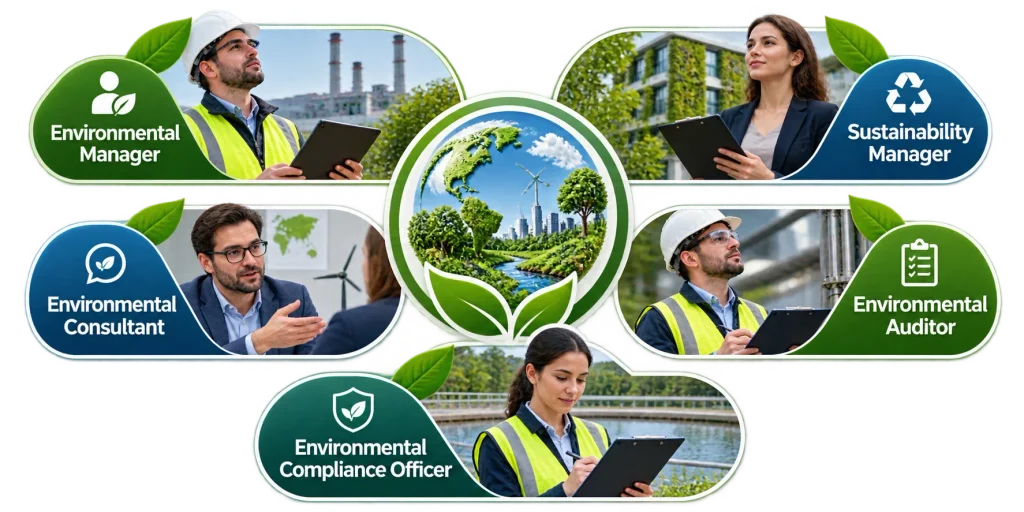
The following roles represent common career paths within the environmental management sector:
- Environmental Manager: Oversees environmental policies, management systems, compliance procedures and sustainability initiatives within an organisation.
- Environmental Consultant: Advises organisations on environmental risks, sustainability practices, regulatory responsibilities and environmental improvement strategies.
- Sustainability Manager: Develops and coordinates strategies to reduce environmental impacts, improve resource efficiency and integrate sustainability into organisational decisions.
- Environmental Compliance Officer: Monitors operational activities, reviews environmental requirements and supports compliance with applicable legislation and standards.
- Environmental Auditor: Evaluates environmental management systems, examines organisational procedures and identifies areas requiring corrective action or improvement.
- Environmental Impact Assessment Specialist: Assesses the potential environmental consequences of development projects and contributes to mitigation plans and assessment reports.
- Environmental Policy Advisor: Supports the development, evaluation and implementation of policies addressing environmental protection, climate change and sustainable development.
- Environmental Risk Manager: Identifies potential environmental hazards, evaluates organisational exposure and develops strategies to prevent environmental incidents.
Key Areas of Professional Environmental Work
Environmental management careers also involve specialised areas that support environmental protection, regulatory compliance and sustainable development. Professional responsibilities may include:
- Environmental assessment and impact evaluation.
- Air quality monitoring and pollution control.
- Water resource management and conservation.
- Ecology and biodiversity protection.
- Climate change planning and adaptation.
- Flood risk assessment and management.
- Environmental policy development and implementation.
These career paths allow professionals to apply environmental knowledge to practical organisational and industry challenges. The choice of role generally depends on technical expertise, management capabilities, professional experience and the environmental responsibilities of the sector.
Environmental Management vs Environmental Science: Career Opportunities in Pakistan and the UK
Career opportunities in both disciplines are influenced by environmental regulations, industrial development, sustainability priorities and the demand for environmental expertise.
However, the types of employers and professional responsibilities may differ between countries.
Career Opportunities in Pakistan
Pakistan faces environmental challenges involving air pollution, water scarcity, industrial waste, deforestation, land degradation, climate change and urban environmental pressures. These challenges create professional opportunities in environmental research, environmental compliance, sustainability and resource management.
Environmental science career opportunities in Pakistan include:
- Environmental Scientist
- Research Assistant
- Water Quality Analyst
- Environmental Laboratory Analyst
- Ecologist
- Climate Change Researcher
- Environmental Monitoring Officer
- Conservation Specialist
Environmental management career opportunities in Pakistan include:
- Environmental Manager
- Environmental Compliance Officer
- Sustainability Manager
- Environmental Consultant
- Environmental Health and Safety Coordinator
- Environmental Auditor
- Environmental Impact Assessment Specialist
- Environmental Policy Officer
Potential employers include:
- Pakistan Environmental Protection Agency (Pak-EPA)
- Provincial environmental protection agencies
- Environmental consultancy firms
- Construction and infrastructure companies
- Manufacturing and industrial organisations
- Energy and renewable energy companies
- Development organisations and NGOs
- Environmental research institutions
The Pakistan Environmental Protection Agency performs functions that include environmental assessment approvals, enforcement of environmental legislation, environmental quality standards and pollution prevention. These responsibilities demonstrate the importance of both scientific expertise and environmental management capabilities in Pakistan.
Career Opportunities in the United Kingdom
The UK has an established environmental and sustainability sector supported by environmental legislation, regulatory oversight, environmental assessment requirements and organisational sustainability initiatives.
Environmental science graduates may pursue careers involving scientific investigation, environmental monitoring, climate research and ecological assessment.
Environmental management professionals may work in environmental compliance, sustainability management, environmental consultancy, auditing and organisational environmental performance.
Potential UK employers include:
- Environmental consultancies
- Government departments and agencies
- Local authorities
- Construction and engineering companies
- Energy and utility organisations
- Manufacturing businesses
- Conservation organisations
- Waste management companies
- Infrastructure and transport organisations
For example, environmental consultants in the UK advise organisations on sustainability, waste management, recycling, flood risks and climate change. The National Careers Service identifies relevant university education and apprenticeships as possible routes into this profession. Get careers information and advice
International Career Opportunities
Internationally, both disciplines contribute to environmental protection and sustainable development.
Professionals may find opportunities in:
- International environmental consultancy
- Renewable energy development
- Climate change programmes
- Environmental policy and governance
- Natural resource management
- Environmental research and conservation
- Sustainable construction and infrastructure
- Corporate sustainability and ESG-related activities
International employment requirements vary according to professional responsibilities, academic background, technical competencies and local regulatory frameworks.
Which Course Should I Choose: Environmental Management or Environmental Science?
Choosing between environmental management and environmental science depends on the learner’s academic interests, career objectives and preferred professional responsibilities.
Both disciplines offer valuable knowledge, but the appropriate choice depends on whether the learner wants to investigate environmental problems scientifically or manage environmental responsibilities within organisations.
Choose Environmental Science If:
Environmental science may be a suitable academic pathway for learners who are interested in scientific research, environmental investigations and understanding natural ecosystems.
Consider this field if the learner:
- Enjoys biology, chemistry, ecology and other natural sciences.
- Wants to investigate environmental pollution and contamination.
- Is interested in laboratory testing and field research.
- Wants to study climate change and environmental processes.
- Enjoys scientific data analysis and environmental modelling.
- Plans to pursue research or technical environmental careers.
Choose Environmental Management If:
Environmental management may be more suitable for learners who want to apply environmental knowledge through organisational planning, environmental compliance and sustainability strategies.
Consider this field if the learner:
- Wants to develop environmental policies and management strategies.
- Is interested in ISO 14001 and environmental management systems.
- Wants to work in sustainability management.
- Is interested in environmental legislation and compliance.
- Wants to manage environmental risks in industrial or construction settings.
- Aims to develop leadership and environmental consultancy capabilities.
Quick Decision Guide
| Career interest | Recommended field |
|---|---|
| Laboratory research | Environmental Science |
| Climate and ecological research | Environmental Science |
| Water and soil quality analysis | Environmental Science |
| Biodiversity investigation | Environmental Science |
| Environmental policy development | Environmental Management |
| ISO 14001 implementation | Environmental Management |
| Organisational sustainability | Environmental Management |
| Environmental compliance | Environmental Management |
| Environmental auditing | Environmental Management |
| Corporate environmental leadership | Environmental Management |
Important: These are general academic and career orientations, not strict boundaries. Environmental scientists can become environmental managers, while environmental management professionals may also undertake technical assessments and research-related activities.
Can Environmental Science Graduates Work in Environmental Management?
Yes, environmental science graduates can pursue careers in environmental management by developing additional knowledge and professional competencies in management systems, environmental compliance, sustainability and organisational planning. Their scientific background provides a valuable foundation for understanding environmental conditions, evaluating pollution risks and interpreting monitoring results. By combining scientific expertise with management capabilities, graduates can contribute to environmental protection, regulatory compliance and sustainable organisational practices.
For example, graduates with knowledge of environmental chemistry, ecological assessment and pollution monitoring can develop their careers in environmental consultancy, environmental compliance and pollution prevention. Additional professional education and practical experience can help strengthen their ability to manage environmental responsibilities within different industries.
Key areas of additional learning that can support this career transition include:
- Environmental Legislation and Regulatory Compliance: Understanding environmental laws, regulatory obligations and organisational responsibilities.
- Environmental Management Systems: Developing knowledge of systems used to monitor and improve environmental performance.
- ISO 14001 Requirements: Understanding the principles and implementation of internationally recognised environmental management standards.
- Environmental Auditing: Learning how to evaluate environmental procedures, identify non-compliance and recommend improvements.
- Environmental Impact Assessment: Developing the ability to assess potential environmental impacts and identify suitable mitigation measures.
- Sustainability Management: Understanding sustainable business practices, resource efficiency and environmental performance.
- Environmental Policy and Governance: Exploring environmental policies, institutional responsibilities and decision-making frameworks.
- Environmental Risk Management: Identifying environmental hazards, evaluating potential consequences and implementing preventive controls.
Similarly, environmental management professionals can strengthen their technical capabilities through additional learning in scientific disciplines and environmental assessment techniques. Developing knowledge of ecology, environmental chemistry, Geographic Information Systems (GIS) and environmental monitoring can improve their understanding of environmental conditions and support more informed management decisions.
Why Environmental Management Is Important for Modern Organisations
Environmental management has become an essential organisational responsibility because business and industrial activities can significantly affect natural resources, ecosystems, public health and environmental quality. Organisations need structured environmental management approaches to identify potential environmental impacts, fulfil applicable legal obligations and improve their overall environmental performance. By integrating environmental considerations into operational activities and strategic decision-making, organisations can reduce environmental risks, use resources responsibly and support sustainable development.
Major Reasons Environmental Management Matters
Effective environmental management provides several important benefits to modern organisations:
- Environmental Regulatory Compliance: Helps organisations identify and fulfil applicable environmental legal obligations relating to pollution, waste disposal, emissions and environmental approvals.
- Pollution Prevention: Supports the identification of pollution sources and the implementation of appropriate preventive and corrective measures.
- Sustainable Resource Utilisation: Encourages the responsible consumption of water, energy, raw materials and other natural resources.
- Environmental Risk Reduction: Enables organisations to identify potential environmental incidents, evaluate their consequences and introduce suitable preventive controls.
- Improved Environmental Performance: Establishes structured procedures for monitoring environmental objectives, reviewing operational performance and identifying opportunities for improvement.
- Corporate Sustainability: Integrates environmental considerations into strategic planning, procurement, production processes and everyday organisational decision-making.
The Role of ISO 14001 in Environmental Management
ISO 14001 provides an internationally recognised framework for establishing, implementing, maintaining and continually improving an Environmental Management System (EMS). It helps organisations manage their environmental responsibilities systematically while identifying opportunities to improve environmental performance. By applying this framework, organisations can establish clear environmental objectives, manage operational impacts and strengthen their approach to environmental compliance.
Key areas supported by ISO 14001 include:
- Identifying environmental aspects and assessing their associated impacts.
- Establishing measurable environmental objectives and improvement targets.
- Managing environmental risks and opportunities.
- Identifying and addressing applicable environmental compliance obligations.
- Monitoring and evaluating environmental performance.
- Reviewing the effectiveness of the Environmental Management System.
- Implementing corrective actions and promoting continual improvement.
ISO 14001:2026, the fourth edition of the standard, was published in 2026. Organisations should consult the official ISO publication to understand the current requirements and implementation guidance applicable to their Environmental Management Systems.
How Does Environmental Impact Assessment Connect Both Disciplines?
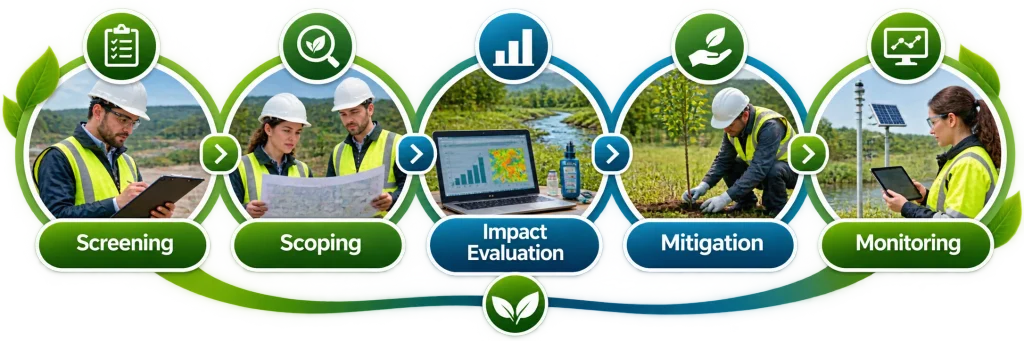
Environmental Impact Assessment (EIA) is an important area where environmental science and environmental management work together to identify, evaluate and address the potential environmental consequences of proposed projects. It provides a systematic approach to understanding how development activities may affect natural resources, ecosystems and environmental quality before major decisions are made.
Environmental science contributes scientific knowledge, research and technical assessments to identify potential environmental impacts. Environmental management uses these findings to develop mitigation strategies, establish environmental controls and monitor compliance with relevant requirements. Both disciplines work together to support responsible project planning and minimise environmental damage.
Example: Environmental Impact Assessment for a Construction Project
Consider a proposed infrastructure development near a river. Before construction begins, an environmental assessment is required to understand the potential effects of project activities on the surrounding environment.
Environmental science contributes through:
- Water Quality Assessment: Studying existing water conditions and identifying potential contamination risks.
- Biodiversity Assessment: Examining nearby ecosystems, wildlife habitats and plant species.
- Soil Investigation: Evaluating soil conditions, erosion risks and possible contamination.
- Air and Noise Assessment: Identifying potential air pollution sources and construction-related noise impacts.
- Baseline Environmental Studies: Collecting scientific information about existing environmental conditions.
Environmental management contributes through:
- Environmental Management Plan (EMP): Preparing a structured plan to manage environmental impacts throughout the project.
- Pollution Prevention: Establishing measures to minimise air, water and soil pollution.
- Waste Management: Developing appropriate procedures for waste segregation, handling, storage and disposal.
- Environmental Responsibilities: Assigning duties to project teams, contractors and environmental personnel.
- Environmental Monitoring: Implementing monitoring programmes to evaluate environmental performance.
- Regulatory Compliance: Reviewing project activities against applicable environmental approval conditions and legal requirements.
The integration of both disciplines enables project teams to make informed decisions using scientific evidence and effective management practices. Environmental science helps identify and predict potential environmental problems, while environmental management ensures that appropriate preventive, corrective and monitoring measures are implemented. This combined approach supports sustainable development, responsible resource utilisation and effective environmental protection.
Professional Development in Environmental Management
Professional development in environmental management helps learners strengthen their understanding of environmental governance, sustainability strategies, regulatory compliance and organisational environmental management systems. Advanced learning in this field supports the development of strategic, analytical and practical skills required to address complex environmental challenges across different industries.
Postgraduate-level environmental management education is particularly relevant to graduates and experienced professionals seeking to enhance their knowledge of environmental protection, sustainable resource utilisation and environmental performance. Key areas of professional learning include:
- Environment and Public: Understanding the relationship between environmental conditions, public well-being and environmental protection.
- Environment – Education and Training: Developing environmental awareness, educational programmes and workplace training initiatives.
- ISO 14001 EMS and Its Legal Compliance: Understanding environmental management systems, regulatory obligations and organisational compliance procedures.
- Environmental Resource Management: Applying sustainable approaches to managing natural resources, including water, energy and land.
- Control of Environmental Degradation and Pollution: Identifying environmental risks and implementing appropriate pollution prevention and control measures.
- Environmental Impact Assessment: Evaluating potential environmental impacts and developing suitable mitigation strategies.
How Does Professional Education Support Environmental Management Knowledge?
Structured professional education enables learners to connect environmental principles with practical workplace responsibilities. It develops an understanding of how environmental policies, management systems and sustainability practices can be applied within organisations.
Through relevant learning and professional development, learners can strengthen capabilities in:
- Environmental policy development and governance.
- Environmental compliance and regulatory responsibilities.
- Environmental management system implementation.
- Sustainable resource planning and utilisation.
- Pollution prevention and environmental risk control.
- Environmental impact assessment and mitigation.
- Sustainability planning and organisational environmental performance.
These areas of knowledge are particularly relevant to individuals pursuing professional responsibilities in environmental consultancy, sustainability management, environmental compliance, environmental auditing and environmental policy development.
Conclusion
Environmental science and environmental management are closely connected disciplines, but they serve different purposes. Environmental science focuses on understanding environmental processes through scientific research, monitoring and investigation, while environmental management applies this knowledge to planning, sustainability, regulatory compliance and environmental protection.
The choice between these fields depends on individual career interests and professional goals. Learners interested in scientific research may prefer environmental science, while those interested in sustainability strategies, organisational planning and environmental performance may find environmental management more suitable.