
How to Develop an Environmental Management Plan for a Business
Developing an Environmental Management Plan (EMP) is an important step for businesses seeking to manage environmental risks, improve operational performance and achieve long-term sustainability. An effective plan helps organisations identify activities that may affect the environment, establish measurable environmental objectives, introduce operational controls and monitor their environmental performance.
Whether a business operates in manufacturing, construction, energy, agriculture, logistics or professional services, an Environmental Management Plan provides a structured approach to controlling pollution, reducing waste, conserving resources and meeting applicable environmental requirements.
This guide explains how to create an environmental management plan for a company, from conducting an initial environmental review to establishing an environmental risk register, assigning responsibilities and implementing a monitoring plan.
What is an Environmental Management Plan?
An Environmental Management Plan (EMP) is a documented framework that explains how a business will identify, prevent, control and monitor the environmental impacts associated with its activities, products and services.
It establishes practical measures for managing environmental responsibilities, including:
- Identifying environmental hazards and potential sources of pollution.
- Assessing environmental risks and their possible consequences.
- Establishing measurable environmental objectives and targets.
- Implementing operational controls to minimise environmental damage.
- Assigning responsibilities to employees and management.
- Monitoring environmental performance and maintaining records.
- Reviewing results and implementing corrective actions.
An EMP may operate as a standalone document or form part of a wider Environmental Management System (EMS). An EMS provides the overall organisational framework, while the EMP translates environmental commitments into specific actions, controls and monitoring arrangements.
The internationally recognised ISO 14001 framework provides a structured approach to establishing and continually improving environmental management systems. The latest edition, ISO 14001:2026, was published in April 2026.
Why Does a Business Need an Environmental Management Plan?
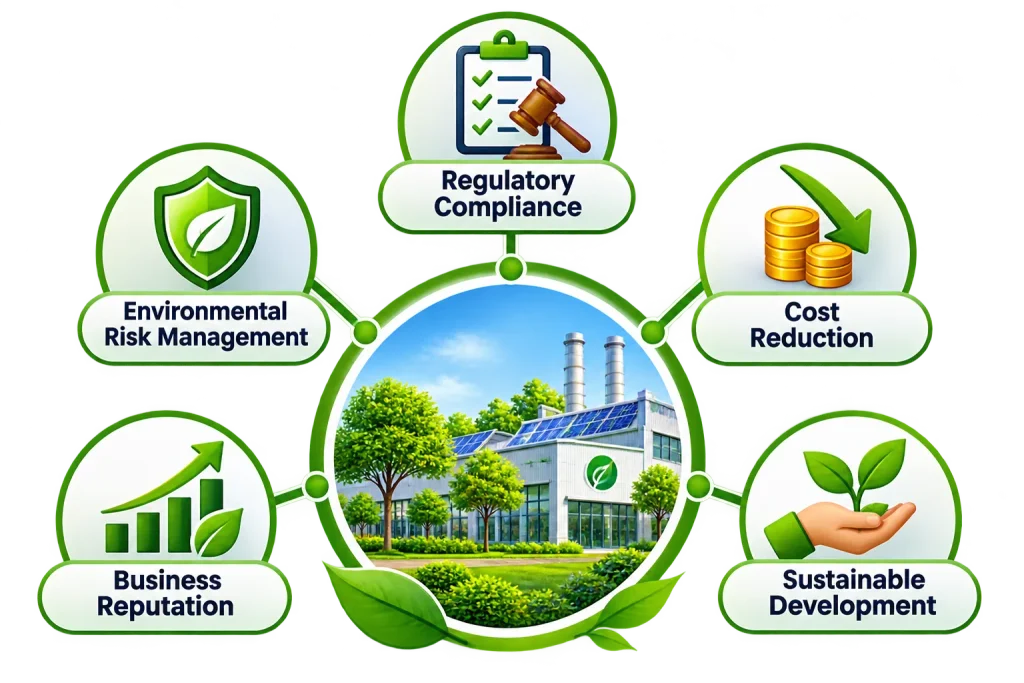
An Environmental Management Plan (EMP) helps businesses integrate environmental responsibility into daily operations while improving operational efficiency and supporting sustainable growth. It provides a structured approach to managing environmental risks, controlling pollution and using natural resources responsibly.
An effective EMP offers several important business benefits:
Better Environmental Risk Management
Businesses can identify potential environmental threats before they develop into serious incidents. These include:
- Preventing air and water pollution.
- Reducing soil contamination risks.
- Controlling excessive workplace noise.
- Improving waste handling and disposal.
- Introducing preventive measures for environmental emergencies.
Improved Legal and Regulatory Compliance
An EMP helps organisations understand and manage their environmental obligations. It supports:
- Identifying applicable environmental legislation and regulations.
- Maintaining relevant permits and licences.
- Monitoring compliance requirements.
- Keeping environmental inspection and monitoring records.
Reduced Operational Costs
Environmental planning helps organisations identify unnecessary resource consumption and improve operational efficiency through:
- Reducing electricity and fuel consumption.
- Minimising raw material wastage.
- Improving water conservation.
- Increasing recycling and material recovery.
- Reducing waste treatment and disposal expenses.
Improved Business Reputation
Demonstrating environmental responsibility can strengthen relationships with customers, investors, suppliers and business partners. Businesses can improve their reputation by:
- Demonstrating commitment to environmental protection.
- Communicating sustainability achievements.
- Building stakeholder confidence.
- Supporting responsible business practices.
Support for Sustainable Business Development
An EMP connects environmental protection with long-term organisational planning. It enables businesses to:
- Integrate sustainability into business decisions.
- Encourage responsible resource management.
- Reduce environmental impacts across operations.
- Support long-term environmental improvement.
- Balance commercial performance with environmental responsibility.
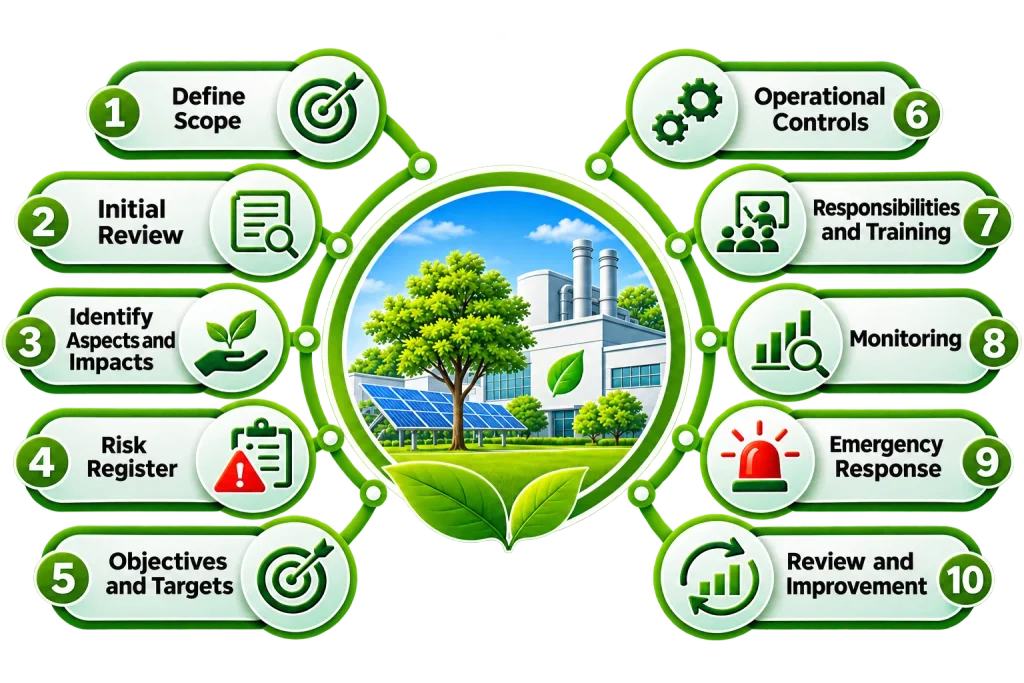
How to Develop an Environmental Management Plan for a Business: 10 Essential Steps
Developing an EMP requires a systematic process that connects environmental risks with practical controls, measurable objectives and management responsibilities.
The following steps provide a practical approach for organisations of different sizes and sectors.
Step 1: Define the Scope and Purpose of the Environmental Management Plan
The first step is to establish why the organisation needs an EMP and which activities, locations, departments and processes it will cover.
Management should consider the nature of business operations, environmental responsibilities, organisational priorities and stakeholder expectations.
Important questions include:
- What products or services does the business provide?
- Which activities have the greatest potential environmental impact?
- Does the organisation operate from one site or several locations?
- Are there existing environmental policies or procedures?
- Which environmental permits, approvals or other obligations apply?
- What environmental improvements does management want to achieve?
For example, a manufacturing company may develop an EMP covering production processes, chemical storage, wastewater discharge, energy consumption, packaging and waste disposal.
A small office-based business may require a simpler plan focusing on electricity consumption, paper use, electronic waste, water consumption and responsible procurement.
Practical recommendation: Define the EMP’s boundaries clearly. A plan should cover the activities and locations relevant to the organisation’s environmental responsibilities rather than relying on a generic business-wide statement.
Step 2: Conduct an Initial Environmental Review
An initial environmental review establishes the organisation’s existing environmental performance and identifies areas requiring improvement.
The review should examine business operations, workplace conditions, resource consumption, waste generation and existing environmental controls.
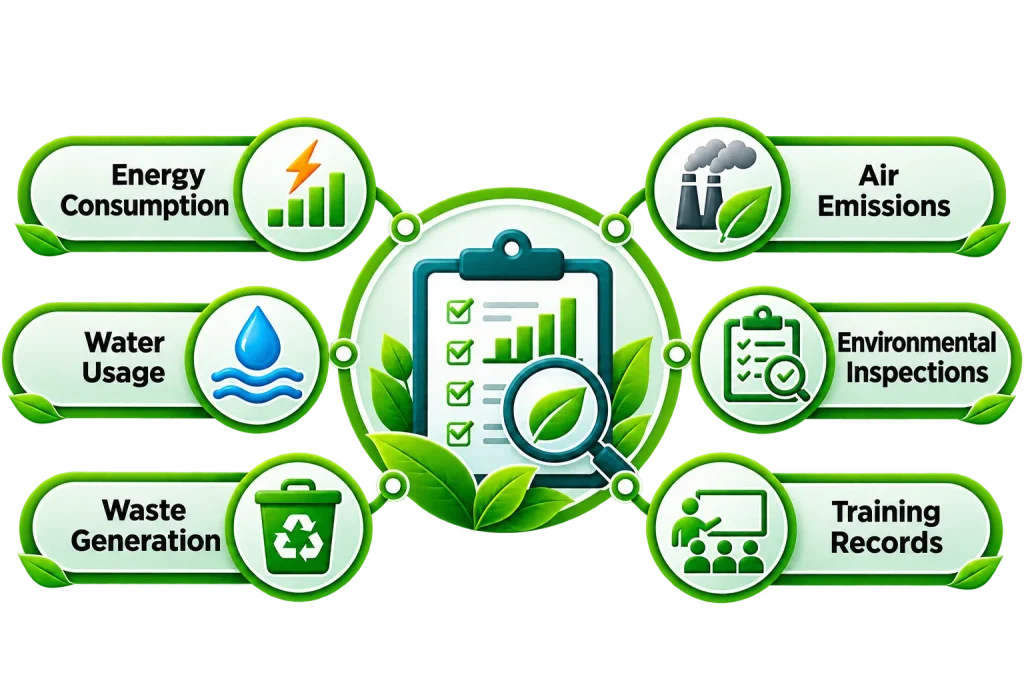
Areas to investigate include:
- Energy consumption: Electricity, fuel and heating requirements.
- Water consumption: Water usage, wastewater generation and potential leakage.
- Waste generation: General, recyclable, hazardous and industrial waste.
- Air emissions: Dust, fumes, smoke, exhaust gases and other emissions.
- Chemical management: Storage, handling, transportation and disposal.
- Land protection: Chemical spills, fuel leaks and contaminated materials.
- Noise pollution: Machinery, transport and industrial operations.
- Resource consumption: Raw materials, packaging and consumable products.
The review should also examine previous environmental incidents, complaints, inspection findings and existing monitoring records.
EXAMPLE: INITIAL ENVIRONMENTAL REVIEW
| Business activity | Environmental concern | Existing control | Improvement opportunity |
|---|---|---|---|
| Manufacturing | Excessive energy consumption | Machinery maintenance | Install energy-efficient equipment |
| Chemical storage | Potential soil contamination | Storage containers | Introduce secondary containment |
| Packaging | Excessive material waste | General waste collection | Introduce recycling arrangements |
| Cleaning | High water consumption | Manual water use | Install water-efficient systems |
| Transportation | Vehicle emissions | Routine servicing | Improve route planning |
The findings provide a baseline against which future environmental performance can be evaluated.
Step 3: Identify Environmental Aspects and Impacts
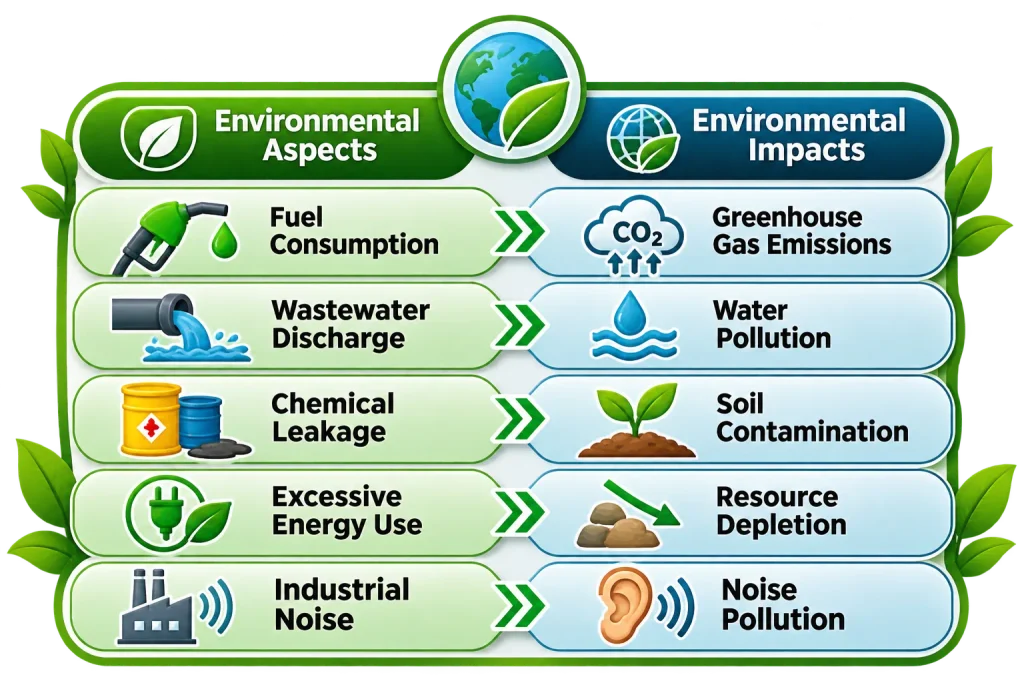
One of the most important stages of environmental planning is identifying environmental aspects and understanding their associated impacts.
An environmental aspect is an element of an organisation’s activities, products or services that can interact with the environment.
An environmental impact is the resulting change to the environment, whether beneficial or adverse.
For example, operating diesel-powered machinery is an environmental aspect, while the resulting air emissions contribute to air pollution.
Organisations should examine routine operations, non-routine activities, maintenance work, foreseeable emergencies and relevant stages of the product or service lifecycle.
| Environmental aspect | Potential environmental impact |
|---|---|
| Fuel consumption | Greenhouse gas emissions and resource depletion |
| Wastewater discharge | Water pollution |
| Chemical leakage | Soil and groundwater contamination |
| Excessive electricity use | Increased energy demand and associated emissions |
| Improper waste disposal | Land pollution and ecosystem damage |
| Industrial noise | Disturbance to surrounding communities and wildlife |
| Excessive packaging | Increased material consumption and waste |
The business should then determine which aspects are significant.
A practical assessment can consider:
- Severity: How serious could the environmental impact become?
- Likelihood: How likely is the impact to occur?
- Frequency: How often does the activity take place?
- Legal relevance: Are specific compliance obligations associated with it?
- Environmental sensitivity: Could the activity affect nearby communities, water bodies or protected areas?
- Stakeholder concerns: Have customers, employees or local communities raised concerns?
A documented assessment helps management prioritise significant environmental aspects instead of allocating equal resources to every minor issue.
Step 4: Develop an Environmental Risk Register
An environmental risk register records identified environmental risks, their potential consequences, existing controls and additional actions required.
It converts environmental assessment findings into a practical management tool.
A useful environmental risk register should include:
- Risk identification number.
- Business activity or process.
- Environmental hazard or aspect.
- Potential environmental impact.
- Likelihood and severity ratings.
- Existing control measures.
- Risk priority.
- Additional control actions.
- Responsible person.
- Target completion date.
- Review status.
Example environmental risk register:
| Environmental risk | Potential impact | Priority | Proposed control |
|---|---|---|---|
| Chemical leakage | Soil and groundwater contamination | High | Bunded storage and regular inspections |
| Excessive water use | Resource depletion | Medium | Water-efficient equipment |
| Poor waste segregation | Increased landfill disposal | Medium | Separate labelled waste containers |
| Fuel spill | Land and water contamination | High | Spill kits and emergency procedures |
| Uncontrolled emissions | Air quality deterioration | High | Equipment maintenance and emission controls |
Priority ratings are illustrative and should be determined using the organisation’s documented assessment criteria.
The risk register should be reviewed whenever there are significant operational changes, new environmental hazards, incidents or changes in compliance obligations.
Step 5: Establish Environmental Objectives and Targets
After identifying significant environmental aspects and risks, the organisation should establish clear environmental objectives.
Environmental objectives describe the improvements the business intends to achieve. Targets translate these objectives into measurable outcomes with defined timescales.
The SMART approach is useful when developing environmental objectives.
- Specific: Clearly identify the intended improvement.
- Measurable: Establish indicators for evaluating performance.
- Achievable: Consider available resources and operational limitations.
- Relevant: Connect the objective with significant environmental impacts.
- Time-bound: Establish a completion date.
Examples of business environmental objectives:
| Environmental objective | Measurable target | Timeframe |
|---|---|---|
| Reduce electricity consumption | Reduce electricity use by 10% against the baseline | 12 months |
| Improve waste management | Divert 60% of suitable waste from disposal | 12 months |
| Conserve water | Reduce water consumption by 8% | 12 months |
| Improve chemical management | Complete monthly inspections of all designated chemical storage areas | Ongoing |
| Improve environmental awareness | Train all relevant employees in environmental procedures | 6 months |
These figures are illustrative targets, not universal industry requirements. Businesses should establish realistic targets using baseline data, technical feasibility and available resources.
The US Environmental Protection Agency also recommends establishing measurable environmental objectives and developing action plans that identify responsible individuals and the resources needed to achieve them.
Step 6: Establish Operational Controls and Environmental Procedures
Operational controls are the practical measures used to prevent or minimise environmental impacts during business activities.
An environmental objective will not achieve meaningful results unless employees understand what actions are required and how those actions should be performed.
Businesses should develop appropriate procedures for significant environmental aspects.
| Operational area | Recommended environmental controls |
|---|---|
| Waste management | Waste segregation, recycling and authorised disposal |
| Chemical storage | Suitable containers, labelling and spill prevention |
| Water management | Leakage inspections and wastewater controls |
| Energy management | Efficient equipment and energy monitoring |
| Air pollution | Emission controls and equipment maintenance |
| Fuel storage | Secure storage and spill response arrangements |
| Procurement | Preference for suitable low-impact materials |
| Transportation | Vehicle maintenance and efficient route planning |
Operational controls should explain:
- What activity needs to be controlled.
- Which procedure employees must follow.
- Who is responsible for implementation.
- What equipment or resources are required.
- How the control will be inspected.
- What action must be taken if the procedure is not followed.
For example, a manufacturing business storing industrial chemicals should establish procedures for safe storage, container inspections, spill prevention, emergency response and waste disposal.
The US EPA identifies operational controls, monitoring requirements, employee responsibilities and implementation procedures as important elements of environmental management system development.
Step 7: Allocate Responsibilities and Provide Employee Training
An Environmental Management Plan requires clearly defined responsibilities at every relevant organisational level.
Senior management should provide leadership, approve environmental objectives, allocate resources and review performance.
Environmental managers or designated environmental officers may coordinate risk assessments, compliance monitoring, reporting and corrective actions.
Departmental managers should ensure that environmental procedures are followed within their areas of responsibility.
Employees should understand the environmental requirements relevant to their daily activities.
Example environmental responsibility structure:
| Role | Main environmental responsibilities |
|---|---|
| Senior management | Approve policy, objectives and resources |
| Environmental manager | Coordinate EMP implementation and monitoring |
| Department managers | Implement departmental controls |
| Supervisors | Conduct inspections and communicate requirements |
| Employees | Follow environmental procedures and report incidents |
| Contractors | Comply with relevant site environmental controls |
Employee training should address:
- Environmental policy and organisational objectives.
- Waste segregation and recycling procedures.
- Pollution prevention practices.
- Chemical handling and spill response.
- Energy and water conservation.
- Emergency reporting arrangements.
- Individual environmental responsibilities.
Training should be relevant to job responsibilities and supported by attendance records, competency assessments or other suitable evidence.
The EPA recommends both general environmental awareness training and specialised training for employees responsible for implementing environmental controls. Implementing an EMS+1
Step 8: Develop an Environmental Monitoring Plan
An environmental monitoring plan explains how the organisation will measure its environmental performance and determine whether established controls and objectives are effective.
Monitoring should be based on significant environmental aspects, applicable compliance obligations and the organisation’s environmental targets.
It should identify what will be measured, how measurements will be taken, how frequently monitoring will occur and who will review the results.
Example environmental monitoring plan:
| Monitoring area | Performance indicator | Monitoring frequency |
|---|---|---|
| Electricity | Monthly electricity consumption | Monthly |
| Water | Water consumption in cubic metres | Monthly |
| Waste | Quantity of waste generated and recycled | Monthly |
| Air emissions | Relevant emission measurements | As required by applicable controls |
| Chemical storage | Storage condition and leakage inspections | Weekly |
| Wastewater | Relevant discharge parameters | According to permit and monitoring requirements |
| Employee training | Training completion records | Quarterly |
The organisation should retain monitoring results and compare them with established baselines and targets.
For example, if a business aims to reduce monthly water consumption by 8%, its monitoring plan should record water usage consistently and identify whether the reduction is being achieved.
If performance falls below expectations, management should investigate the cause and introduce corrective measures.
Step 9: Prepare Emergency Response and Incident Management Procedures
Environmental emergencies can occur even when an organisation has established preventive controls.
An effective EMP should therefore explain how the business will respond to foreseeable environmental incidents.
Potential emergencies include:
- Chemical spills and uncontrolled leaks.
- Fuel storage failures.
- Wastewater system breakdowns.
- Fire-related pollution and contaminated firefighting water.
- Accidental discharge into drainage systems.
- Equipment failures resulting in uncontrolled emissions.
- Flooding that releases stored chemicals or waste.
An environmental emergency response procedure should include:
- Identifying the incident and raising an immediate alert.
- Protecting employees and affected individuals.
- Containing the environmental hazard where safe to do so.
- Preventing further contamination.
- Contacting relevant emergency services and regulatory authorities where required.
- Recording the incident and its environmental consequences.
- Investigating the root cause.
- Implementing corrective and preventive actions.
Businesses should provide appropriate emergency equipment, such as spill kits, suitable containment materials, warning signs and emergency communication arrangements.
Emergency procedures should be tested periodically through suitable drills or exercises.
Step 10: Review, Audit and Continuously Improve the Plan
An Environmental Management Plan (EMP) should be maintained as a working document that evolves with the organisation’s activities, environmental responsibilities and operational requirements. Regular reviews and environmental audits help management evaluate whether established objectives are being achieved and whether existing control measures remain effective.
Businesses should review and update their environmental management plan whenever significant changes or performance issues arise, including:
- Introduction of new equipment, technologies or production processes.
- Changes in business operations, facilities or locations.
- Identification of new environmental risks or impacts.
- Occurrence of environmental incidents or pollution events.
- Unsatisfactory environmental monitoring results.
- Changes in applicable legislation, permits or compliance requirements.
- Internal audit findings or weaknesses in existing procedures.
Applying the Plan-Do-Check-Act (PDCA) Cycle
The Plan-Do-Check-Act (PDCA) cycle provides a structured approach to reviewing environmental performance and achieving continual improvement. It connects environmental planning with practical implementation, performance evaluation and corrective actions.
The four stages of the PDCA cycle include:
- PLAN: Identify environmental aspects, assess risks, establish measurable objectives and determine suitable control measures.
- DO: Implement environmental procedures, allocate resources, assign responsibilities and provide employee training.
- CHECK: Monitor environmental performance, inspect operational controls, evaluate results and conduct environmental audits.
- ACT: Address identified weaknesses, implement corrective actions and improve environmental procedures and performance.
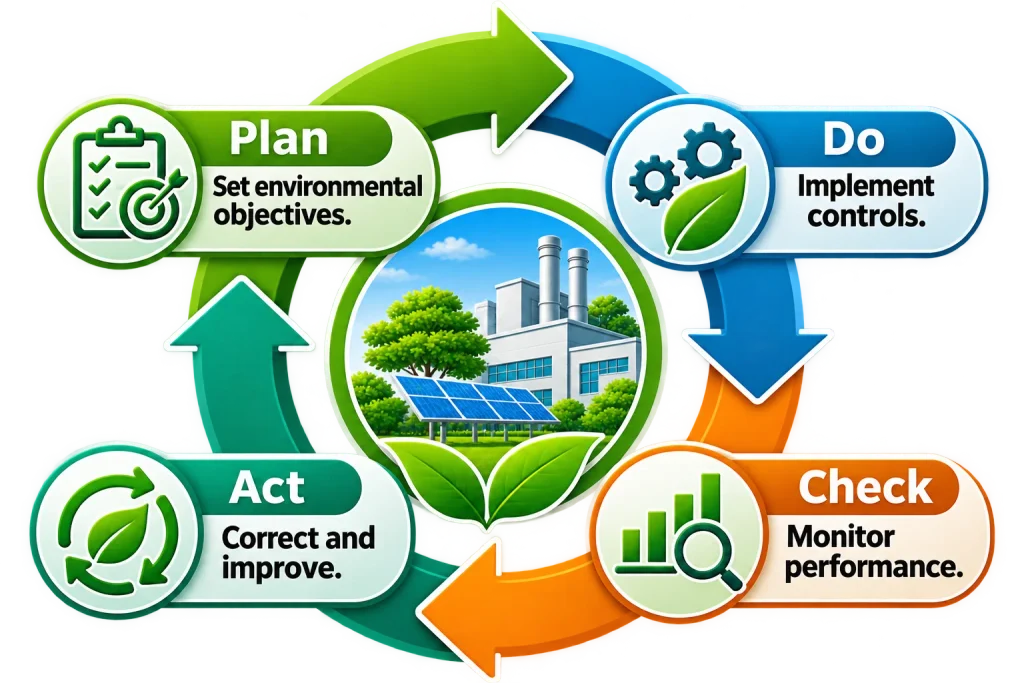
By repeating these four stages, businesses can identify improvement opportunities, strengthen environmental controls and maintain progress towards their environmental objectives.
Environmental Management Plan: Practical Business Template
A structured environmental plan template helps businesses organise their environmental responsibilities and communicate implementation requirements to employees.
The following example provides a basic structure that can be adapted to different industries.
| EMP section | Information to include |
|---|---|
| Business information | Company name, location, activities and departments |
| Purpose and scope | Environmental management objectives and boundaries |
| Environmental policy | Management commitments and environmental principles |
| Initial review | Existing environmental conditions and performance |
| Environmental aspects | Activities that interact with the environment |
| Environmental risk register | Identified risks, impacts and control measures |
| Environmental objectives | Measurable improvement targets |
| Operational controls | Procedures for managing significant environmental aspects |
| Responsibilities | Assigned duties and reporting arrangements |
| Monitoring plan | Indicators, measurement methods and monitoring frequency |
| Emergency response | Procedures for environmental incidents |
| Training arrangements | Employee awareness and competency requirements |
| Environmental records | Inspections, monitoring reports and incident records |
| Review and improvement | Audits, corrective actions and management reviews |
Example of an environmental action plan:
| Action | Responsible person | Target date | Evidence of completion |
|---|---|---|---|
| Introduce waste segregation | Facilities Manager | Within 30 days | Waste segregation inspection |
| Install water-efficient equipment | Maintenance Manager | Within 90 days | Installation records |
| Conduct environmental awareness training | HR Manager | Within 60 days | Training attendance records |
| Review chemical storage arrangements | Environmental Officer | Within 30 days | Inspection report |
| Evaluate environmental performance | Environmental Manager | Quarterly | Performance review report |
The business should customise this template according to its activities, environmental risks, applicable requirements and organisational resources.
Common Challenges When Developing an Environmental Management Plan
Although environmental planning provides a structured approach to improving business performance, organisations may encounter practical challenges during development and implementation.
| Common challenge | Possible solution |
|---|---|
| Limited environmental knowledge | Provide relevant employee training and professional support |
| Insufficient management commitment | Establish clear leadership responsibilities |
| Incomplete environmental data | Conduct initial reviews and introduce systematic monitoring |
| Limited financial resources | Prioritise significant risks and implement improvements in phases |
| Poor employee participation | Communicate objectives and involve employees in implementation |
| Unclear responsibilities | Assign named role owners and reporting arrangements |
| Inadequate monitoring | Establish measurable indicators and review schedules |
| Outdated environmental procedures | Introduce scheduled reviews and change management |
How Can Small Businesses Develop an Effective EMP?
Small and medium-sized businesses do not necessarily need complex environmental management documentation.
A proportionate approach can begin with:
- Identifying the main environmental impacts of business activities.
- Reviewing applicable legal and regulatory requirements.
- Establishing a small number of measurable environmental objectives.
- Introducing practical waste, energy and water management procedures.
- Assigning environmental responsibilities to appropriate employees.
- Recording relevant environmental performance information.
- Reviewing progress and improving procedures periodically.
The level of documentation and control should reflect the organisation’s size, complexity and environmental risks.
How ISO 14001 Supports Environmental Management Planning
ISO 14001 is an international standard for Environmental Management Systems. It provides organisations with a structured framework for managing environmental responsibilities, improving performance and addressing relevant compliance obligations.
Its principles can support the development of an EMP through several interconnected activities.
| Environmental management area | Practical business application |
|---|---|
| Environmental policy | Establish organisational commitments |
| Environmental aspects | Identify activities that interact with the environment |
| Compliance obligations | Identify applicable legal and other requirements |
| Environmental objectives | Establish measurable improvement targets |
| Operational planning | Introduce appropriate environmental controls |
| Competence and awareness | Develop employee knowledge and responsibilities |
| Performance evaluation | Monitor environmental results |
| Internal auditing | Assess the effectiveness of management arrangements |
| Management review | Evaluate performance and improvement opportunities |
Businesses should understand that an EMP alone does not establish ISO 14001 certification. Certification involves assessing the organisation’s wider Environmental Management System against the applicable standard’s requirements.
For organisations seeking a more structured approach, ISO 14001:2026 provides the current international reference point for Environmental Management Systems.
Professional Skills Required for Effective Environmental Management
Developing and implementing an environmental management plan requires a combination of technical, analytical and management skills.
Environmental professionals should understand how organisational activities interact with the environment and how these interactions can be controlled through systematic planning.
Important professional skills include:
- Environmental impact identification and assessment.
- Environmental risk assessment and risk register development.
- Environmental legislation and compliance evaluation.
- Pollution prevention and control.
- Waste and resource management.
- Environmental objectives and performance measurement.
- Environmental auditing and inspection.
- Emergency preparedness and incident management.
- Environmental reporting and documentation.
- Leadership, communication and stakeholder engagement.
- Continuous improvement and sustainability planning.
These capabilities are particularly relevant to environmental managers, environmental consultants, sustainability professionals, compliance officers and individuals responsible for organisational environmental performance.
Conclusion
Developing an Environmental Management Plan for a business requires a systematic approach to identifying environmental impacts, assessing risks, establishing measurable objectives and implementing effective operational controls. Regular monitoring, employee training and environmental audits help organisations maintain compliance, reduce pollution and improve resource efficiency.
A well-structured EMP supports long-term business sustainability by integrating environmental responsibilities into everyday operations. By following recognised environmental management practices and continually reviewing performance, businesses can strengthen environmental protection, improve operational efficiency and achieve their sustainability objectives.