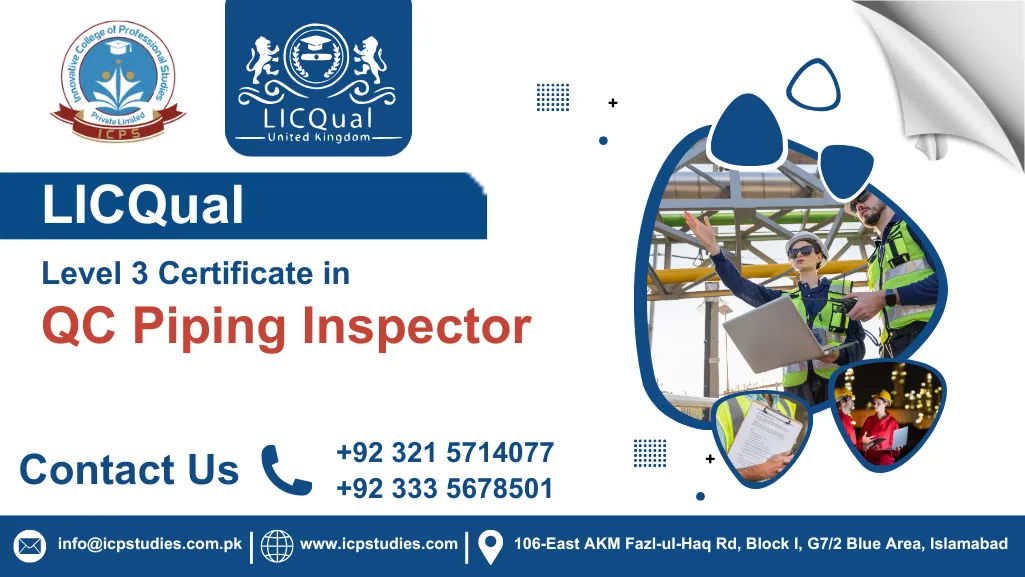
In every large industrial project, thousands of pipes work quietly in the background, carrying energy, water, and vital materials that keep operations alive. But behind this hidden network, there is always a trained eye making sure every joint, weld, and connection meets strict quality expectations. The LICQual Level 3 Certificate in QC Piping Inspector is designed for those who want to step into this precise and responsibility-driven role where every inspection can make a real difference to safety and performance.
This certification introduces the core principles of piping inspection and quality control used in real industrial environments. It focuses on essential areas such as weld inspection, piping system checks, material verification, and understanding basic industry standards. The learning is structured in a way that connects directly with site activities, helping individuals understand how QC inspectors identify issues, verify compliance, and ensure that piping work meets required specifications before systems are put into operation.
What makes this certification valuable is its strong focus on real-world inspection practice rather than theory alone. It builds a clear understanding of how quality control decisions are made on site and how small details can impact entire systems. For anyone drawn to hands-on technical work in industrial environments, this certification offers a grounded and practical entry into the world of piping quality inspection where accuracy is everything.
All About LICQual Level 3 Certificate in QC Piping Inspector
Course Overview
The LICQual Level 3 Certificate in QC Piping Inspector is a structured LICQual certification designed to deliver focused knowledge in piping quality control inspection. It is a programme built with a clear academic framework that includes 6 units, 24 credits, and 120 Guided Learning Hours (GLH). This structure ensures an organised and measurable learning experience aligned with defined inspection and quality control study areas.
The certification is divided into six units that guide learning through core components of QC piping inspection. With a total of 24 credits, it represents a balanced academic load that supports structured understanding across all units. The 120 GLH provides a defined learning duration, ensuring consistent engagement with the content and allowing adequate time to cover each area of study within the certification.
Awarded by LICQual, this certification follows a unit-based delivery model supported by credits and guided learning hours for clear academic structure. It ensures that learning is systematically arranged and easy to follow. The design of this certification focuses on structured knowledge delivery in QC piping inspection, maintaining consistency in learning hours, unit distribution, and overall programme organisation.
Admission Criteria
To enroll in the LICQual Level 3 Certificate in QC Piping Inspector, learners are expected to meet the following entry requirements :
- Age Requirement: Learners must be at least 18 years old.
- Educational Requirements: Applicants must have completed Level 2 qualification in related field.
- English Language Proficiency: Learners should have a reasonable standard of English language proficiency.
- Work Experience: No prior work experience is required.
Study Units
Learning Outcomes
By the end of this course, applicants will be able to:
1. Fundamentals of Piping Systems and Inspection Principles
- Explain the core components and functions of piping systems in industries such as oil and gas, petrochemicals, and construction.
- Describe the principles of quality control inspection and their importance in ensuring the safety and reliability of piping systems.
- Identify the roles and responsibilities of a QC piping inspector in maintaining compliance with project and industry standards.
- Apply basic inspection methodologies to monitor and verify the quality of piping systems during installation and operation.
2. Introduction to Piping Materials, Fittings, and Components
- Identify common piping materials, fittings, and components, such as pipes, valves, and flanges, and their applications in various industries.
- Explain the properties of piping materials (e.g., carbon steel, stainless steel) and their suitability for specific environmental and operational conditions.
- Assess the quality of fittings and components to ensure they meet project specifications and industry standards.
- Demonstrate knowledge of material selection processes to support effective quality control in piping inspections.
3. Basics of Welding Processes and Joint Inspection
- Describe common welding processes used in piping systems, including TIG, MIG, and arc welding, and their impact on joint quality.
- Conduct inspections of welded joints to identify defects such as cracks, porosity, or incomplete fusion, ensuring compliance with quality standards.
- Apply basic welding inspection techniques to verify weld integrity and adherence to welding procedure specifications (WPS).
- Recommend corrective actions for weld imperfections to maintain the structural integrity of piping systems.
4. Piping Drawings, Symbols, and Isometric Reading
- Interpret piping drawings and isometric diagrams to identify components, dimensions, and specifications accurately.
- Recognize standard symbols and annotations used in piping drawings to support inspection and quality control processes.
- Apply isometric reading skills to verify the alignment and configuration of piping systems during inspections.
- Evaluate piping layouts against design drawings to ensure compliance with project requirements and quality standards.
5. Visual Inspection Techniques and Defect Identification
- Perform visual inspections of piping systems using appropriate tools and techniques to identify surface defects and non-conformities.
- Identify common piping defects, such as corrosion, misalignment, or surface cracks, and assess their impact on system performance.
- Document visual inspection findings accurately, including detailed reports on defects and recommended corrective actions.
- Apply industry best practices to ensure thorough and effective visual inspections in piping quality control.
6. Safety, Health, and Environmental Considerations in Piping Inspection
- Identify health, safety, and environmental (HSE) risks associated with piping inspection activities and implement mitigation strategies.
- Apply safe work practices during inspections to ensure a secure working environment for all personnel involved.
- Explain the environmental impact of piping operations and adopt sustainable practices to minimize waste and emissions.
- Ensure compliance with HSE regulations and industry standards to maintain a safe and environmentally responsible inspection process.
Ideal Candidate
The LICQual Level 3 Certificate in QC Piping Inspector is designed for individuals who want to build practical understanding of piping inspection and quality control practices used in real industrial environments. It focuses on structured learning that strengthens awareness of inspection procedures, welding quality, and site-based QA/QC activities. This certification supports development in technical inspection roles within engineering and construction projects.
This certification is ideal for:
- Individuals interested in understanding piping inspection methods used in industrial environments
- Learners who want to develop knowledge of weld inspection and material verification processes
- People aiming to understand quality control procedures applied in piping installation activities
- Those interested in learning how inspection checks are carried out on construction and industrial sites
- Individuals who want to understand basic quality documentation and reporting practices in QC work
- Learners interested in gaining awareness of industry standards used in piping inspection processes
- People who prefer practical, site-related learning in engineering and construction environments
- Individuals interested in oil and gas, petrochemical, or industrial project environments
- Learners who want to build a clear understanding of piping QA/QC inspection activities
- People looking to strengthen technical awareness of quality control practices used in engineering projects
FAQs LICQual Level 3 Certificate in QC Piping Inspector