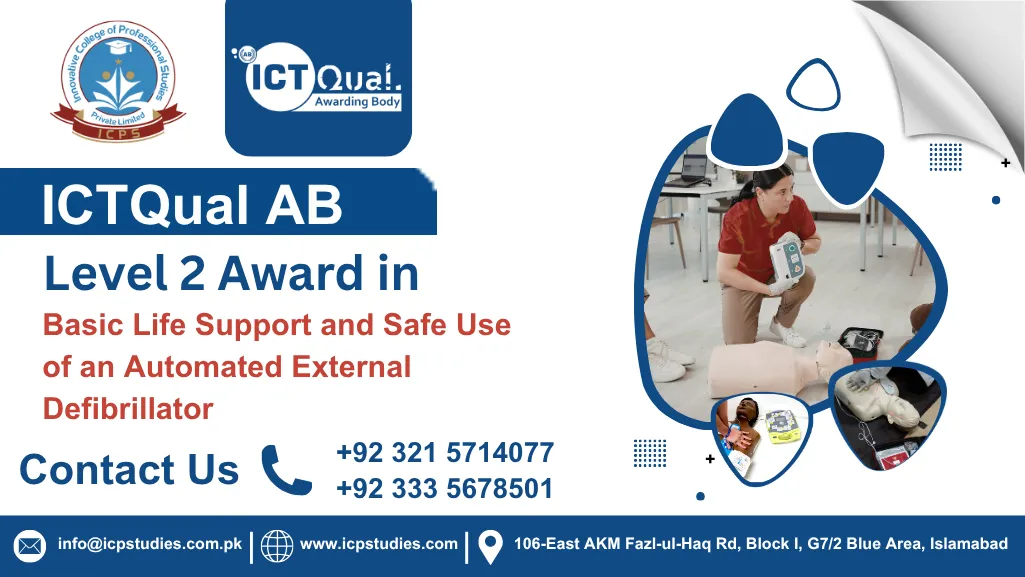
The ICTQual Level 2 Award in Basic Life Support (BLS) and Safe Use of an Automated External Defibrillator (AED) is a professionally designed course that equips learners with essential life-saving skills for responding to cardiac emergencies in workplace, community, and home settings. This qualification is ideal for individuals who want to gain confidence in performing basic life support, operate an AED safely, and provide immediate assistance during critical situations.
The programme focuses on practical, hands-on training in key BLS techniques, including cardiopulmonary resuscitation (CPR) for adults, children, and infants, airway management, and handling choking incidents. Participants will also learn how to safely use an automated external defibrillator (AED), assess emergency scenarios, and coordinate effectively with emergency medical services.
Aligned with recognized first aid and safety standards, the course combines theoretical knowledge with interactive exercises, ensuring learners develop competence, confidence, and rapid decision-making skills. Emphasis is placed on understanding legal responsibilities, workplace safety requirements, and best practices for providing life-saving support until professional help arrives.
By completing the ICTQual Level 2 Award in BLS and AED, learners enhance their professional credibility and employability. This qualification is particularly valuable for workplace first aiders, healthcare support staff, teachers, childcare providers, volunteers, and anyone seeking to act promptly and effectively during cardiac emergencies, saving lives and improving safety outcomes.
All About ICTQual Level 2 Award in Basic Life Support and Safe Use of an Automated External Defibrillator
Course Overview
The ICTQual Level 2 Award in Basic Life Support (BLS) and Safe Use of an Automated External Defibrillator (AED) is a 2-day, 6-hour intensive training programme designed to provide learners with practical skills for responding to cardiac emergencies. The course is structured into 6 study units, each covering essential aspects of basic life support and AED use to ensure participants can act confidently in real-life emergency situations.
Throughout the programme, learners will explore emergency assessment, CPR techniques for adults, children, and infants, choking management, casualty handling, and the safe operation of AED devices. Additional units focus on legal responsibilities, workplace and community safety, and integrating BLS and AED procedures into emergency response plans.
The course emphasizes hands-on, scenario-based training, enabling learners to apply their knowledge in realistic situations. Practical exercises help participants develop the confidence, rapid decision-making skills, and competence required to provide immediate life-saving care until professional medical assistance arrives.
By the end of this 2-day, 6-hour programme, participants will be fully prepared to deliver effective basic life support and operate AED devices safely in a variety of environments. This qualification is ideal for workplace first aiders, healthcare support staff, teachers, childcare providers, and volunteers seeking to enhance emergency preparedness and life-saving skills.
To enroll in the ICTQual Level 2 Award in Basic Life Support (BLS) and Safe Use of an Automated External Defibrillator (AED), applicants should meet the following criteria:
- Age Requirement:
Candidates must be at least 16 years old at the time of registration. - Educational Background:
There are no formal academic qualifications required, although a basic level of education is recommended to support understanding of course content. - Experience:
No prior first aid or BLS experience is required. The course is suitable for beginners and individuals seeking to enhance their emergency response skills. - English Language Proficiency:
Learners must have a good command of English, both written and spoken.
The ICTQual Level 2 Award in Basic Life Support (BLS) and Safe Use of an Automated External Defibrillator (AED) is designed for individuals who need essential life-saving skills to respond effectively in cardiac emergencies. It is ideal for those responsible for safety in workplaces, schools, healthcare, and community environments.
This course is suitable for:
- Workplace First Aiders and Safety Officers ensuring employee safety
- Healthcare Support Staff including nurses, medical assistants, and care workers
- Teachers, Teaching Assistants, and Childcare Providers overseeing children and infants
- Volunteers and Community Workers involved in public safety and emergency support
- Sports Coaches, Fitness Instructors, and Activity Leaders managing active groups
- Parents and Guardians seeking critical emergency response skills
- Individuals seeking recognized BLS and AED certification for career development or personal preparedness
This course is particularly beneficial for anyone looking to build confidence in performing CPR, safely operating AED devices, and providing immediate care during cardiac emergencies, ensuring lives can be saved in both professional and everyday settings.
Study Units
This qualification, the ICTQual Level 2 Award in Basic Life Support and Safe Use of an Automated External Defibrillator, consists of 6 mandatory units.
- Introduction to Basic Life Support (BLS)
- Cardiopulmonary Resuscitation (CPR)
- Management of Choking
- Automated External Defibrillator (AED) Use
- Recovery Position
- Legal and Ethical Considerations
Learning Outcomes:
Learning Outcomes for the Study Units:
Introduction to Basic Life Support (BLS)
- Understanding BLS Principles: Participants will understand the fundamental principles and importance of basic life support, including the chain of survival.
- Role of a First Aider: Participants will be able to describe the responsibilities and duties of a first aider in emergency situations.
- Emergency Response: Participants will recognize the critical need for immediate action when encountering a person in need of BLS.
Cardiopulmonary Resuscitation (CPR)
- CPR Techniques: Participants will be proficient in performing CPR on adults, children, and infants, including the correct ratio of chest compressions to rescue breaths.
- Effective Compressions: Participants will demonstrate the ability to perform effective chest compressions with appropriate depth and rate.
- Rescue Breaths: Participants will know how to give effective rescue breaths, ensuring airway management and ventilation.
- Sequential CPR: Participants will be able to execute the complete CPR sequence in various scenarios, ensuring a systematic and effective approach.
Management of Choking
- Choking Identification: Participants will recognize the signs and symptoms of choking in adults, children, and infants.
- Choking Interventions: Participants will demonstrate the correct techniques for assisting a choking victim, including back blows and abdominal thrusts.
- Adapted Techniques: Participants will understand how to adapt choking management techniques for different age groups and physical conditions.
Automated External Defibrillator (AED) Use
- AED Familiarity: Participants will become familiar with the components and functions of an AED.
- Safe AED Use: Participants will demonstrate the safe and effective use of an AED, including proper pad placement and following device prompts.
- Post-Shock Procedures: Participants will understand and perform necessary actions following an AED shock, including continued CPR and monitoring the victim.
Recovery Position
- Proper Positioning: Participants will learn how to correctly place a casualty in the recovery position to ensure their airway remains open and clear.
- Casualty Monitoring: Participants will demonstrate how to monitor and assess a casualty in the recovery position, ensuring their condition does not deteriorate.
Legal and Ethical Considerations
- Legal Responsibilities: Participants will understand the legal implications and responsibilities involved in providing first aid and BLS.
- Consent and Confidentiality: Participants will know how to obtain consent from a casualty and the importance of maintaining confidentiality.
- Record Keeping: Participants will recognize the importance of accurate and thorough record-keeping following an incident involving first aid and BLS.
FAQs ICTQual Level 2 Award in Basic Life Support and Safe Use of an Automated External Defibrillator