In today’s digital economy, personal data has become one of the most valuable assets and also one of the most sensitive. Every organisation that collects or processes information carries a serious responsibility to protect privacy. A single breach can lead to loss of trust, legal penalties, and long term reputational damage.
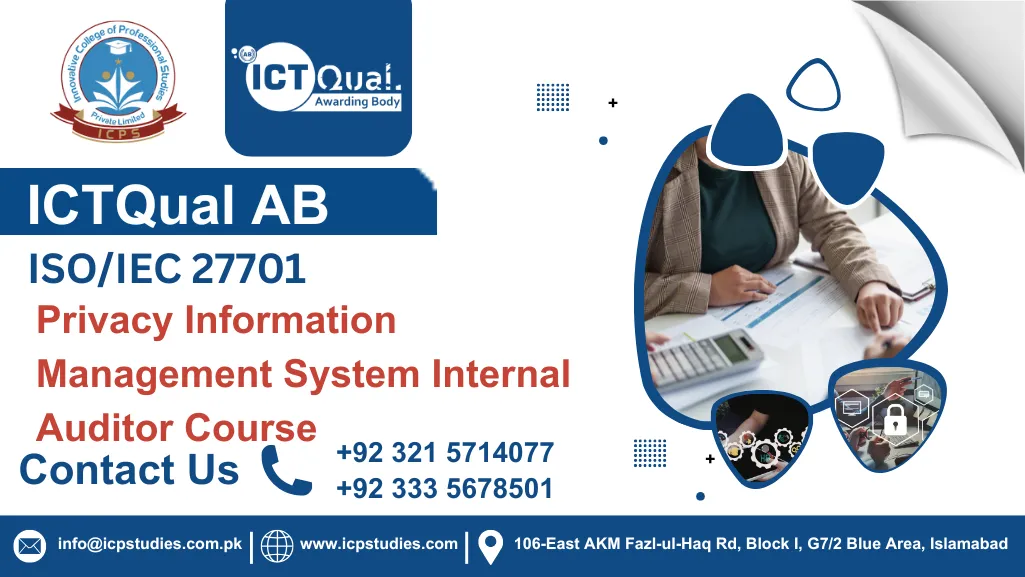
The ICTQual ISO/IEC 27701 Privacy Information Management System Internal Auditor Course is designed to build strong understanding of privacy governance within organisations. It introduces the ISO/IEC 27701 framework, which extends information security into structured privacy management. Learners discover how privacy is embedded into policies, processes, and daily operations rather than treated as a separate function.
Through practical auditing techniques, learners develop the ability to evaluate how personal data is managed, identify privacy risks, and assess compliance with global requirements. The course builds analytical thinking and professional confidence, preparing learners for roles in auditing, compliance, IT, and data governance where privacy protection is essential for modern organisations.
All About ICTQual ISO/IEC 27701 Privacy Information Management System Internal Auditor Course
Course Overview
The ICTQual ISO/IEC 27701 Privacy Information Management System Internal Auditor Course is a structured 5 day professional training programme delivered through 8 mandatory units. It is designed to help learners understand how privacy management systems are built, implemented, and audited within modern organisations.
Across the eight units, learners explore key areas such as personal data governance, privacy risk identification, data processing controls, compliance obligations, and monitoring mechanisms. Each unit connects ISO/IEC 27701 principles with real organisational practices, showing how privacy requirements are applied in everyday business operations.
A strong focus of this programme is internal auditing of privacy information management systems. Learners develop the ability to assess compliance effectiveness, identify privacy gaps, and evaluate how well organisations protect personal data. By the end of this 5 day course, learners are equipped to support organisations in strengthening privacy controls, ensuring regulatory compliance, and building trust in data handling practices.
Entry Requirements
The ICTQual ISO/IEC 27701 Privacy Information Management System Internal Auditor Course has the following recommended entry requirements :
- Age Requirement: Learners must be at least 18 years of age at the time of enrolment.
- Educational Background: A minimum of secondary education or equivalent qualification is recommended.
- Language Proficiency: Learners should have a good command of the English language.
- Work Experience: Prior experience is not mandatory.
Study Units
This qualification, the ICTQual ISO/IEC 27701 Privacy Information Management System Internal Auditor Course, consists of 8 mandatory units.
- Introduction to Privacy Management Systems
- Fundamentals of Internal Auditing
- Understanding ISO/IEC 27701 Requirements
- Audit Preparation and Documentation
- Conducting Privacy Management System Audits
- Reporting and Follow-Up
- Emerging Trends and Challenges in Privacy Governance
- Continuous Improvement and Professional Development
Learning Outcomes:
Learning Outcomes for the Study Units:
Introduction to Privacy Management Systems
By the end of this unit, the learner will be able to:
- Explain the purpose and scope of a Privacy Information Management System (PIMS).
- Understand the role of ISO/IEC 27701 in extending ISO/IEC 27001 for privacy protection.
- Identify the benefits of implementing structured privacy governance frameworks.
- Recognise the relationship between privacy management and organisational trust.
- Describe how PIMS supports compliance with GDPR and other global privacy laws.
- Compare privacy management systems with other management frameworks.
- Appreciate the importance of privacy in digital transformation and data‑driven industries.
Fundamentals of Internal Auditing
By the end of this unit, the learner will be able to:
- Define the purpose and objectives of internal audits in privacy management systems.
- Apply the principles of independence, objectivity, and professional ethics.
- Understand the responsibilities of internal auditors in planning and execution.
- Differentiate between first‑party, second‑party, and third‑party audits.
- Recognise the importance of confidentiality and impartiality in auditing.
- Explain how internal audits contribute to compliance and continual improvement.
- Apply auditing principles to ensure accountability in privacy governance.
Understanding ISO/IEC 27701 Requirements
By the end of this unit, the learner will be able to:
- Interpret the clauses and requirements of ISO/IEC 27701.
- Understand how ISO/IEC 27701 integrates with ISO/IEC 27001 and ISO/IEC 27002.
- Apply ISO/IEC 27701 requirements to real‑world privacy management practices.
- Recognise the importance of leadership, planning, and resources in PIMS implementation.
- Evaluate the role of documented information in ensuring compliance.
- Understand how ISO/IEC 27701 addresses data subject rights and privacy controls.
- Assess how the standard supports accountability and transparency in data processing.
Audit Preparation and Documentation
By the end of this unit, the learner will be able to:
- Plan an internal audit in alignment with ISO/IEC 27701 requirements.
- Develop audit checklists and criteria tailored to privacy management systems.
- Collect and review relevant documentation, policies, and procedures.
- Identify key risks and areas of focus for privacy system audits.
- Prepare audit schedules and allocate resources effectively.
- Ensure audit documentation meets professional and regulatory standards.
- Establish clear communication channels with auditees before the audit.
Conducting Privacy Management System Audits
By the end of this unit, the learner will be able to:
- Apply recognised audit techniques to assess privacy management systems.
- Conduct effective interviews with stakeholders and data protection officers.
- Observe processes and evaluate compliance with ISO/IEC 27701.
- Identify nonconformities, risks, and opportunities for improvement.
- Use sampling methods to assess privacy controls and data handling practices.
- Apply ethical considerations when auditing sensitive personal data.
- Ensure objectivity and accuracy in evidence collection.
Reporting and Follow‑Up
By the end of this unit, the learner will be able to:
- Prepare clear, accurate, and objective audit reports.
- Communicate findings effectively to management and stakeholders.
- Classify nonconformities and recommend corrective actions.
- Provide constructive feedback to support continual improvement.
- Establish timelines for corrective and preventive actions.
- Monitor the implementation of corrective measures.
- Conduct follow‑up audits to verify effectiveness of improvements.
Emerging Trends and Challenges in Privacy Governance
By the end of this unit, the learner will be able to:
- Identify current and emerging trends in privacy governance and regulation.
- Understand the challenges of global compliance with multiple privacy laws.
- Evaluate the impact of new technologies on privacy, such as AI and big data.
- Recognise risks associated with cross‑border data transfers.
- Analyse case studies of privacy breaches and lessons learned.
- Anticipate future challenges in auditing privacy management systems.
- Recommend strategies for organisations to stay ahead of regulatory changes.
Continuous Improvement and Professional Development
By the end of this unit, the learner will be able to:
- Explain the importance of continual improvement in privacy management systems.
- Recommend corrective and preventive actions to resolve nonconformities.
- Support organisations in embedding a culture of privacy and accountability.
- Evaluate the effectiveness of improvement initiatives.
- Align professional development with emerging privacy auditing skills.
- Pursue advanced certifications and training in privacy governance and auditing.
- Contribute to industry knowledge through research, publications, or professional networks.
Ideal Candidate
This course is designed for learners who want to understand how organisations protect personal data and manage privacy in a structured, responsible way. It is ideal for those who are interested in how privacy rules and systems are applied in real business environments.
It is highly suitable for professionals working in IT, cybersecurity, compliance, legal, auditing, and data management roles. The course helps learners move beyond basic awareness and develop the ability to evaluate how privacy systems are designed, implemented, and monitored.
It is also valuable for internal auditors, risk professionals, and governance staff who are responsible for ensuring data protection and regulatory compliance. It builds the skills needed to assess privacy risks and identify weaknesses in data handling processes.
For anyone aiming to build a strong career in privacy, compliance, or auditing, this qualification provides practical, industry relevant skills that support long-term professional growth.
FAQs ICTQual ISO/IEC 27701 Privacy Information Management System Internal Auditor Course