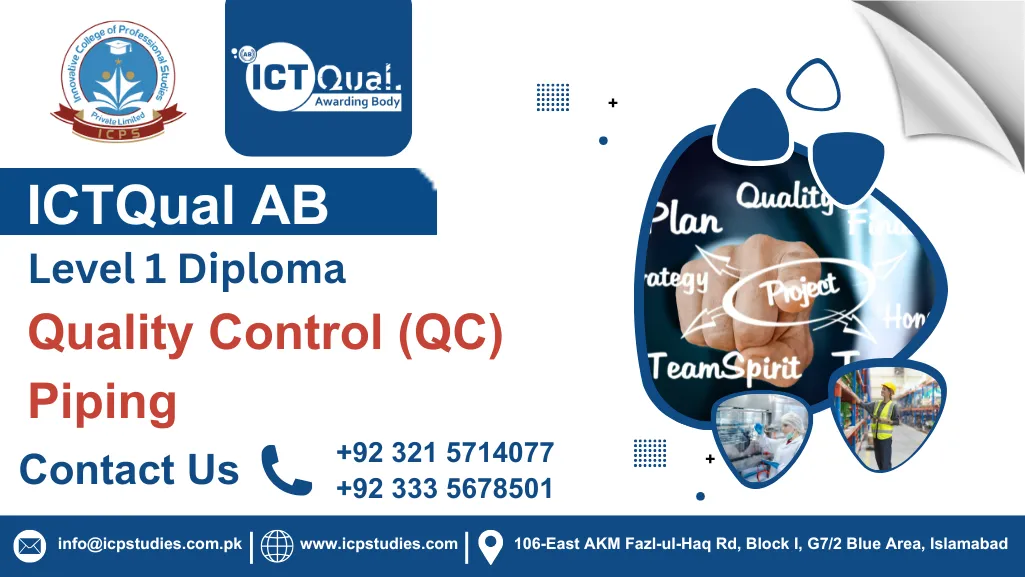
The ICTQual AB Level 1 Diploma in Quality Control (QC) Piping is an entry-level qualification designed to introduce learners to the fundamental principles of piping quality control within engineering, construction, oil and gas, petrochemical, power generation, and industrial environments. It provides a structured foundation for learners who want to understand how piping materials, fabrication, installation, inspection, and testing are controlled to meet required quality standards and project specifications.
This qualification introduces essential concepts related to piping systems, quality control procedures, engineering drawings, material identification, fabrication processes, welding quality, inspection activities, measurement, testing, and quality documentation. Learners gain an awareness of how QC teams monitor piping work, identify potential defects, maintain inspection records, and support compliance with approved procedures and technical requirements.
The ICTQual AB Level 1 Diploma in Quality Control (QC) Piping is suitable for beginners, aspiring QC professionals, piping and fabrication workers, and individuals looking to build a foundation for a career in engineering quality control. It can help learners develop industry-relevant knowledge before progressing to higher-level qualifications in piping QA/QC, inspection, welding, mechanical engineering, or quality management.
By completing this qualification, learners can build a stronger understanding of piping quality control practices and prepare for further professional development in the engineering and construction sectors.
All About ICTQual AB Level 1 Diploma in Quality Control (QC) Piping
Course Overview
The ICTQual AB Level 1 Diploma in Quality Control (QC) Piping is an introductory qualification designed to provide learners with a foundation in piping quality control, inspection, fabrication, testing, and quality documentation. The qualification consists of 5 units and carries 10 credits, with the required Guided Learning Hours (GLH) as specified by the approved qualification structure.
The course introduces learners to essential piping QC procedures, engineering drawings, material identification, fabrication processes, welding quality, inspection activities, measurement, defect identification, and quality records. Learners develop an understanding of how quality control is applied to piping work within engineering, construction, oil and gas, petrochemical, power generation, and industrial environments.
Through its 5-unit structure, the qualification provides accessible and industry-relevant learning for individuals beginning their professional journey in piping quality control. Learners gain an understanding of the basic responsibilities of QC personnel and how inspection and quality procedures contribute to achieving project requirements and maintaining piping quality.
The ICTQual AB Level 1 Diploma in Quality Control (QC) Piping is suitable for beginners, junior QC personnel, piping and fabrication workers, aspiring piping inspectors, and individuals seeking entry-level knowledge of piping quality control.
Successful completion can provide a foundation for progression to higher-level qualifications in Piping QA/QC, Piping Inspection, Welding Inspection, Mechanical Engineering, and Quality Management.
Entery Requirment
- Age: Minimum 16 years.
- Educational Background: Basic secondary education or equivalent is recommended.
- Experience: No previous piping or QC experience is required.
- English Language: Basic English proficiency is recommended.
- Technical Knowledge: Basic understanding of construction, engineering, or piping is beneficial but not essential.
- Computer Skills: Basic computer skills are recommended for accessing learning materials and completing assignments.
Study Units
This qualification, the ICTQual AB Level 1 Diploma in Quality Control (QC) Piping, consists of 5 mandatory units.
- Introduction to Piping Systems and Components
- Basics of Quality Control in Piping
- Fundamental Inspection Techniques
- Safety Practices in Piping Installations
- Understanding Piping Materials and Tools
Learning Outcomes:
Learning Outcomes for the Study Units:
1. Introduction to Piping Systems and Components
By the end of this unit, learners will be able to:
- Define the purpose and structure of piping systems used in industrial applications.
- Identify key components such as pipes, elbows, tees, reducers, valves, gaskets, and flanges.
- Interpret basic piping drawings and understand standard symbols and layouts.
2. Basics of Quality Control in Piping
By the end of this unit, learners will be able to:
- Explain the principles and importance of quality control in piping projects.
- Describe the stages of quality assurance throughout the piping lifecycle.
- Recognise common quality documentation, including inspection plans, test reports, and compliance records.
3. Fundamental Inspection Techniques
By the end of this unit, learners will be able to:
- Apply basic inspection methods such as visual inspection and dimensional checks.
- Identify weld defects and surface irregularities using standard inspection tools.
- Document inspection findings accurately in accordance with industry guidelines.
4. Safety Practices in Piping Installations
By the end of this unit, learners will be able to:
- Describe essential health and safety protocols during piping inspection and installation.
- Recognise typical workplace hazards in piping environments and how to mitigate them.
- Demonstrate correct use of personal protective equipment (PPE) and adherence to safe working practices.
5. Understanding Piping Materials and Tools
By the end of this unit, learners will be able to:
- Select and use basic tools and instruments required for quality control and inspection activities.
- Identify various piping materials such as carbon steel, stainless steel, and plastic piping.
- Understand the properties and applications of materials used in different industrial conditions.
Ideal Candidate
The ICTQual AB Level 1 Diploma in Quality Control (QC) Piping is designed for beginners and individuals who want to build foundational knowledge of piping quality control, inspection, fabrication, and testing.
- Individuals starting a career in Piping Quality Control (QC).
- Beginners interested in piping inspection and quality assurance.
- Junior QC personnel seeking foundational knowledge.
- Piping and fabrication workers who want to develop QC skills.
- Individuals interested in oil and gas, petrochemical, construction, and industrial engineering.
- Aspiring piping inspectors and quality control assistants.
- Learners seeking basic knowledge of piping fabrication, inspection, testing, and quality documentation.
- Individuals planning to progress to higher-level Piping QA/QC and inspection qualifications.
- Career changers looking to enter the engineering quality control sector.
FAQs ICTQual AB Level 1 Diploma in Quality Control (QC) Piping