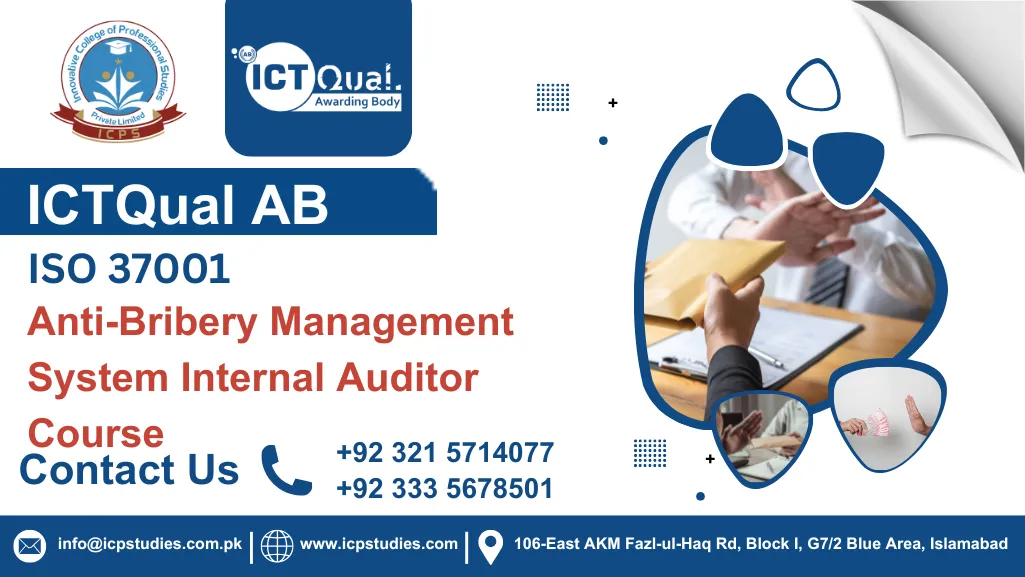
In every workplace, there comes a moment when someone quietly notices that something is not right an unfair advantage, an unexplained decision, or a hidden risk that no one wants to talk about. The ICTQual ISO 37001 Anti-Bribery Management System Internal Auditor Course begins exactly at that point. It is designed for individuals who do not ignore these signals, but instead want to understand them, question them, and help build a workplace where honesty is the standard, not the exception.
This course takes you inside the world of ISO 37001, the international framework that helps organizations prevent, detect, and respond to bribery risks. Instead of heavy theory, you are guided through real auditing thinking how systems operate, where risks hide, and how controls can fail if they are not properly checked. It shows you how internal auditors become the quiet guardians of integrity, ensuring that every process is fair, transparent, and accountable.
By the end of this journey, you are no longer just a learner you become someone who can step into any organization and see what others might miss. You gain the confidence to evaluate systems, raise meaningful concerns, and support ethical decisions that protect both businesses and people. This course is not just about compliance; it is about shaping a professional identity built on trust, responsibility, and quiet strength in the face of wrongdoing.
All About ICTQual ISO 37001 Anti-Bribery Management System Internal Auditor Course
Course Overview
The ICTQual ISO 37001 Anti-Bribery Management System Internal Auditor Course is a focused 5 day training program built to develop strong, practical auditing skills in a short but intensive learning journey. Structured across 8 mandatory units, the course gradually takes learners from foundational understanding to applied internal audit techniques used in real organizational environments.
Throughout the program, each unit builds a new layer of competence from understanding anti bribery principles and ISO 37001 requirements to identifying risks, evaluating controls, and preparing audit reports. The learning is designed to feel practical and engaging, using real world scenarios that reflect challenges faced in modern workplaces where compliance and ethics must work together.
By the end of five days, learners gain a complete picture of how anti-bribery systems function and how internal auditors play a key role in protecting organizational integrity. It is a compact yet powerful learning experience that transforms theoretical knowledge into confident, workplace ready auditing ability.
Entry Requirements
The ICTQual ISO 37001 Anti-Bribery Management System Internal Auditor Course has the following recommended entry requirements :
- Age Requirement: Learners must be at least 18 years of age at the time of enrollment.
- Educational Background: A minimum of secondary education (or equivalent qualification) is recommended.
- English Language Proficiency:
Learners must have a good command of English, both written and spoken.Participants should have a reasonable level of English language - Work Experience: Prior exposure to business operations, compliance, administration, quality assurance, or internal auditing is preferred but not compulsory.
Study Units
This qualification, the ICTQual ISO 37001 Anti-Bribery Management System Internal Auditor Course, consists of 8 mandatory units.
- Introduction to Anti-Bribery Management Systems
- Fundamentals of Internal Auditing
- Understanding ISO 37001 Requirements
- Risk Assessment and Mitigation Strategies
- Conducting Audit Activities
- Reporting and Follow-Up
- Ethical Considerations and Integrity
- Continuous Improvement and Professional Development
Learning Outcomes:
Learning Outcomes for the Study Units:
Introduction to Anti-Bribery Management Systems
By the end of this unit, the learner will be able to:
- Explain the purpose and importance of Anti-Bribery Management Systems (ABMS) in global business.
- Identify the key principles of anti-bribery compliance and ethical governance.
- Recognise the role of ISO 37001 in promoting transparency and accountability.
- Describe the impact of bribery on organisations, stakeholders, and society.
- Understand the relationship between ABMS and wider corporate governance frameworks.
- Outline the benefits of implementing an effective anti-bribery management system.
- Discuss the responsibilities of organisations in preventing bribery and corruption.
Fundamentals of Internal Auditing
By the end of this unit, the learner will be able to:
- Define the purpose and scope of internal auditing within compliance frameworks.
- Understand the principles of independence, objectivity, and evidence-based auditing.
- Identify the stages of the internal audit process.
- Apply auditing techniques to assess compliance with management system standards.
- Recognise the role of internal auditors in supporting organisational improvement.
- Distinguish between different types of audits (first, second, and third party).
- Appreciate the importance of professional judgement and critical thinking in auditing.
Understanding ISO 37001 Requirements
By the end of this unit, the learner will be able to:
- Interpret the structure and clauses of ISO 37001.
- Explain the requirements for establishing, implementing, and maintaining an ABMS.
- Understand the roles of leadership, planning, and support in ISO 37001 compliance.
- Identify documentation and record-keeping requirements under the standard.
- Recognise the importance of monitoring, measurement, and evaluation.
- Apply ISO 37001 requirements to real-world organisational contexts.
- Understand how ISO 37001 integrates with other ISO management system standards.
Risk Assessment and Mitigation Strategies
By the end of this unit, the learner will be able to:
- Define bribery-related risks and their potential impact on organisations.
- Apply risk assessment methodologies to identify and evaluate bribery risks.
- Develop risk registers and prioritisation frameworks.
- Recommend mitigation strategies to reduce bribery-related vulnerabilities.
- Understand the role of due diligence in managing third-party risks.
- Evaluate the effectiveness of risk controls and monitoring mechanisms.
- Integrate risk management into the wider anti-bribery management system.
Conducting Audit Activities
By the end of this unit, the learner will be able to:
- Plan and prepare for an internal audit in line with ISO 37001 requirements.
- Conduct opening meetings and establish audit objectives with stakeholders.
- Apply effective questioning and evidence-gathering techniques.
- Evaluate compliance through document review, observation, and interviews.
- Record audit findings accurately and objectively.
- Manage audit teams and allocate responsibilities effectively.
- Handle challenges and conflicts during the audit process with professionalism.
Reporting and Follow-Up
By the end of this unit, the learner will be able to:
- Prepare clear, concise, and evidence-based audit reports.
- Communicate audit findings to management and relevant stakeholders.
- Differentiate between major, minor, and opportunity-for-improvement findings.
- Recommend corrective and preventive actions to address nonconformities.
- Monitor the implementation of corrective actions and verify effectiveness.
- Conduct follow-up audits to ensure sustained compliance.
- Maintain accurate records to support accountability and transparency.
Ethical Considerations and Integrity
By the end of this unit, the learner will be able to:
- Recognise the importance of ethical behaviour in auditing and compliance.
- Apply principles of integrity, impartiality, and confidentiality in audit practice.
- Identify potential conflicts of interest and manage them appropriately.
- Understand the ethical responsibilities of auditors under ISO 37001.
- Promote a culture of honesty and accountability within organisations.
- Evaluate the consequences of unethical behaviour in auditing.
- Demonstrate professional conduct in all audit-related activities.
Continuous Improvement and Professional Development
By the end of this unit, the learner will be able to:
- Contribute to the advancement of ethical and compliant business practices globally.
- Understand the role of continuous improvement in anti-bribery management systems.
- Apply audit findings to drive organisational learning and improvement.
- Recognise the importance of ongoing monitoring and performance evaluation.
- Develop strategies for enhancing the effectiveness of ABMS over time.
- Identify opportunities for personal and professional growth as an auditor.
- Engage in lifelong learning to maintain competence and credibility.
Ideal Candidate
This course is ideal for professionals who want to take an active role in promoting ethical business practices and reducing bribery risks within organizations. It is especially useful for those working in compliance, auditing, risk management, administration, or governance who want to strengthen their practical understanding of ISO 37001 and internal control systems.
It is also suitable for managers, supervisors, and team leaders who are responsible for ensuring fair decision making and transparent operations. Whether you already have experience in internal auditing or are newly entering this field, the course helps you understand how anti-bribery systems function in real workplace environments.
Fresh graduates and aspiring professionals looking to build a career in compliance or auditing will also benefit greatly. This training provides a strong foundation for global opportunities in governance and anti-bribery management, making it a valuable step for anyone committed to integrity, accountability, and long term professional growth.
FAQs ICTQual ISO 37001 Anti-Bribery Management System Internal Auditor Course