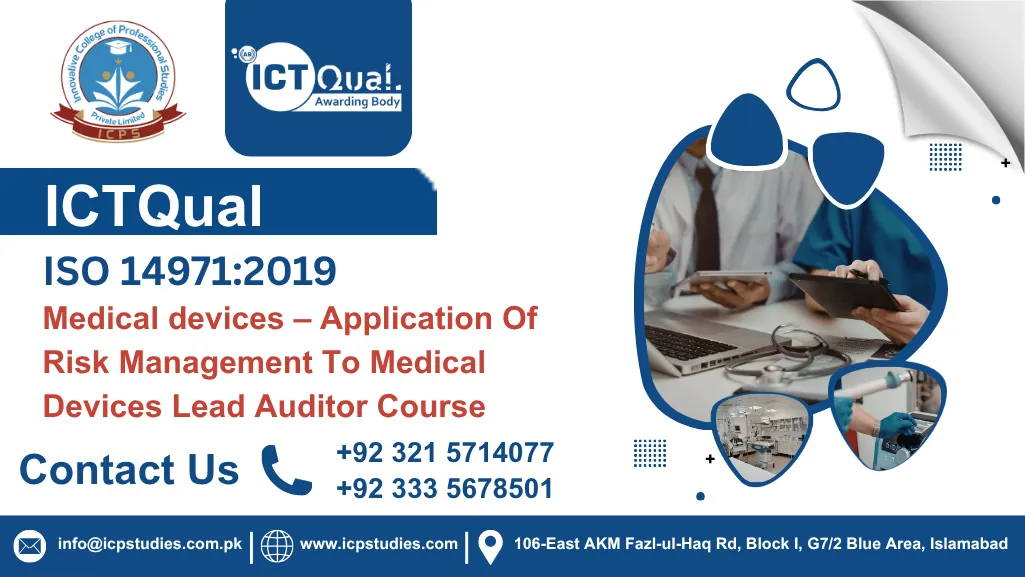
The ICTQual ISO 14971:2019 Medical Devices – Application of Risk Management to Medical Devices Lead Auditor Course is a specialized training program designed to equip professionals with advanced knowledge and auditing skills in medical device risk management systems. Based on the internationally recognized ISO 14971:2019 standard, this course focuses on identifying, evaluating, controlling, and monitoring risks associated with medical devices throughout their lifecycle. It provides a structured approach to ensuring patient safety, regulatory compliance, and product quality within the healthcare and medical device industry.
This course delivers in-depth insights into risk management principles, hazard analysis, risk evaluation, and post-market surveillance, enabling participants to effectively assess compliance with ISO 14971 requirements. Learners will also develop the competencies required to plan, conduct, and lead audits of risk management systems, ensuring organizations meet global regulatory expectations and maintain high safety standards.
Ideal for quality assurance professionals, regulatory affairs specialists, auditors, and medical device manufacturers, this course supports career advancement in a highly regulated industry. By completing this program, participants will gain the expertise needed to lead audits, improve risk management processes, and contribute to the development of safe and reliable medical devices in line with international best practices.
All About ICTQual ISO 14971:2019 Medical devices – Application Of Risk Management To Medical Devices Lead Auditor Course
Course Overview
The ICTQual ISO 14971:2019 Medical Devices – Application of Risk Management to Medical Devices Lead Auditor Course is a comprehensive 5-day training program structured across 8 in-depth study units, designed to provide both technical knowledge and practical auditing expertise. This course offers a detailed understanding of how risk management systems are applied within the medical device lifecycle, ensuring compliance with ISO 14971:2019 and global regulatory frameworks.
Throughout the program, participants will explore key areas such as risk management planning, hazard identification, risk analysis and evaluation, risk control measures, and post-production monitoring. Each study unit is carefully organized to build progressive knowledge, enabling learners to understand how to implement and assess effective risk management processes in real-world medical device environments.
A strong emphasis is placed on auditing principles and practices, including audit planning, conducting internal and external audits, reporting findings, and ensuring continual improvement. Learners will develop the skills required to evaluate compliance, identify gaps, and recommend corrective actions aligned with international standards.
Delivered over five intensive days, this course ensures a balanced approach between theoretical concepts and practical application. By the end of the training, participants will be fully prepared to lead audits, support regulatory compliance, and enhance the safety and performance of medical devices within a competitive global market.
To enroll in the ICTQual ISO 14971:2019 Medical Devices – Application of Risk Management to Medical Devices Lead Auditor Course, applicants should meet the following criteria:
- Age Requirement:
Learners must be at least 18 years of age at the time of enrollment. - Educational Background:
A minimum of a high school diploma or equivalent is required. However, a background in life sciences, biomedical engineering, healthcare, quality management, or related fields is highly recommended to better understand the technical aspects of the course. - Experience:
It is advisable for learners to have prior experience in medical devices, healthcare, quality assurance, regulatory affairs, or risk management systems. Basic knowledge of ISO standards or auditing principles will be beneficial but is not mandatory. - English Language Proficiency:
Learners must have a good command of English, both written and spoken.
The ICTQual ISO 14971:2019 Medical Devices – Application of Risk Management to Medical Devices Lead Auditor Course is designed for professionals involved in medical device manufacturing, quality management, and regulatory compliance. It is particularly suitable for:
- Quality Assurance and Quality Control Professionals
Individuals responsible for maintaining product quality and ensuring compliance with international standards. - Medical Device Manufacturers and Engineers
Professionals involved in the design, development, and production of medical devices who need to understand risk management requirements. - Regulatory Affairs Specialists
Those managing compliance with global medical device regulations and standards. - Lead Auditors and Internal Auditors
Professionals seeking to develop or enhance their auditing skills in accordance with ISO 14971:2019. - Healthcare and Biomedical Professionals
Individuals working in clinical environments who require knowledge of medical device safety and risk management. - Risk Management Professionals
Those responsible for identifying, evaluating, and controlling risks associated with medical devices. - Consultants and Compliance Officers
Experts advising organizations on implementing ISO standards and improving regulatory compliance systems. - Professionals Seeking Career Advancement
Individuals aiming to build or advance a career in the medical device, healthcare, or regulatory sectors.
This course is ideal for both experienced professionals and those looking to specialize in medical device risk management and auditing, ensuring improved safety, compliance, and operational excellence.
Study Units
This qualification, the ICTQual ISO 14971:2019 Medical devices – Application Of Risk Management To Medical Devices Lead Auditor Course, consists of 8 mandatory units.
- Introduction to ISO 14971:2019
- Risk Management Principles and Framework
- Risk Analysis
- Risk Control
- Risk Management Plan and Report
- Audit Preparation and Planning
- Conducting the Audit
- Reporting and Follow-Up
Learning Outcomes:
Learning Outcomes for the Study Units:
1. Introduction to ISO 14971:2019
- Understand the Scope and Purpose: Explain the scope, purpose, and significance of ISO 14971:2019 in the medical device industry.
- Identify Key Terminology: Define and use key terms related to risk management and the standard.
- Recognize Historical Context: Describe the evolution and historical context of ISO 14971 and its impact on medical device safety and compliance.
2. Risk Management Principles and Framework
- Explain Risk Management Fundamentals: Articulate the core principles and concepts of risk management in the context of medical devices.
- Develop a Risk Management Framework: Outline the structure and key elements of an effective risk management system.
- Integrate with Quality Management Systems: Explain how ISO 14971 integrates with other quality management standards like ISO 13485.
3. Risk Analysis
- Conduct Hazard Identification: Apply techniques for identifying potential hazards associated with medical devices.
- Perform Risk Estimation: Use methods for estimating the probability and severity of identified risks.
- Evaluate Risks: Evaluate risks using established criteria to determine their acceptability.
4. Risk Control
- Implement Risk Control Measures: Identify and implement appropriate risk control measures.
- Verify Control Effectiveness: Ensure that risk control measures are effective through verification techniques.
- Assess Residual Risk: Evaluate residual risks after controls have been applied to ensure they are acceptable.
5. Risk Management Plan and Report
- Develop a Risk Management Plan: Create a comprehensive risk management plan outlining key activities and responsibilities.
- Maintain a Risk Management File: Compile and maintain documentation for all risk management activities in a structured file.
- Prepare Risk Management Reports: Write detailed reports summarizing risk management activities, findings, and outcomes.
6. Audit Preparation and Planning
- Understand Audit Principles: Explain the principles and types of audits relevant to ISO 14971.
- Plan an Audit: Develop a detailed audit plan, including defining objectives, scope, and criteria.
- Organize an Audit Team: Identify roles and responsibilities of audit team members and organize the team accordingly.
7. Conducting the Audit
- Execute an Audit: Conduct an effective audit by following the planned steps, including opening meetings and evidence gathering.
- Utilize Audit Techniques: Apply various tools and techniques to collect and verify audit evidence.
- Identify Audit Findings: Recognize and categorize audit findings, including non-conformities and areas for improvement.
8. Reporting and Follow-Up
- Write Audit Reports: Structure and write comprehensive audit reports that clearly present findings and recommendations.
- Manage Non-Conformities: Address non-conformities through root cause analysis and implement corrective actions.
- Conduct Follow-Up Activities: Perform follow-up activities to ensure corrective actions are effectively implemented and sustained.
FAQs ICTQual ISO 14971:2019 Medical devices – Application Of Risk Management To Medical Devices Lead Auditor Course