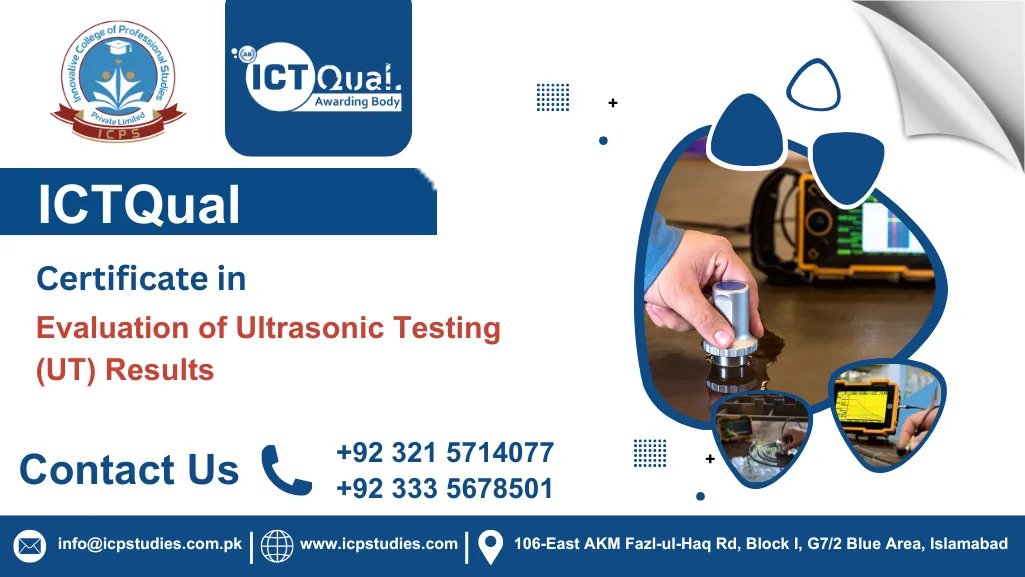
The ICTQual Certificate in Evaluation of Ultrasonic Testing (UT) Results is a specialized training program designed for Non-Destructive Testing (NDT) professionals who want to enhance their ability to interpret and evaluate ultrasonic inspection data accurately. Ultrasonic Testing (UT) is a critical method used across industries such as oil and gas, power generation, manufacturing, and construction to detect internal defects, assess material integrity, and ensure operational safety. Accurate evaluation of UT results is essential for identifying cracks, corrosion, weld defects, and other structural anomalies that could compromise safety or performance.
The ICTQual Certificate in Evaluation of Ultrasonic Testing (UT) Results equips participants with the knowledge and practical skills needed to interpret ultrasonic signals, understand reflection patterns, and apply standardized evaluation procedures. The course emphasizes best practices in data analysis, signal interpretation, and defect sizing, providing learners with the expertise required to make informed inspection decisions.
Through a combination of theoretical instruction and practical examples, participants will gain a deep understanding of UT evaluation principles, reporting standards, and industry compliance requirements. By completing the ICTQual Certificate in Evaluation of Ultrasonic Testing (UT) Results, professionals will strengthen their ability to analyze ultrasonic inspection data, improve defect detection accuracy, and support quality assurance and safety in critical industrial applications.
All About ICTQual Certificate in Evaluation of Ultrasonic Testing (UT) Results
Course Overview
The ICTQual Certificate in Evaluation of Ultrasonic Testing (UT) Results is a focused 3-day training program designed to equip professionals with the skills and knowledge required to accurately interpret and evaluate ultrasonic inspection data. Ultrasonic Testing (UT) is a vital Non-Destructive Testing (NDT) method used across industries such as oil and gas, power generation, manufacturing, and construction to detect internal defects, assess material integrity, and ensure operational safety.
Structured into 9 comprehensive study units, this course covers the full spectrum of UT evaluation, including signal interpretation, defect sizing, reflection analysis, calibration procedures, reporting standards, and practical assessment of real inspection data. Participants will gain a deep understanding of how ultrasonic signals relate to material conditions, enabling precise identification of cracks, corrosion, weld defects, and other structural anomalies.
The ICTQual Certificate in Evaluation of Ultrasonic Testing (UT) Results combines theoretical instruction with practical exercises and real-world case studies, allowing learners to apply evaluation techniques effectively in industrial scenarios. By the end of the program, participants will be able to analyze UT results with confidence, improve defect detection accuracy, and produce high-quality inspection reports.
To enroll in the ICTQual Certificate in Evaluation of Ultrasonic Testing (UT) Results, participants should meet the following criteria to ensure they can fully benefit from the course content:
- Age Requirement:
Participants must be 18 years or older at the time of enrollment. - Educational Background:
A technical diploma, vocational qualification, or degree in engineering, science, or a related technical field is recommended.Candidates with relevant industrial experience may also be considered. - Experience:
Basic knowledge or practical experience in Non-Destructive Testing (NDT) is highly recommended.Familiarity with Ultrasonic Testing (UT) methods, inspection procedures, or other NDT techniques will help participants better understand course material. - English Language Proficiency:
Learners must have a good command of English, both written and spoken.
The ICTQual Certificate in Evaluation of Ultrasonic Testing (UT) Results is designed for professionals involved in Non-Destructive Testing (NDT), inspection, and quality assurance who want to strengthen their expertise in evaluating ultrasonic inspection data. Accurate UT evaluation is critical for detecting defects, assessing material integrity, and ensuring operational safety across industrial applications.
This course is particularly suitable for:
- NDT Technicians and Inspectors working with Ultrasonic Testing (UT) who need to enhance their signal interpretation and defect evaluation skills.
- Quality Control and Quality Assurance Professionals responsible for reviewing inspection results and ensuring compliance with industry standards.
- Maintenance and Reliability Engineers involved in monitoring the condition of critical components in industries such as oil and gas, power generation, manufacturing, and construction.
- Industrial Engineers and Technical Specialists seeking practical knowledge of UT evaluation procedures, reporting standards, and defect sizing.
- Professionals aiming to improve accuracy in defect detection, produce reliable inspection reports, and support industrial safety.
The ICTQual Certificate in Evaluation of Ultrasonic Testing (UT) Results is ideal for individuals looking to advance their career in NDT, enhance their expertise in ultrasonic testing, and contribute to safer, more reliable industrial operations.
Study Units
This qualification, the ICTQual Certificate in Evaluation of Ultrasonic Testing (UT) Results, consists of 9 mandatory units.
- Fundamentals of Ultrasonic Testing
- Ultrasonic Testing Equipment
- Testing Techniques and Procedures
- Signal Processing and Data Analysis
- Flaw Characterization
- Materials and Applications
- Standards and Codes
- Quality Assurance and Control
- Health and Safety
Learning Outcomes
Learning Outcomes for the Study Units:
1. Fundamentals of Ultrasonic Testing
- Understanding Ultrasonic Principles: Grasp the basic concepts of sound waves, including frequency, wavelength, and velocity.
- Wave Propagation Knowledge: Explain how ultrasonic waves travel through different materials and identify types of waves used in testing.
- Basic Skills Application: Apply foundational ultrasonic principles in practical testing scenarios.
2. Ultrasonic Testing Equipment
- Equipment Proficiency: Identify and describe various types of transducers and probes, and their specific applications.
- Instrumentation Mastery: Operate different ultrasonic testing machines, both analog and digital, with proficiency.
- Calibration Skills: Perform accurate calibration of ultrasonic testing equipment to ensure reliable measurements.
3. Testing Techniques and Procedures
- Manual Testing Techniques: Conduct manual ultrasonic tests following standardized procedures.
- Automated Testing Utilization: Use automated ultrasonic testing systems and understand their advantages.
- Flaw Detection Techniques: Apply appropriate techniques for detecting surface and subsurface defects.
4. Signal Processing and Data Analysis
- Display Interpretation: Understand and interpret A-Scan, B-Scan, and C-Scan displays.
- Signal Analysis: Analyze ultrasonic signals to identify and characterize flaws.
- Digital Processing: Utilize digital signal processing techniques to enhance and interpret ultrasonic data.
5. Flaw Characterization
- Defect Identification: Identify and describe common defects such as cracks, inclusions, and porosity.
- Sizing Flaws: Determine the size and orientation of detected flaws using appropriate methods.
- Detection Probability: Assess the probability of detecting various types of flaws in different materials.
6. Materials and Applications
- Material Properties Impact: Understand how different material properties affect ultrasonic testing results.
- Industry-Specific Applications: Apply ultrasonic testing techniques to specific industries such as aerospace, automotive, oil and gas, and construction.
- Case Study Analysis: Analyze real-world case studies to understand practical applications of ultrasonic testing.
7. Standards and Codes
- Standards Familiarity: Identify and apply relevant international standards such as ASNT, ISO, and ASTM.
- Compliance Understanding: Ensure testing procedures comply with industry standards and best practices.
- Documentation Skills: Maintain proper documentation for compliance and traceability.
8. Quality Assurance and Control
- Quality Assurance Principles: Implement quality assurance principles to ensure the accuracy and reliability of UT results.
- Error Mitigation: Identify and mitigate sources of error in ultrasonic testing.
- Audit Proficiency: Conduct internal audits and inspections to maintain high-quality standards.
9. Health and Safety
- Safety Practices Implementation: Follow best practices to ensure the safety of personnel during ultrasonic testing.
- Hazard Identification: Recognize and address potential hazards associated with ultrasonic testing equipment and processes.
- Regulatory Compliance: Comply with relevant health and safety regulations related to ultrasonic testing.
FAQs ICTQual Certificate in Evaluation of Ultrasonic Testing (UT) Results