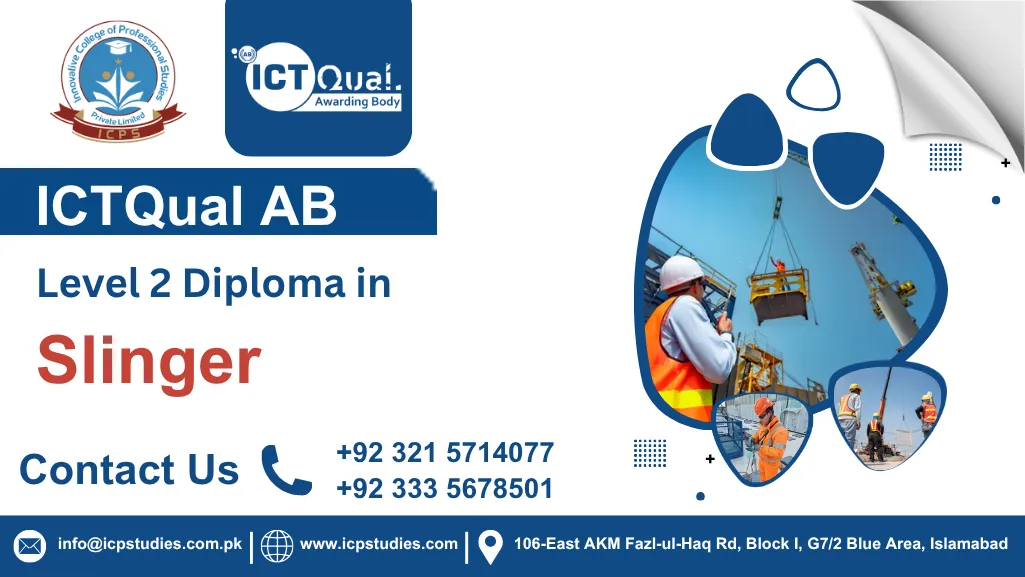
The ICTQual AB Level 2 Diploma in Slinger is a professional training program designed for individuals who want to develop intermediate-level skills in slinging and lifting operations within the construction, engineering, and industrial sectors. This qualification builds on basic knowledge and prepares learners to handle lifting tasks with improved accuracy, safety awareness, and technical competence.
Participants will gain a solid understanding of advanced slinging techniques, load control, and the correct selection, inspection, and safe use of lifting equipment. The course also focuses on essential health and safety principles, including hazard identification, risk assessment, and compliance with industry regulations to ensure safe and efficient lifting operations on-site.
This Level 2 Diploma is ideal for site operatives, junior slingers, and banksmen who already have basic experience and are looking to progress into more skilled rigging and lifting roles. It provides a nationally recognized certification that enhances employability and demonstrates practical competence in workplace lifting operations.
Through a combination of theoretical instruction, guided practical training, and real-world site applications, learners will develop the confidence to support and perform slinging duties effectively. Completing the ICTQual AB Level 2 Diploma in Slinger is a key step toward advanced qualifications and career progression in the lifting and rigging industry.
All About ICTQual AB Level 2 Diploma in Slinger
Course Overview
The ICTQual AB Level 2 Diploma in Slinger is a 20 Credit Hours structured training program designed to develop intermediate-level skills in slinging operations for construction, engineering, and industrial environments. Delivered through six comprehensive study units, the course focuses on strengthening both technical knowledge and practical competence required for safe lifting activities.
The curriculum covers advanced slinging techniques, load estimation, and the correct selection, inspection, and safe use of lifting accessories. Each study unit is designed to enhance accuracy and build confidence in performing slinging tasks under supervision in real workplace conditions.
A strong emphasis is placed on health and safety, including hazard identification, risk assessment procedures, and compliance with relevant industry regulations. Learners also develop effective communication skills to coordinate efficiently with crane operators, riggers, and site personnel during lifting operations.
Through practical, scenario-based training, participants apply their skills in realistic lifting environments to improve decision-making and operational performance. On completion, the ICTQual AB Level 2 Diploma in Slinger provides a nationally recognized qualification that supports career progression in slinging and lifting operations.
To enroll in the ICTQual AB Level 2 Diploma in Slinger, candidates must meet the following entry requirements to ensure they are prepared for this 20 Credit Hours intermediate-level training program:
- Age Requirement:
Applicants must be at least 16 years old. - Educational Background:
A basic education level is required, along with good literacy and numeracy skills to understand training materials, safety instructions, and basic lifting calculations. - Experience:
Candidates should ideally have basic knowledge or prior exposure to construction, rigging, or lifting operations. Completion of a Level 1 Slinger, Banksman, or Rigger qualification (or equivalent experience) is recommended but not mandatory. - English Language Proficiency:
Learners must have a good command of English, both written and spoken.
The ICTQual AB Level 2 Diploma in Slinger is designed for individuals who want to develop intermediate skills in slinging and advance their career in construction, engineering, and industrial lifting operations. This course is suitable for:
- Junior slingers and entry-level riggers looking to build on basic knowledge and gain more practical competence.
- Construction site workers and laborers involved in lifting and load-handling activities.
- Banksmen and lifting assistants who support crane operations and want to enhance their technical skills.
- Individuals with Level 1 qualifications in slinging, rigging, or banksman roles seeking career progression.
- Aspiring lifting professionals aiming to move into more skilled and responsible site-based roles.
By completing this Level 2 Diploma, learners gain improved technical ability, stronger safety awareness, and a nationally recognized qualification that supports progression toward advanced slinging, rigging, and supervisory positions in the lifting industry.
Study Units
This qualification, the ICTQual AB Level 2 Diploma in Slinger, consists of 6 mandatory units.
- Advanced Load Control and Stability Practices (Credits: 6)
- Complex Lift Planning and Risk Mitigation (Credits: 6)
- Supervising Safe Slinging and Rigging Operations (Credits: 6)
- Emergency Response and Crisis Management in Lifting (Credits: 6)
- International Standards and Legal Considerations for Slinging (Credits: 6)
- Documentation and Compliance in Lifting Operations (Credits: 6)
Learning Outcomes:
Here are the learning outcomes for each study unit:
Advanced Load Control and Stability Practices
- Analyse the principles of load distribution and stability in complex lifting operations.
- Apply advanced techniques to control load movement and prevent instability during lifting.
- Evaluate different types of lifting accessories and their impact on load balance and security.
- Identify potential hazards related to load control and implement corrective measures.
Complex Lift Planning and Risk Mitigation
- Develop detailed lift plans that account for load weight, centre of gravity, and environmental conditions.
- Conduct risk assessments to identify and mitigate potential hazards in lifting operations.
- Implement advanced rigging methods to enhance safety and efficiency during complex lifts.
- Coordinate with crane operators and other personnel to ensure seamless execution of lifting plans.
Supervising Safe Slinging and Rigging Operations
- Oversee slinging and rigging activities to ensure compliance with safety protocols and best practices.
- Provide guidance and training to team members on proper lifting techniques and equipment usage.
- Monitor lifting operations and intervene when unsafe practices or potential risks are identified.
- Enforce adherence to site-specific safety regulations and industry standards.
Emergency Response and Crisis Management in Lifting
- Develop and implement emergency response procedures for lifting-related incidents.
- Assess and manage risks associated with equipment failure, load drops, or environmental hazards.
- Coordinate with emergency services and site personnel to ensure a rapid and effective response.
- Conduct post-incident evaluations to improve future emergency preparedness.
International Standards and Legal Considerations for Slinging
- Interpret and apply international lifting standards, including ISO and LOLER regulations.
- Ensure compliance with national and global safety laws governing slinging and lifting operations.
- Evaluate the impact of regulatory changes on lifting procedures and workplace safety.
- Implement standardised practices to meet industry and legal requirements in different regions.
Documentation and Compliance in Lifting Operations
- Maintain accurate records of lifting plans, equipment inspections, and risk assessments.
- Ensure compliance with documentation requirements for regulatory audits and workplace safety.
- Analyse inspection reports and certification records to verify equipment suitability and compliance.
- Develop systematic procedures for record-keeping and reporting in lifting operations.
FAQs ICTQual AB Level 2 Diploma in Slinger