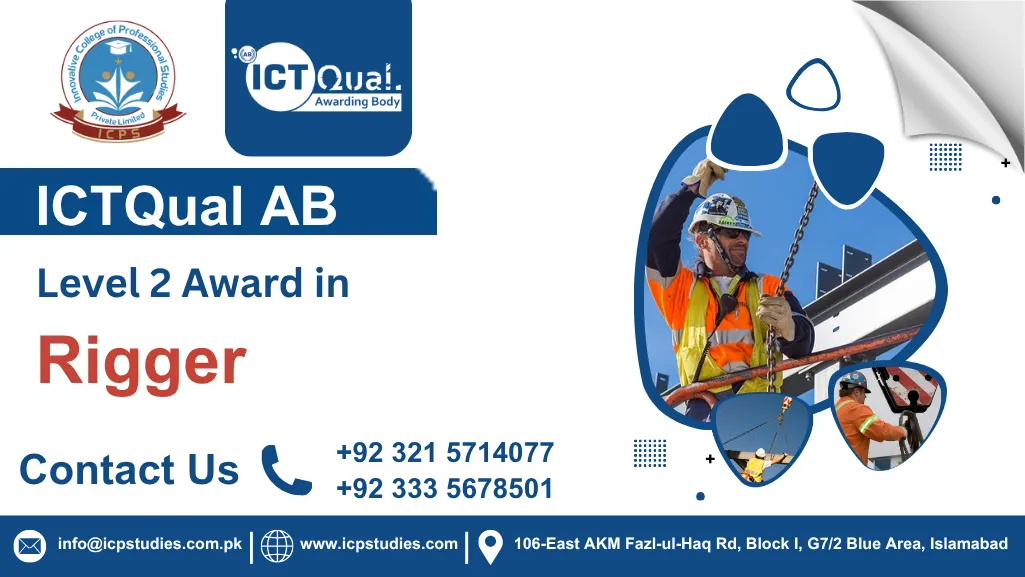
The ICTQual AB Level 2 Award in Rigger is a focused professional training program designed for individuals who want to develop intermediate-level skills in rigging and lifting operations within construction, engineering, and industrial environments. This qualification builds upon basic rigging knowledge and prepares learners to perform rigging tasks with greater confidence, accuracy, and safety awareness.
Participants will gain practical understanding of advanced slinging techniques, load control, and the correct selection, inspection, and safe use of lifting equipment. The course also emphasizes essential health and safety principles, including hazard identification, risk assessment, and compliance with industry regulations to ensure safe and efficient lifting operations on-site.
This Level 2 Award is ideal for site operatives, junior riggers, banksmen, and slingers who already have basic experience and are looking to progress into more skilled rigging responsibilities. It provides a nationally recognized certification that demonstrates competence and enhances employability in construction and industrial sectors.
Through a combination of theoretical learning, guided practical training, and real-world site scenarios, learners will develop the ability to support and carry out rigging operations effectively. Completing the ICTQual AB Level 2 Award in Rigger strengthens professional capability and serves as a key step toward advanced rigging qualifications and career progression in the lifting industry.
All About ICTQual AB Level 2 Award in Rigger
Course Overview
The ICTQual AB Level 2 Award in Rigger is a short, intensive 2-day training program designed to develop intermediate rigging skills for individuals working in construction, engineering, and industrial lifting environments. Delivered over up to 6 hours of structured learning, the course is divided into six focused study units that combine theoretical knowledge with practical application.
The curriculum covers key areas such as advanced slinging techniques, safe load handling, and the correct selection, inspection, and basic maintenance of lifting equipment. Each study unit is structured to improve technical understanding and strengthen the learner’s ability to support rigging operations safely and effectively under supervision.
A strong emphasis is placed on workplace health and safety, including hazard identification, risk assessment procedures, and compliance with industry regulations. Learners also develop essential communication skills to work efficiently with crane operators and site teams, ensuring safe coordination of lifting activities.
Through practical demonstrations and scenario-based learning, participants gain real-world experience in applying rigging principles on-site. On completion, the ICTQual AB Level 2 Award in Rigger provides a recognized qualification that enhances professional competence and supports progression in the rigging and lifting industry.
To enroll in the ICTQual AB Level 2 Award in Rigger, candidates are expected to meet the following entry requirements to ensure they can successfully complete the 2-day, six-unit training program:
- Age Requirement:
Applicants must be at least 18 years old. - Educational Background:
A basic level of literacy and numeracy is required to understand safety instructions, training materials, and complete simple technical assessments. Completion of a Level 1 Award or equivalent training in rigging, banksman, or slinging is recommended. - Experience:
Candidates should ideally have basic on-site experience in construction, lifting operations, or industrial environments, as the course is designed for learners who already understand fundamental rigging concepts and are ready to progress to intermediate-level skills. - English Language Proficiency:
Learners must have a good command of English, both written and spoken.
The ICTQual AB Level 2 Award in Rigger is designed for individuals who want to develop intermediate rigging skills and progress within the construction, engineering, and industrial lifting sectors. This course is suitable for:
- Site operatives and construction workers involved in lifting and rigging activities.
- Junior riggers, slingers, and banksmen looking to upgrade their skills and responsibilities.
- Workers with basic rigging knowledge who want formal recognition of their competence.
- Apprentices or trainees aiming to progress toward higher-level rigging qualifications.
- Individuals seeking improved safety awareness in lifting, load handling, and site operations.
By completing this Level 2 Award, learners gain a nationally recognized qualification that strengthens practical rigging competence, improves employability, and prepares them for more advanced roles in lifting operations and site coordination.
Study Units
This qualification, the ICTQual AB Level 2 Award in Rigger, consists of 6 mandatory units.
- Rigging Hardware and Sling Selection (Credits: 1)
- Load Securing Techniques and Inspection (Credits: 1)
- Basic Calculations for Safe Rigging (Credits: 1)
- Pre-use Inspection of Rigging Equipment (Credits: 1)
- Risk Assessment and Hazard Identification (Credits: 1)
- Lifting Plan Execution and Safety Compliance (Credits: 1)
Learning Outcomes:
Here are the learning outcomes for each study unit:
Rigging Hardware and Sling Selection
- Identify different types of rigging hardware and their applications in lifting operations.
- Select appropriate slings based on load type, weight, and lifting conditions.
- Understand the limitations and load-bearing capacities of various rigging components.
Load Securing Techniques and Inspection
- Apply proper load securing methods to ensure stability during lifting and transportation.
- Recognise potential load shifting hazards and implement preventive measures.
- Conduct visual and functional inspections of load-securing equipment before use.
Basic Calculations for Safe Rigging
- Perform load weight calculations to determine the appropriate rigging setup.
- Calculate sling angles and tension to ensure safe lifting operations.
- Apply basic mathematical principles to assess centre of gravity and load balance.
Pre-use Inspection of Rigging Equipment
- Identify signs of wear, damage, and defects in rigging equipment.
- Follow standard inspection procedures to ensure compliance with safety regulations.
- Understand the importance of regular maintenance and proper storage of rigging gear.
Risk Assessment and Hazard Identification
- Recognise common rigging hazards and assess potential risks before lifting operations.
- Implement control measures to minimise workplace accidents and equipment failures.
- Understand legal and safety requirements for conducting thorough risk assessments.
Lifting Plan Execution and Safety Compliance
- Develop and execute a structured lifting plan for various rigging tasks.
- Ensure compliance with industry regulations and safety protocols during lifting operations.
- Communicate effectively with team members to coordinate safe and efficient rigging activities.
FAQs ICTQual AB Level 2 Award in Rigger