
OTHM Level 5 Diploma in Health and Social Care Management: A Complete Guide for Learners
Introduction
Health and social care management plays a vital role in ensuring that individuals receive safe, effective, respectful and person-centred support. Across the UK, health and social care services require professionals who understand safeguarding, team leadership, communication, professional supervision and continuous improvement. As care services respond to changing individual needs and service expectations, developing management knowledge can be an important step towards professional growth.
The OTHM Level 5 Diploma in Health and Social Care Management is a vocational qualification designed to develop knowledge and understanding relevant to management and professional development within health and social care. It provides a structured learning pathway covering partnership working, safeguarding and protection, health education, team management, professional supervision and research methods.
For Learners who want to strengthen their understanding of health and social care management, this qualification offers an opportunity to explore how effective leadership, appropriate decision-making and collaborative working contribute to quality care. It may be relevant to experienced care workers, team leaders, supervisors and individuals preparing for further study in the sector, subject to the qualification’s entry requirements.
This comprehensive guide explains what the OTHM Level 5 Diploma in Health and Social Care Management involves, who it is designed for, what Learners study, how assessments work and which career and further education pathways may be worth exploring. It also examines the importance of management skills in UK health and social care settings and answers common questions prospective Learners ask before enrolling.

What Is the OTHM Level 5 Diploma in Health and Social Care Management?
The OTHM Level 5 Diploma in Health and Social Care Management is a regulated qualification awarded by OTHM. It is designed to develop knowledge and understanding relevant to managing health and social care services and progressing towards further academic or professional development.
The qualification explores the relationship between effective management and the delivery of appropriate care. Rather than focusing exclusively on individual care tasks, it considers wider responsibilities such as coordinating teams, supporting staff, understanding safeguarding procedures, promoting wellbeing and using research to inform decisions.
According to OTHM’s published qualification information, the diploma has six mandatory units, a total value of 120 credits, 600 Guided Learning Hours and 1,200 hours of Total Qualification Time. The published qualification duration is one year, although actual study arrangements depend on the learning centre.
The qualification is listed under Ofqual qualification reference number 610/1537/4. Learners should consult the official OTHM specification for the current qualification requirements and assessment information.
Key facts about the qualification
| Qualification detail | Information |
|---|---|
| Qualification title | OTHM Level 5 Diploma in Health and Social Care Management |
| Awarding organisation | OTHM |
| Qualification level | Level 5 |
| Ofqual qualification reference | 610/1537/4 |
| Total credits | 120 |
| Guided Learning Hours | 600 |
| Total Qualification Time | 1,200 hours |
| Published duration | One year |
| Number of mandatory units | Six |
| Assessment method | Coursework |
| Overall grading | Pass or Fail |
These details should be checked against the latest published specification before enrolment.
What does Level 5 mean?
Level 5 identifies the academic level of the qualification rather than guaranteeing a particular occupational position. It indicates the level at which the relevant knowledge, understanding and skills are assessed.
The qualification can support professional development and provide a foundation for further study. However, completing a Level 5 diploma does not automatically make a Learner eligible for a registered manager position, professional registration or admission to a particular university programme.
Employers and universities may apply additional requirements relating to experience, previous qualifications, competence and admissions criteria.
Why Is Health and Social Care Management Important in the UK?
Health and social care management involves organising people, processes and resources to support safe, effective and person-centred services. It includes communication, team coordination, staff development, safeguarding, quality assurance and the management of responsibilities within a care setting.
In England, the Care Quality Commission (CQC) regulates relevant health and social care services and assesses whether providers meet applicable requirements. Its fundamental standards address important areas including person-centred care, dignity and respect, consent, safety and safeguarding.
Effective management helps translate these expectations into everyday working practices. Policies and procedures alone are not sufficient; staff need appropriate guidance, clear responsibilities, suitable training and systems for identifying and responding to concerns.
The importance of health and social care management can be seen in several areas.
Promoting person-centred care
Person-centred care recognises that every individual has their own needs, preferences, values and goals. Effective services involve people in decisions about their care and respect their dignity, independence and rights.
Managers can contribute by ensuring that staff understand care plans, communicate respectfully, record relevant information and raise concerns when support does not meet an individual’s needs.
Maintaining safeguarding standards
Safeguarding involves protecting people from abuse, neglect, exploitation and other forms of harm. Managers and supervisors need to understand relevant responsibilities, reporting arrangements and organisational procedures.
Appropriate safeguarding practices help staff recognise concerns, record information accurately and escalate issues to the correct people or authorities.
Supporting staff and teams
Care quality depends partly on the knowledge, communication and performance of the workforce. Effective managers help clarify responsibilities, identify learning needs, encourage professional behaviour and support staff development.
Good team management can also improve coordination between colleagues and help reduce avoidable misunderstandings.
Encouraging continuous improvement
Health and social care services should review their performance, consider feedback and learn from incidents and complaints. Management knowledge can help professionals identify recurring problems, investigate possible causes and contribute to practical improvements.
Regulatory requirements differ across England, Scotland, Wales and Northern Ireland. Learners should therefore understand which regulatory arrangements apply to their workplace or intended career.
What Will You Learn on the OTHM Level 5 Diploma?
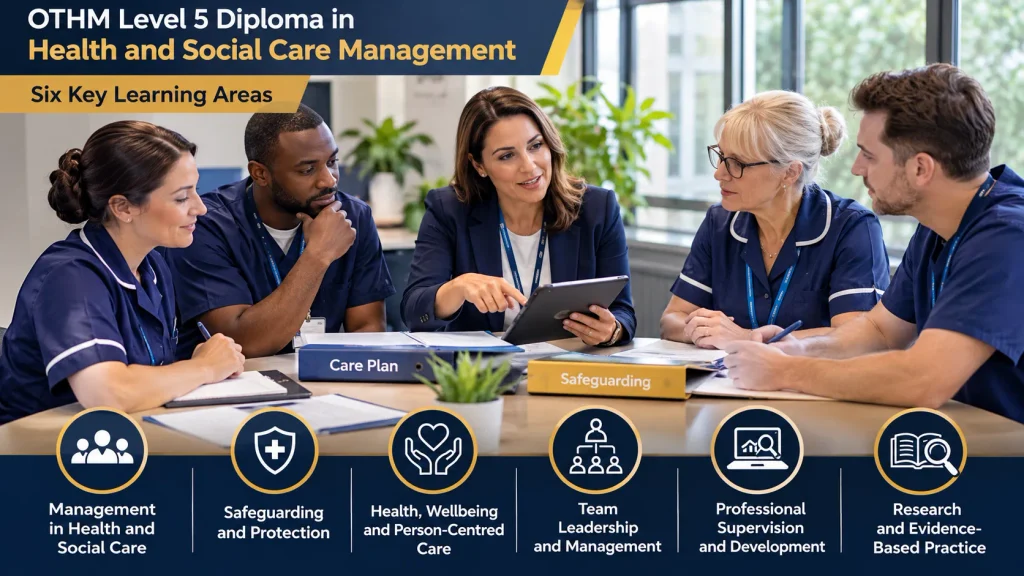
The OTHM Level 5 Diploma in Health and Social Care Management consists of six mandatory units. Each unit carries 20 credits, providing a broad foundation in management-related knowledge and professional practice.
1. Working in Partnership in Health and Social Care
Partnership working involves collaboration between individuals, care providers, families and relevant professionals. Coordinated working can help ensure that support reflects an individual’s needs and that responsibilities are understood.
Learners explore the value of communication, collaboration and shared decision-making in health and social care environments.
Key areas include:
- Understanding the purpose of partnership working.
- Recognising the roles of professionals and organisations.
- Identifying barriers to effective communication.
- Understanding the importance of coordinated support.
- Considering confidentiality, consent and appropriate information sharing.
For example, an individual receiving support at home may require input from care workers, healthcare professionals and family members. Effective communication can help those involved understand the individual’s preferences and coordinate appropriate support.
2. Managing the Safeguarding and Protection of Vulnerable Individuals
Safeguarding is a fundamental responsibility in health and social care. People receiving support may be at risk of abuse, neglect, exploitation or other forms of harm, making appropriate protection procedures essential.
This unit explores safeguarding responsibilities and the management of protective measures.
Learners consider how to recognise potential concerns, follow reporting procedures, maintain accurate records and understand the importance of timely action.
Important areas include:
- Recognising potential indicators of abuse and neglect.
- Understanding safeguarding responsibilities.
- Following organisational reporting and escalation procedures.
- Considering risk assessment and protective measures.
- Promoting dignity, rights and individual safety.
For example, if a staff member reports a concern about possible neglect, a manager needs to follow the appropriate safeguarding procedures, record information accurately and ensure that immediate risks are addressed.
The qualification develops safeguarding-related knowledge but does not replace workplace-specific safeguarding training or the responsibilities attached to a particular role.
3. Health Education and Promoting Wellbeing
Health education and wellbeing involve helping people understand factors that influence their health and supporting informed choices wherever possible.
Wellbeing may include physical, emotional and social aspects of life. Support should reflect the individual’s circumstances, abilities, preferences and care requirements.
Learners explore areas such as:
- Understanding health education and health promotion.
- Recognising factors that influence wellbeing.
- Communicating health information appropriately.
- Supporting informed choices and positive health behaviours.
- Understanding how care services can contribute to individual wellbeing.
For example, a care team may support an individual with information about hydration, nutrition, physical activity or social engagement. Advice and support should be appropriate to the person’s needs and consistent with their care plan and relevant professional guidance.
4. Team Management in Health and Social Care
Effective team management helps care services coordinate activities, clarify responsibilities and maintain appropriate standards of practice.
This unit explores how teams function and how managers can support communication, cooperation and performance.
Learners develop an understanding of:
- Team roles and responsibilities.
- Effective communication and teamwork.
- Staff performance and development.
- Constructive approaches to workplace challenges.
- Accountability and shared responsibility.
- Positive and inclusive workplace cultures.
Consider a care setting experiencing repeated communication problems during staff handovers. A manager may need to review the existing process, clarify what information should be shared, reinforce confidentiality requirements and encourage staff to report concerns promptly.
These management principles can be relevant to residential care, domiciliary care, supported living and other appropriate health and social care environments.
5. Professional Supervision Practice in Health and Social Care
Professional supervision gives staff an opportunity to discuss their work, reflect on practice, identify development needs and receive guidance.
Supervision can also help managers identify training requirements, address concerns, reinforce professional expectations and support staff wellbeing.
This unit explores the role of supervision in maintaining professional practice and supporting continuous improvement.
Key areas include:
- Understanding the purpose of professional supervision.
- Preparing for structured supervision discussions.
- Providing constructive feedback.
- Identifying learning and development needs.
- Encouraging reflective practice.
- Recording agreed actions and reviewing progress.
For example, a supervisor may use a meeting to discuss a care worker’s difficulty managing a challenging situation. The discussion can identify relevant training, clarify expectations and agree on practical actions for improving future practice.
Professional supervision should be more than an administrative exercise. When used appropriately, it can support learning, accountability and a stronger culture of continuous development.
6. Research Methods in Health and Social Care
Research methods help Learners understand how information can be collected, evaluated and used to investigate questions relevant to health and social care.
Evidence-informed decision-making is important because management decisions should not rely solely on assumptions or anecdotal experience. Appropriate research can help services understand recurring issues, assess possible improvements and identify areas requiring further investigation.
This unit explores areas such as:
- Identifying a suitable research question.
- Developing research aims and objectives.
- Reviewing relevant literature and existing evidence.
- Considering appropriate information collection methods.
- Recognising ethical issues and data protection responsibilities.
- Analysing findings and presenting conclusions.
For example, a Learner might investigate whether changes to staff handover procedures could improve communication in a care setting. The work could involve reviewing relevant literature, collecting appropriate information with the necessary permissions and evaluating the findings.
Research should be conducted ethically, with appropriate attention to consent, confidentiality, data protection and any required organisational approvals.
Who Is the OTHM Level 5 Diploma in Health and Social Care Management For?
The qualification may be suitable for Learners who want to develop their knowledge of care leadership, team management, safeguarding and professional practice.
It can be relevant to people already working in health and social care as well as eligible applicants who are preparing for further study or seeking to develop management-related knowledge.
Potential intended Learners include:
- Care assistants who want to understand how care services are managed.
- Senior care workers seeking to strengthen their leadership skills.
- Team leaders responsible for coordinating staff and daily activities.
- Care supervisors who want to develop their understanding of professional supervision.
- Assistant managers working in residential or domiciliary care.
- Professionals involved in safeguarding, partnership working or quality improvement.
- Individuals seeking a structured academic pathway in health and social care management.
- Eligible Learners planning further study at a higher qualification level.
The qualification’s suitability depends on the Learner’s educational background, experience, career objectives and ability to meet the entry requirements.
Is the diploma suitable for beginners?
Not every beginner will automatically meet the entry requirements. OTHM identifies relevant Level 4 qualifications, GCE Advanced Level qualifications in three subjects or equivalent qualifications among typical entry routes. Its published information also describes an entry route for eligible mature Learners with relevant management experience.
Prospective Learners should confirm their eligibility with the approved learning centre before applying.
OTHM Level 5 Diploma Entry Requirements
Understanding the entry requirements is an important step before enrolling. Applicants should review the current qualification specification and ask the learning centre what evidence is required for their application.
Educational background
Typical entry routes include:
- A relevant Level 4 Diploma or equivalent qualification.
- GCE Advanced Level qualifications in three subjects or equivalent qualifications.
- An applicable mature-entry route for eligible applicants with relevant management experience.
The centre should assess whether the applicant’s previous qualifications meet the applicable requirements.
Age requirements
The published OTHM specification describes the qualification as suitable for Learners typically aged 18 and above. It also identifies a mature-entry route for eligible Learners over 21 with relevant management experience, subject to centre confirmation.
Applicants should check the current specification and the centre’s admission procedures.
English language proficiency
Learners need sufficient English language ability to understand course materials, interpret assignment instructions, research relevant information and present written work clearly.
Applicants who are not from a majority English-speaking country should check the awarding organisation’s applicable English language requirements and the evidence accepted by their centre.
Relevant work experience
Previous experience may help Learners connect academic concepts with workplace situations. However, relevant work experience should not be treated as a universal requirement for every applicant unless the applicable entry route specifies it.
Applicants should provide accurate information about their qualifications and experience so that the centre can assess eligibility appropriately.

How Is the OTHM Level 5 Diploma Assessed?
The OTHM Level 5 Diploma in Health and Social Care Management is assessed through coursework. The published specification explains that the units are internally assessed and quality-assured by the centre, with external verification by OTHM.
Learners must demonstrate achievement against the learning outcomes and assessment criteria for each unit. The exact tasks and evidence requirements are provided in the applicable assignment briefs.
What does coursework assessment involve?
Depending on the unit and assignment brief, Learners may need to explain concepts, analyse situations, evaluate approaches or apply knowledge to health and social care scenarios.
Assessment tasks may require Learners to demonstrate their ability to:
- Explain relevant health and social care management principles.
- Apply safeguarding knowledge to appropriate scenarios.
- Analyse partnership working and communication.
- Evaluate team management or supervision practices.
- Explore a research question using suitable methods.
- Present evidence-based conclusions in a structured format.
The precise requirements must be checked against the assessment criteria for each unit.
Tips for completing assessments successfully
- Read the assignment brief carefully before starting.
- Identify each learning outcome and assessment criterion.
- Research the subject using credible sources.
- Use appropriate examples to explain how concepts apply in practice.
- Structure the assignment with clear headings and logical paragraphs.
- Reference sources consistently and acknowledge other people’s work.
- Check that the submitted work addresses every assessment criterion.
- Use tutor feedback to identify areas for improvement.
Completing an assignment does not automatically guarantee a pass. Learners must provide appropriate evidence that demonstrates the required knowledge and understanding.

Key Benefits of the OTHM Level 5 Diploma in Health and Social Care Management
Choosing a qualification is an important decision. Learners should consider whether the programme aligns with their career objectives, existing responsibilities and future learning plans.
Developing management knowledge
The qualification covers six interconnected areas, helping Learners understand how partnership working, safeguarding, wellbeing, supervision and research relate to the management of care services.
This broader perspective can help Learners understand the responsibilities that extend beyond direct care tasks.
Strengthening leadership and teamwork knowledge
Team management and professional supervision are important parts of the programme. These areas help Learners explore how managers communicate expectations, support colleagues, address challenges and encourage reflective practice.
Improving understanding of safeguarding
Safeguarding knowledge is relevant to professionals who contribute to protecting people from abuse, neglect and harm. The programme provides an opportunity to examine safeguarding responsibilities from a management perspective.
Building evidence-informed decision-making skills
Research methods help Learners develop a more systematic approach to investigating problems and evaluating information.
This knowledge may be useful when reviewing workplace procedures, identifying recurring issues or considering possible service improvements.
Supporting professional development
The programme provides structured learning in areas relevant to leadership, teamwork, communication and staff development. Learners may be able to apply this knowledge to their current responsibilities or use it as part of a wider professional development plan.
Exploring further academic opportunities
Successful completion may support applications for further study, including the OTHM Level 6 Diploma in Health and Social Care Management, subject to the relevant progression requirements.
University admission and credit transfer depend on the receiving institution’s policies and the Learner’s individual circumstances.
These benefits describe potential learning outcomes. The qualification does not guarantee employment, promotion, higher earnings or admission to a particular academic programme.
Career Opportunities After the OTHM Level 5 Diploma
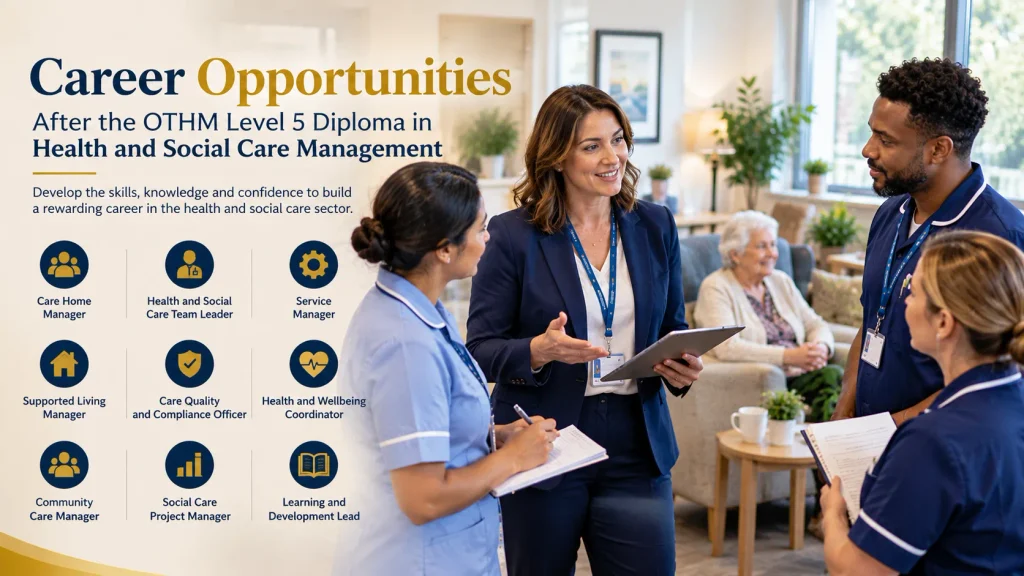
A common question prospective Learners ask is what they could do after completing the OTHM Level 5 Diploma in Health and Social Care Management.
The qualification is designed to support management-related career development or further study. However, actual job opportunities depend on previous experience, employer requirements, relevant competence and any regulatory conditions attached to the role.
Senior Care Worker
A senior care worker may support frontline colleagues, coordinate care activities and contribute to maintaining appropriate standards of practice.
Relevant experience, communication skills and an understanding of individual care needs can be important for these responsibilities.
Health and Social Care Team Leader
Team leaders help coordinate daily activities, support colleagues and promote clear communication. Management knowledge may be useful when developing towards these responsibilities.
Care Supervisor
Care supervisors may monitor aspects of service delivery, support staff and help ensure that agreed procedures are followed. Employers may require relevant experience and additional training.
Assistant Care Manager
Depending on the employer and setting, an assistant care manager may support staffing, supervision, documentation, service coordination and quality improvement.
The diploma may contribute to professional development, but employers determine the qualifications and experience needed for each appointment.
Residential Care Management Pathway
Learners interested in residential care management may use the qualification as part of their wider professional development. Registered management roles can involve additional requirements relating to experience, competence and registration.
Community Care Coordination
Community-based roles may involve coordinating support, communicating with service users and professionals, and helping ensure that care arrangements reflect individual needs.
These are potential career directions rather than guaranteed destinations. Learners should research actual job descriptions and identify any additional qualifications or experience needed for their preferred role.
What skills do health and social care employers value?
Health and social care employers may value communication, person-centred practice, safeguarding awareness, teamwork, leadership, problem-solving and the ability to support staff development.
The Skills for Care Leadership Qualities Framework provides guidance on effective leadership across adult social care, including person-centred practice, equality, inclusion and professional development.
Learners should consider how their qualification, practical experience and ongoing development can work together to support their longer-term career goals.

Further Study and Progression After the OTHM Level 5 Diploma
Learners who want to continue their academic development may explore higher-level qualifications or investigate university progression opportunities.
Progression to the OTHM Level 6 Diploma
The OTHM Level 6 Diploma in Health and Social Care Management is a potential progression option after successful completion of the Level 5 Diploma, subject to the current entry requirements.
This route may suit Learners who want to develop their knowledge further and explore more advanced study in health and social care management.
Before enrolling, Learners should review the Level 6 specification, confirm eligibility and understand the study commitments and assessment expectations.
Exploring university progression
OTHM’s published specification describes potential academic progression opportunities, including consideration for advanced entry to certain UK bachelor’s degree programmes.
However, academic level comparability does not mean that every university will accept the qualification for direct entry into a particular year of study.
Learners should contact their intended university to confirm:
- Whether the specific qualification is accepted.
- Whether the intended degree subject is compatible with their previous study.
- What grades, credits or supporting evidence are required.
- Whether direct entry or credit transfer is available.
- Whether additional conditions apply to their circumstances.
No particular university admission outcome should be assumed without confirmation from the receiving institution.
Planning your professional development
The right progression route depends on whether a Learner wants to develop within employment, pursue further academic study or combine both approaches.
A useful plan should consider current experience, desired responsibilities, qualification requirements and the competencies needed for the intended role.
Health and Social Care Management in Practice
Understanding how a qualification relates to realistic workplace situations helps Learners appreciate its potential practical value.
Consider a domiciliary care service experiencing repeated complaints about late visits and inconsistent communication. A manager needs to understand the underlying issues rather than simply instruct staff to work faster.
A structured approach could involve the following steps:
- Review complaints and relevant records to identify recurring problems.
- Speak with appropriate staff and understand the circumstances affecting visit schedules.
- Consider the effect of delays on the people receiving support.
- Review communication arrangements and the allocation of responsibilities.
- Identify suitable changes and provide guidance to the team.
- Monitor whether the changes improve service delivery.
- Record findings and use feedback to inform further improvements.
This example connects several themes within the OTHM Level 5 Diploma, including partnership working, team management, professional supervision, wellbeing and research methods.
In practice, decisions must be based on individual needs, applicable legislation, organisational policies and the responsibilities of the people involved. Safeguarding concerns and immediate risks must be addressed through the appropriate procedures rather than treated as ordinary performance issues.
Developing reflective practice
Reflective practice involves examining experiences, decisions and outcomes to identify what worked well and what could be improved.
A Learner might reflect on a team meeting that failed to resolve a communication problem. They could consider whether responsibilities were clear, whether everyone had an opportunity to contribute and whether the agreed actions were specific enough.
This process encourages professional learning and can support more considered management decisions.
Understanding the connection between management and care quality
Management decisions can affect staffing arrangements, staff development, communication, record keeping and the way concerns are handled.
Good management does not mean that every problem can be eliminated. It means establishing appropriate systems, listening to feedback, responding to risks and learning from mistakes.
For Learners who want to progress in health and social care, understanding this relationship can provide a useful foundation for future responsibilities.

How to Choose the Right OTHM Learning Centre
Selecting an appropriate learning centre is an important part of the enrolment process. Learners should confirm that the provider is authorised to deliver the specific qualification and can explain the course requirements clearly.
Check centre approval
Confirm the centre’s approval status and ensure that its course information matches the official qualification title and current specification.
Review academic and assessment support
Ask how the centre supports Learners with assignment briefs, academic writing, referencing, feedback and assessment planning.
Understand the study arrangements
Clarify the available delivery mode, expected timetable, access to learning resources, tutor support and arrangements for submitting coursework.
Confirm fees and enrolment conditions
Request a clear explanation of tuition fees, registration charges, payment terms, additional costs and the documentation required before registration.
A suitable centre should provide accurate information without promising guaranteed passes, jobs or university admission.
Frequently Asked Questions About the OTHM Level 5 Diploma in Health and Social Care Management
What is the OTHM Level 5 Diploma in Health and Social Care Management?
It is a regulated Level 5 qualification designed to develop knowledge relevant to management and professional development in health and social care. It contains six mandatory units covering partnership working, safeguarding, wellbeing, team management, professional supervision and research methods.
How many units are included in the qualification?
The qualification contains six mandatory units, each worth 20 credits, giving a total of 120 credits. Learners must complete all six units to achieve the qualification.
How long does it take to complete the OTHM Level 5 Diploma?
The published duration is one year, with 600 Guided Learning Hours and 1,200 hours of Total Qualification Time. Actual delivery arrangements and study schedules depend on the approved learning centre.
What are the entry requirements?
Typical entry routes include a relevant Level 4 Diploma or equivalent, GCE Advanced Level qualifications in three subjects or equivalent, and an entry route for eligible mature Learners with relevant management experience. Applicants should confirm their individual eligibility with the centre.
Is the OTHM Level 5 Diploma assessed through examinations?
The published qualification specification identifies coursework as the assessment method. Learners must demonstrate achievement against the learning outcomes and assessment criteria for each unit.
What jobs can I pursue after completing the diploma?
Potential career directions include senior care worker, team leader, care supervisor and assistant care manager roles, depending on previous experience and employer requirements. The qualification does not guarantee employment or promotion.
Can I progress to a Level 6 qualification?
The OTHM Level 6 Diploma in Health and Social Care Management is a potential progression route. Learners should check the current Level 6 specification and entry requirements before applying.
Is the OTHM Level 5 Diploma recognised in the UK?
The published qualification information identifies it as regulated by Ofqual under reference number 610/1537/4. Qualification regulation should be distinguished from professional registration, employer acceptance and university admission, which may involve separate requirements.
Can I study the OTHM Level 5 Diploma online?
Online and distance-learning delivery may be available through approved centres. Availability, study schedules and tutor support vary by provider, so confirm the delivery arrangements before enrolling.
Is work experience compulsory?
The published entry profile includes several routes, so relevant work experience is not stated as a universal requirement for every applicant. However, the mature-entry route specifically refers to relevant management experience, which should be confirmed with the centre.
Does the diploma guarantee promotion or a higher salary?
No. The qualification may support learning and professional development, but promotion and salary outcomes depend on experience, responsibilities, employer requirements, vacancies and individual performance.
Does the diploma qualify me to become a registered care manager?
Not automatically. Registered management roles may require relevant experience, suitable qualifications, competence and compliance with the requirements applicable to the service and jurisdiction.
Conclusion: Is the OTHM Level 5 Diploma in Health and Social Care Management Right for You?
The OTHM Level 5 Diploma in Health and Social Care Management provides a structured opportunity to develop knowledge across six important areas: partnership working, safeguarding, health education and wellbeing, team management, professional supervision and research methods.
For Learners who want to strengthen their understanding of health and social care management, explore supervisory responsibilities or prepare for further study, the qualification may be a valuable part of their professional development plan.
The best choice depends on your existing qualifications, experience and long-term objectives. Before applying, review the official qualification specification, confirm your eligibility and consider how the programme aligns with your intended career or academic pathway.