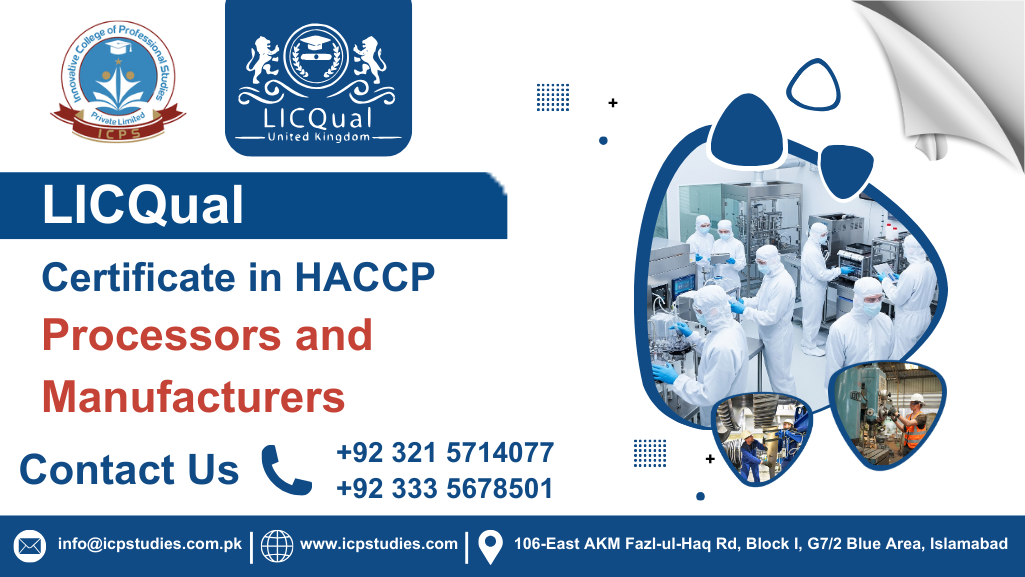
Achieve Excellence: LICQual HACCP Training for Processors & Manufacturers
LICQual Certificate in HACCP for Processors and Manufacturers is a specialized training program designed to equip learners with the essential knowledge and skills required to manage food safety hazards in processing and manufacturing environments. The course focuses on Hazard Analysis and Critical Control Points (HACCP) principles, ensuring participants can identify, monitor, and control risks effectively. With practical applications tailored to industrial operations, it prepares learners to uphold high standards of hygiene and compliance across food production facilities.
This program is suitable for professionals working in food processing plants, manufacturing units, and related industries who want to strengthen their expertise in food safety. Learners gain valuable insights into contamination prevention, safe handling practices, monitoring procedures, and documentation. In addition to this certificate, individuals may also pursue further certifications and diplomas such as the Diploma in Food Safety Management or the Certificate in Food Hygiene to broaden their career opportunities and enhance their professional credibility.
LICQual Certificate in HACCP for Processors and Manufacturers provides learners with practical skills that can be applied immediately in real-world industrial settings. The course highlights the importance of risk assessment, compliance with international food safety guidelines, and effective documentation. By completing this certification, participants demonstrate their commitment to food safety excellence, making them valuable assets to employers across the food processing and manufacturing sectors.
All About LICQual Certificate in HACCP for Processors and Manufacturers
Course Overview
The LICQual Certificate in HACCP for Processors and Manufacturers is designed to provide learners with essential knowledge of food safety management. The program focuses on Hazard Analysis and Critical Control Points (HACCP) principles, ensuring participants can identify, monitor, and control hazards effectively in food processing and manufacturing environments.
This training spans 30 hours of guided learning, offering a balanced mix of theory and practical applications. The structured format makes it accessible for professionals working in food production facilities, manufacturing plants, and related industries who require advanced expertise in food safety and hygiene practices.
The course is divided into 10 units, each addressing a critical aspect of HACCP implementation. Topics include contamination risks, safe handling procedures, monitoring systems, and documentation. Learners gain step‑by‑step knowledge that builds confidence in applying HACCP principles effectively within industrial operations to ensure compliance and consumer protection.
By completing the LICQual Certificate in HACCP for Processors and Manufacturers, participants demonstrate their commitment to food safety excellence. The certification enhances professional credibility, equipping learners with practical skills to safeguard food quality, protect consumers, and contribute to the overall success of food processing and manufacturing businesses.
Entry Requirements
To enroll in the LICQual Certificate in HACCP for Processors and Manufacturers, learners are expected to meet the following criteria:
- Age Requirement: Applicants must be at least 18 years old to ensure maturity and readiness for professional training.
- Educational Background: A basic secondary education is recommended. Holding a related qualification such as a Diploma in Food Safety Management or a Certificate in Food Hygiene will provide a strong foundation for understanding the course content.
- Language Proficiency: Learners should have a good command of English to follow course materials, participate in discussions, and complete assessments effectively.
- Work Experience: Prior experience in food processing, manufacturing, catering, or hospitality is beneficial but not mandatory.
This course is designed to be accessible while maintaining professional standards. Meeting these entry requirements ensures participants can fully benefit from the training and confidently apply HACCP principles to manage food safety risks in processing and manufacturing environments.
Ideal Learner
The ideal learner for the LICQual Certificate in HACCP for Processors and Manufacturers is someone motivated to strengthen their food safety expertise and apply HACCP principles effectively in industrial environments.
- Professionals working in food processing plants, manufacturing units, or large‑scale production facilities.
- Supervisors and managers responsible for ensuring compliance with food safety standards.
- Quality assurance officers seeking to improve monitoring and documentation practices.
- Learners with prior certifications such as a Certificate in Food Hygiene or a Diploma in Food Safety Management.
- Employees aiming to enhance career prospects in food safety and manufacturing industries.
- Individuals committed to preventing contamination and protecting consumer health.
- Those with strong analytical and organizational skills for risk assessment and hazard control.
This course is best suited for learners who want to gain practical skills, demonstrate their commitment to food safety excellence, and become valuable assets in food processing and manufacturing sectors where HACCP compliance is critical.
Study Units
- Introduction to HACCP and Food Safety Management Systems
- Identifying and Assessing Food Safety Hazards in Processing and Manufacturing
- Critical Control Points (CCPs) and Monitoring Procedures
- Establishing Corrective Actions and Preventive Measures in HACCP
- HACCP Documentation, Record Keeping, and Traceability
- HACCP Audits, Verification, and Continuous Improvement
Learning Outcomes
Introduction to HACCP and Food Safety Management Systems
- Demonstrate a clear understanding of HACCP principles and their role in food safety management systems.
- Explain how HACCP integrates with food safety management systems to prevent food safety hazards in the processing and manufacturing sectors.
- Articulate the objectives and benefits of implementing a HACCP system in food production environments.
Identifying and Assessing Food Safety Hazards in Processing and Manufacturing
- Identify biological, chemical, and physical food safety hazards at various stages of the food processing and manufacturing process.
- Conduct a thorough hazard analysis to assess risks in food production environments.
- Apply appropriate hazard identification techniques to evaluate the potential impact of food safety hazards on product quality and consumer health.
Critical Control Points (CCPs) and Monitoring Procedures
- Identify Critical Control Points (CCPs) in food production and processing systems and explain their importance in preventing contamination.
- Develop and implement effective monitoring procedures to ensure that CCPs are properly controlled.
- Establish critical limits for CCPs and ensure the system’s ability to control food safety hazards in line with HACCP guidelines.
Establishing Corrective Actions and Preventive Measures in HACCP
- Design and implement corrective actions when deviations occur at identified CCPs to maintain food safety.
- Develop preventive measures to minimize or eliminate the risk of food safety hazards during the production process.
- Understand the importance of proactive measures in HACCP to ensure consistent food safety and high-quality standards.
HACCP Documentation, Record Keeping, and Traceability
- Establish accurate documentation and record-keeping practices to ensure compliance with HACCP guidelines.
- Demonstrate the importance of traceability in food production to enhance product accountability and transparency.
- Develop and maintain detailed records for all HACCP activities, including hazard assessments, monitoring results, and corrective actions.
HACCP Audits, Verification, and Continuous Improvement
- Conduct internal HACCP audits to evaluate the effectiveness of food safety management systems.
- Implement verification procedures to confirm that HACCP plans are functioning properly and meeting regulatory requirements.
- Develop and apply continuous improvement strategies to enhance HACCP systems, address emerging risks, and adapt to changing food safety regulations.
FAQs About LICQual Certificate in HACCP for Processors and Manufacturers