
Environmental Education and Workplace Training: How to Build Staff Awareness
Environmental education and workplace training play an important role in helping organisations develop responsible, sustainable and environmentally conscious working practices. Employees make everyday decisions that influence energy consumption, water usage, waste generation, resource efficiency and pollution prevention. Without appropriate knowledge and guidance, even well-designed environmental policies may fail to achieve their intended objectives.
Environmental awareness training helps employees understand how their activities affect the natural environment and what practical steps they can take to reduce negative impacts. Through structured workplace sustainability training, organisations can improve environmental competence, encourage responsible behaviour and strengthen employee participation in environmental management initiatives.
This guide explains how organisations can design effective environmental training programmes, develop staff awareness, measure training effectiveness and establish a workplace culture that supports continuous environmental improvement.
What is Environmental Education and Workplace Training?
Environmental education is the process of developing knowledge, understanding, skills and attitudes that help individuals recognise environmental challenges and make informed decisions about environmental protection. In the workplace, it focuses on helping employees understand the environmental consequences of organisational activities and adopt responsible working practices.
Workplace environmental training translates this knowledge into practical actions. It explains how employees can reduce waste, conserve resources, prevent pollution, identify environmental risks and follow relevant organisational procedures.
Environmental education and workplace training are closely connected, but they serve slightly different purposes.
Environmental education develops broader understanding of environmental issues, including climate change, biodiversity, resource depletion, pollution and sustainable development. Workplace training focuses on applying this understanding to specific activities, operational processes and professional responsibilities.
For example, an employee may understand that excessive energy consumption contributes to environmental impacts. However, workplace training explains how to operate equipment efficiently, identify unnecessary energy use and follow the organisation’s energy conservation procedures.
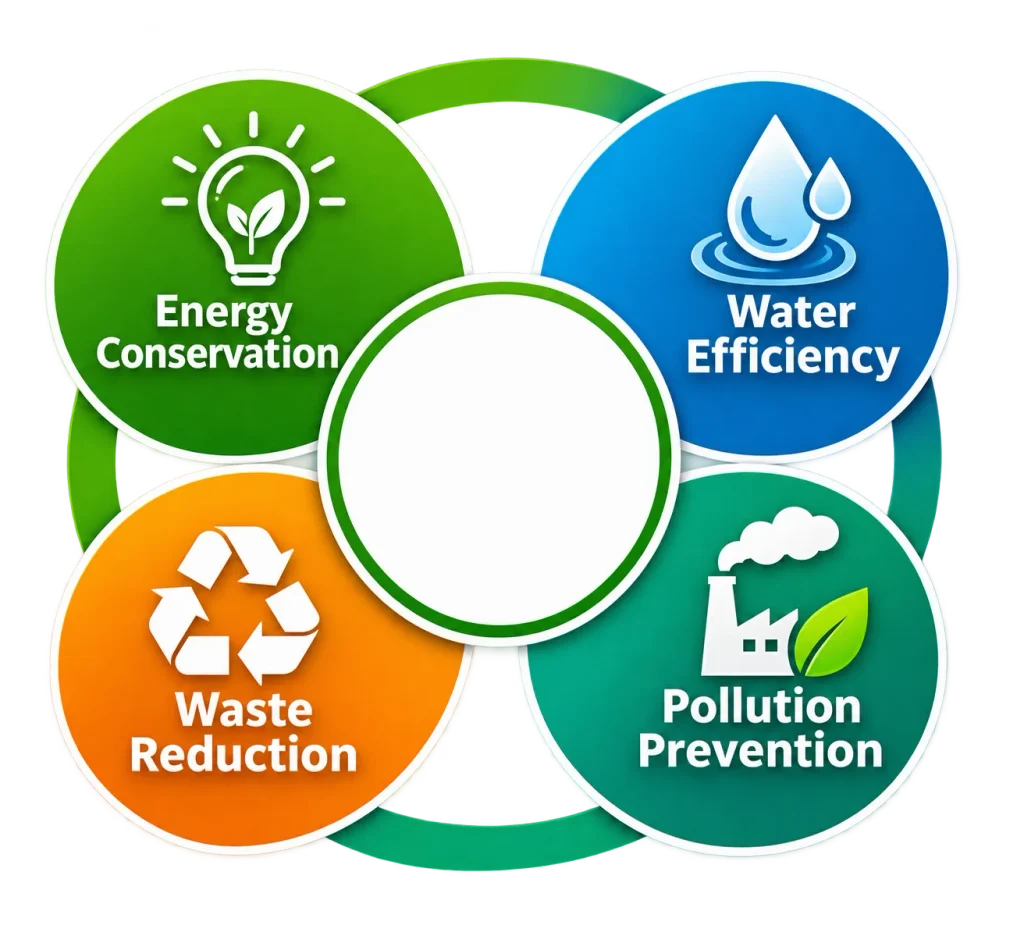
Why Environmental Awareness Matters in Modern Organisations
Environmental awareness helps employees recognise that environmental responsibility is not limited to senior management or dedicated sustainability teams. Every department can influence environmental performance.
In manufacturing, employees can improve material utilisation, identify production waste and follow procedures for handling potentially polluting substances. In offices, staff can reduce unnecessary printing, manage electronic waste and conserve electricity. In construction, workers can support responsible material storage, waste segregation and pollution prevention.
Environmental awareness can support organisations in several ways:
- Improved resource efficiency: Employees learn how to reduce unnecessary consumption of electricity, water, fuel and raw materials.
- Better waste management: Staff understand waste segregation, reuse, recycling and responsible disposal procedures.
- Pollution prevention: Employees become more aware of activities that could cause air, water or soil pollution.
- Environmental risk reduction: Workers learn to identify environmental hazards and report incidents or unsafe practices.
- Stronger organisational participation: Employees can contribute suggestions and participate in environmental improvement initiatives.
- Sustainability performance: Better-informed employees can help organisations implement environmental objectives and monitor progress.
However, awareness alone does not guarantee improved environmental performance. Organisations must also provide appropriate equipment, clear procedures, management support and opportunities for employees to apply what they learn.
Why Do Organisations Need Workplace Sustainability Training?
Workplace sustainability training helps employees understand how environmental responsibilities relate to their daily activities and wider organisational objectives. Although businesses may introduce environmental policies, recycling systems, energy-saving targets and resource management procedures, their effectiveness depends partly on employees understanding and applying the relevant practices.
Building Environmental Responsibility Across Departments
Different departments influence environmental performance in different ways. Training should explain individual responsibilities and help employees recognise how their work contributes to organisational sustainability.
Examples of departmental environmental responsibilities include:
- Procurement Teams: Making responsible purchasing decisions and selecting materials with lower environmental impacts.
- Facilities Teams: Monitoring energy and water consumption and supporting efficient resource management.
- Production Employees: Improving material efficiency, reducing waste and following pollution prevention procedures.
- Transport Teams: Supporting fuel efficiency and reducing unnecessary transport-related emissions.
Supporting Environmental Management Systems
Workplace sustainability training also supports organisations implementing an Environmental Management System (EMS). ISO 14001 provides an internationally recognised framework that connects environmental responsibilities with organisational planning, operational controls, performance monitoring and continual improvement.
Employees should understand relevant environmental policies, their responsibilities and the consequences of failing to follow workplace procedures. Training should focus on practical application rather than simply memorising policies. Organisations reviewing their EMS should also consult the current ISO 14001 edition to ensure their arrangements remain appropriate.
Encouraging Sustainable Workplace Behaviour
Environmental awareness training encourages employees to develop responsible working habits and contribute to practical sustainability improvements, including:
- Switching off unused lights, computers and equipment.
- Reducing unnecessary printing and paper consumption.
- Preventing water wast
What Should an Effective Environmental Awareness Training Programme Include?
An effective environmental awareness training programme should address the environmental impacts associated with the organisation’s activities and the responsibilities of its employees.
A generic presentation may introduce environmental concepts, but a structured programme should connect learning outcomes with practical workplace requirements.
Understanding Environmental Issues
Employees should develop an understanding of the main environmental challenges relevant to their industry and workplace.
Training may cover:
- Climate change and greenhouse gas emissions.
- Air, water and soil pollution.
- Biodiversity loss and ecosystem degradation.
- Natural resource depletion.
- Waste generation and disposal.
- Water and energy conservation.
- Sustainable production and consumption.
The level of technical detail should depend on employees’ roles, existing knowledge and responsibilities.
Waste Management and Resource Efficiency
Waste management training explains how employees can prevent unnecessary waste and use organisational resources more efficiently.
Employees should understand waste prevention, reuse, recycling and responsible disposal. They should also know how to separate different waste streams according to workplace procedures.
Resource efficiency training can cover electricity, water, fuel, raw materials, packaging and other resources used during business operations.
Pollution Prevention and Environmental Protection
Employees should understand how workplace activities may contribute to environmental pollution.
Relevant topics can include:
- Preventing chemical and fuel spills.
- Correct storage and handling of materials.
- Controlling dust and emissions.
- Managing wastewater.
- Preventing contamination of land and drainage systems.
- Reporting environmental incidents.
- Following emergency response procedures.
Practical training should explain what employees need to do when they identify a potential environmental problem.
Environmental Policies and Employee Responsibilities
Employees should understand the environmental policies and procedures relevant to their positions.
This may include organisational environmental objectives, reporting arrangements, waste management procedures, purchasing requirements and emergency response responsibilities.
Managers and supervisors may require additional training because they are responsible for communicating procedures, monitoring implementation and supporting environmental improvement.
How to Design an Environmental Awareness Training Programme
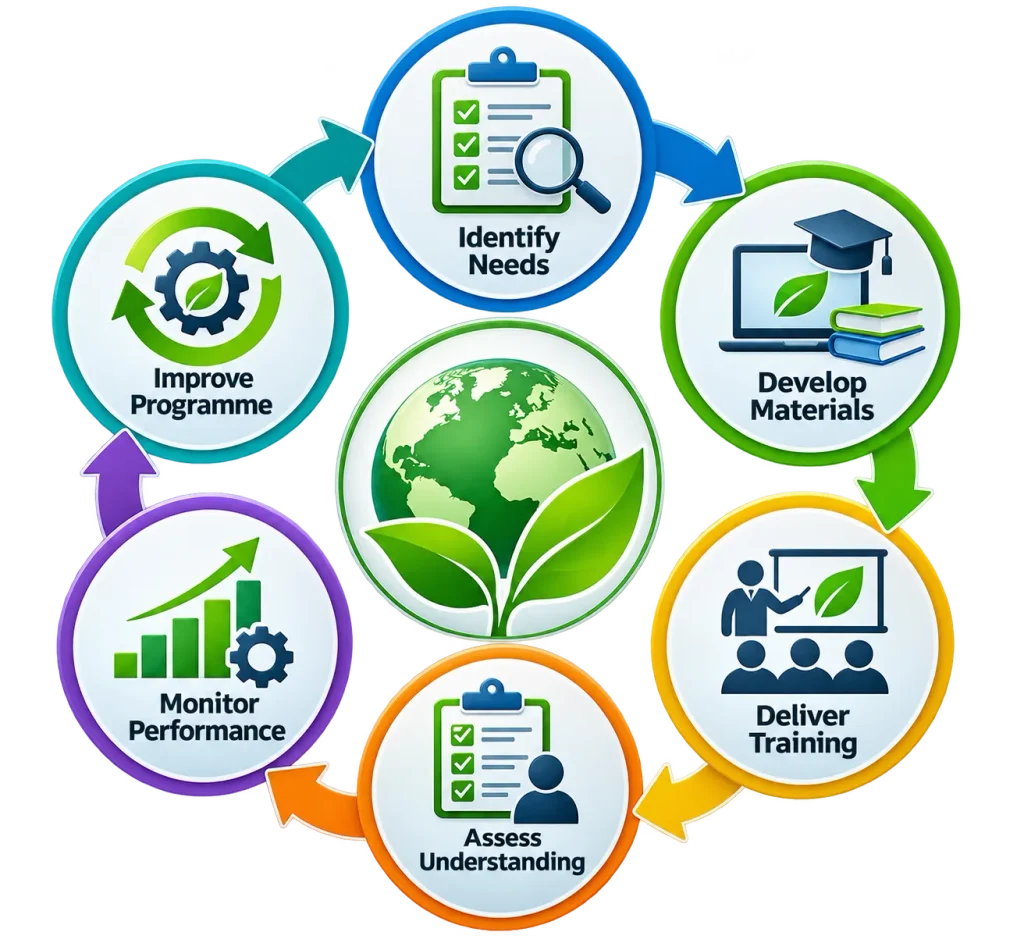
A successful workplace environmental training plan should be developed systematically. Organisations should first understand their environmental priorities, identify employee learning needs and establish measurable training objectives.
Step 1: Identify Organisational Environmental Impacts
Begin by identifying the environmental aspects associated with workplace activities.
These may include electricity consumption, water usage, transport emissions, waste generation, chemical storage, packaging, material consumption and wastewater discharge.
An organisation should consider which activities have the greatest environmental significance and which employees influence those activities.
For example, a manufacturing business may prioritise material waste, energy efficiency, chemical handling and industrial wastewater. An office-based organisation may focus on electricity, paper consumption, electronic waste and sustainable procurement.
Step 2: Assess Employee Knowledge and Training Needs
A training needs assessment helps determine what employees already understand and where additional knowledge is required.
Organisations can use:
- Employee questionnaires.
- Departmental interviews.
- Workplace inspections.
- Environmental incident records.
- Internal audit findings.
- Supervisor feedback.
- Reviews of existing environmental procedures.
The assessment should identify differences between departments and job responsibilities.
A facilities manager, for example, may need technical knowledge of energy management, while an administrative employee may primarily need guidance on responsible resource use and waste segregation.
Step 3: Establish Clear Learning Objectives
Training objectives should describe what employees are expected to know or demonstrate after completing the programme.
Examples include:
- Identify common environmental aspects associated with workplace activities.
- Explain the organisation’s environmental policy.
- Demonstrate correct waste segregation.
- Recognise activities that may cause pollution.
- Describe how to report environmental incidents.
- Apply appropriate resource conservation practices.
- Explain individual responsibilities within the environmental management system.
Clear objectives make it easier to select suitable learning activities and evaluate training outcomes.
Step 4: Select Appropriate Training Methods
Different employees learn through different approaches. Organisations should select methods that are appropriate to the workforce, operational environment and training objectives.
Possible methods include classroom sessions, practical demonstrations, e-learning, toolbox talks, workshops, workplace inspections and group discussions.
Practical activities are particularly useful when employees need to demonstrate specific procedures rather than simply understand theoretical concepts.
Step 5: Deliver Training and Encourage Participation
Training should be interactive and relevant to employees’ actual working conditions.
Trainers can use workplace examples, photographs, short videos, group exercises, practical demonstrations and problem-solving activities.
Employees should also be encouraged to discuss environmental challenges they experience in their departments.
This creates opportunities to identify operational problems that management may not otherwise recognise.
Step 6: Evaluate Training Effectiveness
Training should be evaluated to establish whether employees have gained relevant knowledge and can apply it in their work.
Organisations can use knowledge assessments, practical observations, workplace inspections, employee feedback and environmental performance indicators.
The results should inform future training requirements and improvement activities.
Environmental Awareness Training Programme: Practical Planning Table
| Training stage | Main activity | Expected outcome |
|---|---|---|
| Needs assessment | Review environmental impacts and employee knowledge | Identified training priorities |
| Objective setting | Establish role-specific learning outcomes | Clear training direction |
| Programme design | Select content and learning methods | Relevant training materials |
| Training delivery | Conduct workshops and practical sessions | Improved knowledge and skills |
| Evaluation | Assess understanding and workplace application | Evidence of training effectiveness |
| Continuous improvement | Review results and update materials | Ongoing environmental development |
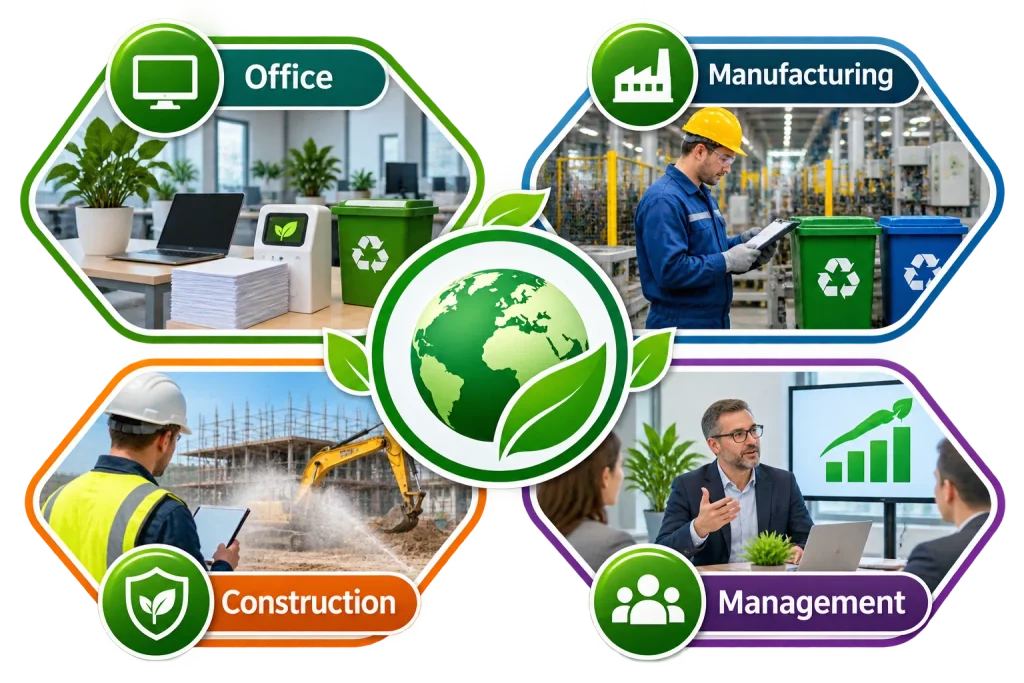
How to Build Staff Awareness Across Different Workplace Departments
Building effective environmental awareness requires organisations to recognise that each department has different environmental responsibilities and operational challenges. Training should therefore be tailored to employees’ daily activities, workplace risks and environmental priorities. Department-specific learning helps staff understand how their individual actions contribute to responsible resource management and improved environmental performance.
Environmental Awareness for Office Employees
Office employees can support workplace sustainability through responsible energy consumption, waste reduction and efficient use of office resources. Their training should focus on practical actions such as:
- Reducing unnecessary printing and using digital documents.
- Switching off unused computers, lights and office equipment.
- Separating recyclable and general waste correctly.
- Reducing disposable office supplies.
- Avoiding unnecessary water consumption.
- Following appropriate electronic waste disposal procedures.
Environmental Training for Manufacturing Employees
Manufacturing employees should understand how production activities influence energy consumption, material use, waste generation and pollution risks. Practical training and demonstrations can help them apply appropriate environmental controls.
Key training areas include:
- Responsible material handling and storage.
- Waste segregation and disposal procedures.
- Safe chemical storage and handling.
- Spill prevention and environmental incident reporting.
- Efficient equipment operation and resource consumption.
Environmental Education for Construction Workers
Construction activities can create environmental impacts through dust generation, material waste, water use, land disturbance and pollution risks. Site-specific environmental training helps workers understand the controls required for their activities.
Important training topics include:
- Responsible storage and handling of construction materials.
- Construction waste reduction and management.
- Spill prevention and pollution control.
- Dust management and water protection.
- Compliance with site-specific environmental procedures.
Environmental Awareness for Managers and Supervisors
Managers and supervisors play an important role in promoting environmental responsibility and ensuring that employees follow organisational procedures. Their training should develop leadership, communication and performance-monitoring capabilities.
Key areas of management training include:
- Understanding environmental objectives and organisational priorities.
- Encouraging employee participation in sustainability initiatives.
- Monitoring environmental performance and resource consumption.
- Implementing operational controls and corrective actions.
- Communicating environmental expectations across teams.
- Identifying opportunities for continuous improvement.
A department-specific approach makes environmental education more relevant and practical. By connecting training with actual job responsibilities, organisations can strengthen employee engagement, improve environmental practices and develop a consistent culture of sustainability.erstand how to communicate environmental expectations and encourage employees to report improvement opportunities.
Workplace Environmental Training Methods That Improve Employee Engagement
Effective environmental training depends on how information is delivered and how well it relates to employees’ daily responsibilities. Organisations should combine different learning methods to make environmental education practical, accessible and engaging. Using a variety of approaches also helps reinforce environmental knowledge and encourage employees to apply sustainable practices in their workplace.
Key Workplace Environmental Training Methods
- Classroom and Instructor-Led Training: Provides structured learning through presentations, discussions and question-and-answer sessions. It is useful for explaining environmental policies, technical concepts and organisational responsibilities.
- E-Learning and Digital Training: Allows employees to access training through computers, tablets and mobile devices. Short learning modules, interactive activities and knowledge checks are particularly useful for organisations with multiple locations, shift-based employees and distributed teams.
- Practical Workplace Demonstrations: Help employees apply environmental knowledge in real working situations. Examples include demonstrating correct waste segregation, identifying water leaks and explaining appropriate responses to minor spills under workplace procedures.
- Toolbox Talks and Team Briefings: Reinforce environmental responsibilities through short, regular discussions. Common topics include energy conservation, waste prevention, water efficiency, environmental incident reporting and responsible material use.
- Environmental Campaigns and Awareness Activities: Encourage employee participation through recycling initiatives, energy-saving challenges, water conservation campaigns and workplace sustainability discussions.
Combining these methods helps organisations maintain employee interest, strengthen environmental awareness and encourage positive workplace behaviour. Visual reminders, staff recognition and regular evaluation can further support engagement and help assess the impact of environmental awareness initiatives.
How to Measure Environmental Training Effectiveness
Measuring environmental training effectiveness helps organisations determine whether employees have understood and applied the environmental practices covered during training. Attendance records alone are not sufficient; organisations should evaluate knowledge, practical competence, workplace behaviour and improvements in environmental performance.
Key Methods for Measuring Training Effectiveness
Knowledge and Understanding Assessments
Use short quizzes, questionnaires, interviews and group discussions to assess employees’ understanding of environmental responsibilities. Questions should reflect actual workplace duties rather than simply test memorisation.
Practical Competence Assessment
Observe employees performing relevant environmental tasks, such as separating waste, following resource conservation procedures and identifying environmental hazards. Assessment criteria should reflect individual job roles and workplace procedures.
Behavioural Observation
Supervisors should monitor whether employees apply their training in daily activities. Examples include switching off unused equipment, following waste segregation procedures and reporting environmental problems. Feedback should be constructive and consistent.
Environmental Performance Indicators
Use measurable indicators to monitor workplace improvements and identify areas requiring further training.
| Performance Indicator | What It Measures | Example of Monitoring |
|---|---|---|
| Energy consumption | Electricity and fuel use | Monthly energy records |
| Water consumption | Water used in operations | Meter readings |
| Waste generation | Total waste produced | Waste collection records |
| Recycling rate | Proportion of waste recycled | Waste contractor reports |
| Environmental incidents | Reported spills and environmental events | Incident register |
| Training completion | Employees completing relevant training | Training records |
| Employee participation | Staff involvement in environmental initiatives | Campaign and suggestion records |
These methods provide a broader understanding of training outcomes and help organisations identify opportunities for improvement. However, performance indicators should be interpreted carefully because changes may result from factors other than employee awareness. For example, reduced energy consumption may reflect lower production levels rather than improved workplace behaviour. Therefore, organisations should compare results against suitable baselines and consider operational conditions when evaluating progress., operational activity and other relevant factors.
Common Challenges in Environmental Awareness Training
Organisations may face several challenges when implementing environmental awareness training. These difficulties can affect employee engagement, training effectiveness and the achievement of environmental objectives. Addressing them through practical learning, management involvement and regular evaluation helps create a more effective training programme.
Key Challenges and Solutions
- Lack of Employee Interest: Employees may consider environmental responsibilities unrelated to their daily duties. Organisations should connect training topics with actual job roles and explain how individual actions influence environmental performance.
- Limited Management Support: Without leadership commitment, training may become an isolated activity. Senior management should allocate appropriate resources, communicate expectations and demonstrate environmentally responsible behaviour.
- Generic Training Content: Training that does not reflect workplace activities may reduce employee engagement. Content should be tailored to operational needs, such as waste management and resource efficiency in offices or pollution prevention and site practices in construction.
- Inadequate Follow-Up: One-off training sessions may not create lasting behavioural changes. Refresher sessions, workplace reminders, supervision and regular performance reviews can reinforce important environmental practices.
- Difficulty Measuring Results: Environmental improvements may be influenced by several operational factors. Organisations should combine knowledge assessments, behavioural observations and relevant performance indicators to evaluate training effectiveness.
By recognising these challenges and applying appropriate solutions, organisations can strengthen employee participation, improve environmental awareness and support continuous improvement.
How Environmental Education Supports Sustainable Organisational Development
Environmental education supports sustainable organisational development by helping employees understand how their daily decisions influence environmental performance and wider sustainability objectives. When employees recognise the importance of environmental procedures, they become more confident in contributing to workplace improvements, responsible resource use and pollution prevention.
Key ways environmental education supports organisational development include:
- Improved Employee Awareness: Helps staff understand their environmental responsibilities and workplace sustainability practices.
- Responsible Resource Management: Encourages efficient use of energy, water, materials and other resources.
- Stronger Employee Participation: Promotes communication and collaboration between employees, supervisors and environmental management teams.
- Better Environmental Performance: Helps identify opportunities to improve operational practices and reduce environmental impacts.
- Continuous Improvement: Connects environmental learning with organisational strategy, employee development and performance evaluation.
By integrating environmental training into everyday operations, organisations can develop a stronger environmental culture and make sustainability an ongoing part of their management approach.
Conclusion
Environmental education and workplace training help organisations develop a responsible approach to environmental management. Effective environmental awareness training enables employees to understand their responsibilities, use resources efficiently, prevent pollution and support sustainability objectives through everyday workplace practices.
A structured training approach combines practical learning, management support, employee participation and performance evaluation to build a strong environmental culture. It also helps organisations improve environmental performance, encourage sustainable behaviour and integrate environmental responsibility into their long-term operations.