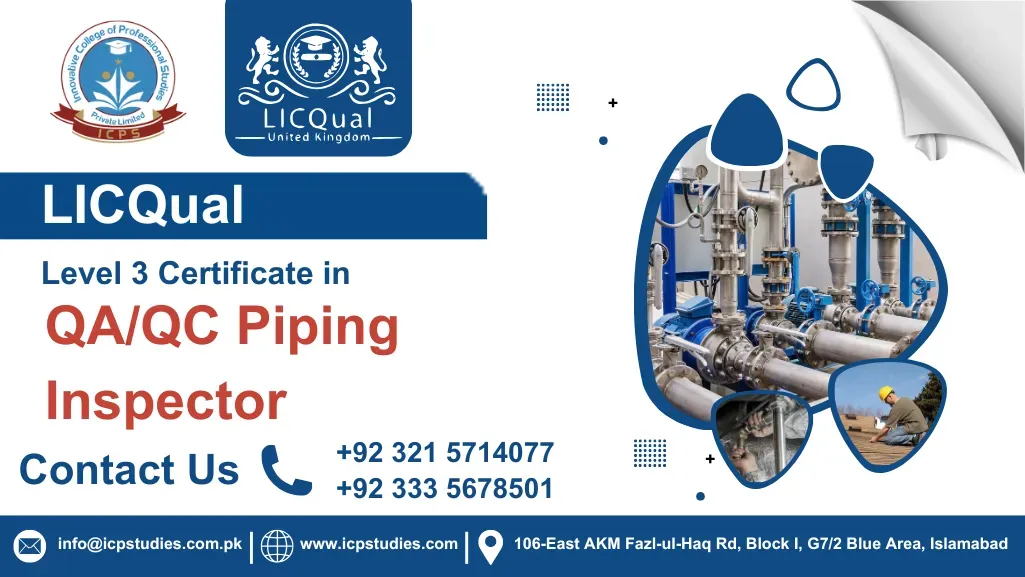
Behind every safe industrial facility is a piping system that has been carefully inspected and verified for quality. Even a minor flaw in a pipe, fitting, or weld can lead to costly downtime, safety risks, or operational failure. The LICQual Level 3 Diploma in QA/QC Piping Inspector is designed to help learners understand the critical role of quality assurance and quality control in piping inspection. This industry focused certification introduces the principles, standards, and inspection practices that support reliable piping systems across engineering, construction, manufacturing, and energy sectors.
Modern industries rely on professionals who can ensure that piping installations meet technical specifications and recognised quality requirements. Through the LICQual Level 3 Diploma in QA/QC Piping Inspector, learners explore essential inspection methods, piping materials, quality documentation, testing procedures, and compliance practices. The certification combines technical knowledge with practical inspection concepts, helping learners understand how quality is maintained throughout every stage of a piping project.
Success in industrial projects depends on accuracy, consistency, and a strong commitment to quality. This certification encourages a detail-oriented approach while building a solid understanding of inspection responsibilities, reporting practices, and industry expectations. By developing practical QA/QC knowledge and inspection awareness, learners become better prepared to support safe operations, improve project reliability, and contribute to high quality engineering outcomes in today’s demanding industrial environment.
All About LICQual Level 3 Certificate in QC Piping Inspector
Course Overview
The LICQual Level 3 Diploma in QA/QC Piping Inspector is a professional certification awarded by LICQual. It is designed to provide a structured learning experience through a well organised programme that supports the development of knowledge in QA/QC piping inspection. It offers a focused framework that aligns with recognised learning outcomes and professional standards.
This certification is made up of 6 units, carrying a total of 60 credits, with 240 Guided Learning Hours (GLH). The course structure allows learners to progress through each unit in a logical sequence, helping them build a clear understanding of the subject while maintaining consistency throughout the learning process. Each unit contributes towards the overall achievement of the certification.
The LICQual Level 3 Diploma in QA/QC Piping Inspector reflects LICQual’s commitment to delivering high quality professional certifications that support knowledge development and industry relevance. With its balanced combination of units, credits, and guided learning hours, the certification provides a comprehensive learning pathway for those seeking to strengthen their understanding of QA/QC piping inspection through a recognised and professionally awarded certification.
Admission Criteria
To enroll in the LICQual Level 3 Diploma in QA/QC Piping Inspector, learners are expected to meet the following entry requirements :
- Age Requirement: Learners must be at least 18 years old.
- Educational Requirements: A minimum of a Level 2 qualification or an equivalent is recommended.
- English Language Proficiency: Learners should have a good command of English.
- Work Experience: No prior work experience is required.
Study Units
Learning Outcomes
By the end of this course, applicants will be able to:
1. Fundamentals of Piping Systems and Components
By the end of this unit, learners will be able to:
- Identify and describe various piping system components such as pipes, fittings, flanges, and valves.
- Understand the classification and grading of piping materials based on industrial standards.
- Interpret basic piping drawings, layouts, and isometric diagrams.
- Explain the role of different piping components in system functionality and safety.
2.International Codes, Standards, and Specifications
By the end of this unit, learners will be able to:
- Recognize the purpose and importance of international codes and standards in piping inspection.
- Interpret and apply relevant standards such as ASME, API, ASTM, and ISO.
- Differentiate between various project specifications and understand their application in quality control.
- Ensure compliance with applicable regulatory and contractual requirements.
3. Welding Processes and Inspection Techniques
By the end of this unit, learners will be able to:
- Understand key welding processes including SMAW, GTAW, and GMAW.
- Identify welding symbols, joints, and positions used in piping projects.
- Interpret Welding Procedure Specifications (WPS) and Procedure Qualification Records (PQR).
- Conduct basic visual inspections of welds and recognize common welding defects.
4. Non-Destructive Testing (NDT) in Piping Inspection
By the end of this unit, learners will be able to:
- Explain the principles and methods of common NDT techniques (VT, PT, MT, RT, UT).
- Select appropriate NDT methods based on inspection requirements.
- Interpret NDT results and determine the acceptance or rejection of components.
- Adhere to safety and quality standards during NDT procedures.
5. QA/QC Inspection Procedures and Documentation
By the end of this unit, learners will be able to:
- Develop and follow Inspection Test Plans (ITPs) and quality checklists.
- Maintain accurate and complete inspection records, reports, and logs.
- Document and report non-conformities, and assist in corrective/preventive actions.
- Manage material traceability and ensure proper QA/QC documentation flow.
6. Pressure Testing and Piping Integrity Verification
By the end of this unit, learners will be able to:
- Understand the principles and purpose of hydrostatic and pneumatic pressure testing.
- Prepare piping systems for pressure testing in accordance with safety protocols.
- Monitor and record test procedures and interpret results for integrity verification.
- Identify and report test failures or defects, and suggest corrective actions.
Ideal Candidate
The LICQual Level 3 Diploma in QA/QC Piping Inspector is designed to develop a strong understanding of quality assurance and quality control principles in piping inspection. This certification provides structured knowledge of inspection practices, technical standards, and quality procedures, making it valuable for building professional competence in industrial inspection environments.
This certification is ideal for:
- Develop a solid understanding of QA/QC principles used in piping inspection.
- Learn how to interpret inspection requirements, technical specifications, and quality standards.
- Build knowledge of piping materials, components, and inspection procedures.
- Understand quality control documentation, inspection records, and reporting practices.
- Gain awareness of inspection methods used to verify compliance and product quality.
- Strengthen the ability to identify quality issues and support corrective actions.Improve attention to detail, accuracy, and consistency during inspection activities.
- Enhance understanding of safe working practices and quality focused processes.
- Develop confidence in applying recognised QA/QC procedures across piping projects.
- Earn a professionally awarded LICQual certification that demonstrates verified knowledge in QA/QC piping inspection.
FAQs LICQual Level 3 Diploma in QA/QC Piping Inspector