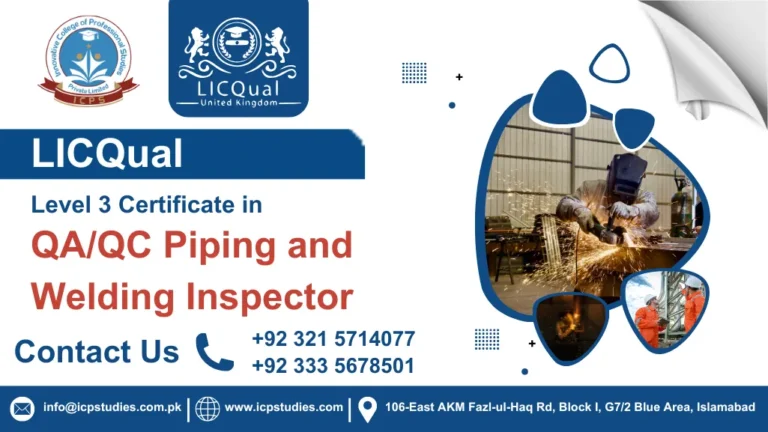
In every major industrial project, piping systems quietly carry the responsibility of keeping operations safe, stable, and efficient. Behind every successful pipeline is a professional who understands how to maintain quality at every stage, from fabrication to final inspection. The LICQual Level 3 Diploma in Piping QA/QC Engineer is designed for those who want to step into this critical role where precision, discipline, and attention to detail shape real project outcomes.
This certification introduces a deeper and more structured understanding of piping quality assurance and quality control practices used across global engineering environments. It focuses on essential areas such as inspection techniques, welding quality checks, material verification, piping codes, and documentation procedures. The learning experience is designed to reflect real site conditions, helping individuals understand how QA/QC decisions are applied in practical engineering situations where accuracy cannot be compromised.
What makes this certification valuable is its strong focus on applied knowledge in real industrial settings. It builds confidence in handling piping inspection activities and understanding how quality standards are maintained throughout complex projects. Instead of theory alone, it connects learning with actual industry practices, preparing individuals to work with a clear sense of responsibility in piping QA/QC environments where every detail directly impacts safety and performance.
All About LICQual Level 3 Diploma in Piping QA/QC Engineer
Course Overview
The LICQual Level 3 Diploma in Piping QA/QC Engineer is a structured LICQual certification designed to provide in-depth knowledge of piping quality assurance and quality control practices. It is developed with a clear academic framework that includes 6 units, 60 credits, and 240 Guided Learning Hours (GLH). This structured format ensures a balanced and progressive learning experience focused on industrial piping QA/QC systems.
The certification covers a wide range of essential piping QA/QC areas, including inspection techniques, welding quality control processes, material verification, dimensional checks, and the interpretation of technical drawings. It also introduces the application of industry codes and standards used in piping fabrication and installation projects. Each unit is designed to reflect practical site-based requirements, ensuring that learning remains closely aligned with real engineering environments.
Awarded by LICQual, this diploma emphasizes structured learning through defined units and credit value, supporting a clear understanding of quality systems in piping engineering. The 240 GLH ensures sufficient learning time for detailed engagement with QA/QC procedures and documentation practices. This certification builds a strong foundation in maintaining quality, compliance, and consistency across piping systems in industrial projects.
Admission Criteria
To enroll in the LICQual Level 3 Diploma in Piping QA/QC Engineer, learners are expected to meet the following entry requirements :
- Age Requirement: Applicants must be at least 18 years of age.
- Educational Requirements: Applicants must have completed a Level 2 qualification in related field.
- English Language Proficiency: Learners should have a reasonable standard of English language proficiency.
- Work Experience: At least 1 year of relevant work experience in piping, welding, or industrial QA/QC is recommended.
Study Units
Learning Outcomes
By the end of this course, applicants will be able to:
1. Advanced Piping Design and Isometric Drawing Interpretation
- Analyze complex piping engineering designs and isometric drawings to accurately identify components, dimensions, and specifications.
- Apply advanced interpretation skills to translate isometric drawings into practical applications for piping fabrication, erection, and installation.
- Evaluate piping design layouts against project requirements to ensure compliance with engineering and quality standards.
- Develop solutions to design-related challenges in piping systems to enhance quality and operational efficiency.
2. International Standards and Codes (ASME, API, ANSI, ASTM)
- Interpret and apply international standards and codes, such as ASME B31.3, API 1104, ANSI, and ASTM, to ensure compliance in piping projects.
- Assess the relevance of specific standards to different piping applications, considering factors like material, pressure, and environmental conditions.
- Implement quality control measures aligned with global codes to ensure the safety and reliability of piping systems.
- Verify compliance with international standards through documentation and inspection processes in QA/QC workflows.
3. Welding Inspection, NDT Methods, and Testing Procedures
- Conduct detailed welding inspections to identify imperfections, such as cracks or incomplete fusion, ensuring compliance with quality standards.
- Apply non-destructive testing (NDT) methods, including ultrasonic, radiographic, and magnetic particle testing, to evaluate piping integrity.
- Interpret NDT results and testing outcomes to assess weld quality and recommend corrective actions when necessary.
- Execute welding and testing procedures safely and accurately, adhering to industry best practices and project specifications.
4. Piping Fabrication, Erection, and Installation Quality Control
- Implement quality control procedures during piping fabrication, erection, and installation to ensure adherence to project specifications.
- Identify and address defects or non-conformities in piping fabrication and installation processes to maintain structural integrity.
- Monitor and verify alignment, fit-up, and assembly techniques to ensure high-quality piping installations.
- Collaborate with project teams to integrate quality control measures throughout the fabrication and installation phases.
5. QA/QC Procedures and Project Quality Planning
- Develop and implement QA/QC procedures to ensure consistent quality across all phases of piping projects.
- Create comprehensive project quality plans that align with client requirements, industry standards, and regulatory guidelines.
- Evaluate the effectiveness of QA/QC procedures through audits and inspections to identify areas for improvement.
- Coordinate with stakeholders to integrate quality planning into project timelines, budgets, and resource allocation.
6. Practical QA/QC Case Studies and Site Reporting Techniques
- Analyze real-world QA/QC case studies to identify best practices and solutions for common piping project challenges.
- Apply practical QA/QC techniques to address issues like material defects, welding errors, or installation non-conformities.
- Develop accurate and detailed site reports to document inspection findings, non-conformities, and corrective actions.
- Utilize effective communication and reporting techniques to present QA/QC outcomes to project teams and stakeholders.
Ideal Candidate
The LICQual Level 3 Diploma in Piping QA/QC Engineer is recommended for individuals who want to build practical understanding of piping quality assurance and quality control in real industrial environments. It focuses on structured, job-related learning that strengthens awareness of inspection methods, welding quality, and piping systems. This certification supports development in technical and site-based QA/QC practices used across engineering projects.
This certification is ideal for:
- Individuals interested in understanding piping inspection methods and quality control processes used on industrial sites
- Learners who want to gain practical knowledge of welding quality checks and material verification in piping systems
- People aiming to understand how piping QA/QC procedures are applied during fabrication and installation activities
- Those who want to develop awareness of industry codes and standards used in piping engineering projects
- Individuals interested in working with technical drawings and piping documentation used in QA/QC work
- Learners who prefer structured, practical learning focused on real industrial engineering environments
- People interested in oil and gas, construction, petrochemical, or power plant project environments
- Individuals who want to understand quality assurance systems used in piping inspection and compliance activities
- Learners aiming to strengthen technical understanding of site-based quality control procedures
- People who want to build a solid foundation in piping QA/QC engineering practices used in industry standards and project execution
FAQs LICQual Level 3 Diploma in Piping QA/QC Engineer