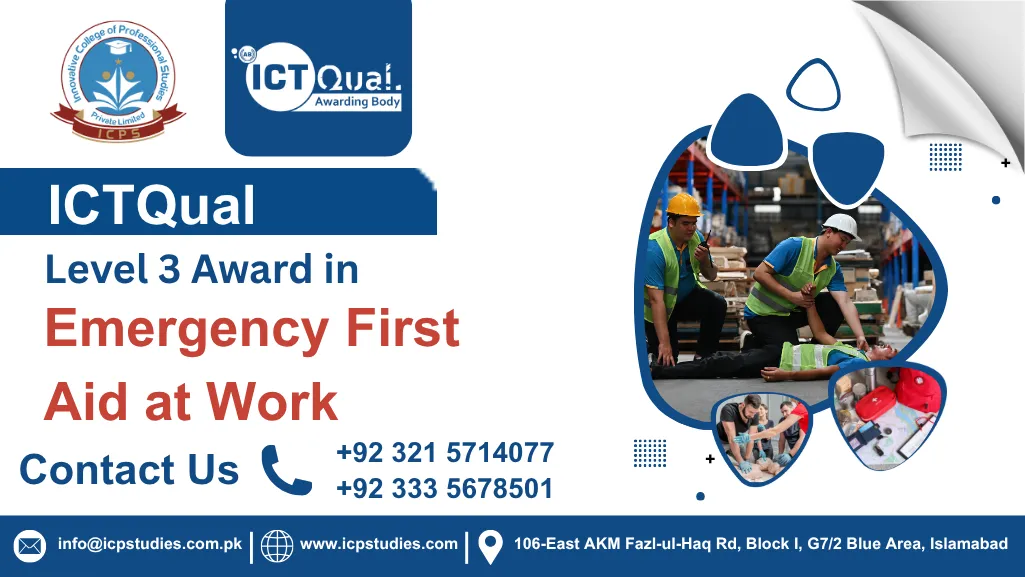
The ICTQual Level 3 Award in Emergency First Aid at Work is a professionally recognized qualification designed to equip individuals with the essential skills and knowledge required to respond effectively to workplace emergencies. This course is ideal for employees, supervisors, and designated first aiders who play a critical role in maintaining a safe and compliant working environment across various industries.
This comprehensive training program focuses on developing practical first aid skills that can be applied in real-life emergency situations. Learners will gain the ability to assess incidents, provide immediate care, and manage conditions such as unconsciousness, choking, bleeding, burns, and minor injuries. The course also includes essential life-saving techniques, including CPR and the safe use of automated external defibrillators (AEDs), aligned with current health and safety standards.
By completing this qualification, participants will be prepared to act quickly and confidently in emergency situations, potentially saving lives and reducing the severity of injuries in the workplace. The ICTQual Level 3 Award in Emergency First Aid at Work not only supports legal compliance with occupational health and safety regulations but also enhances overall workplace safety culture, making it an essential certification for responsible and safety-conscious organizations.
All About ICTQual Level 3 Award in Emergency First Aid at Work
Course Overview
The ICTQual Level 3 Award in Emergency First Aid at Work is a structured and practical training program designed to develop essential first aid competencies required in workplace environments. Delivered over 3 days (9 guided learning hours), this course provides a focused and efficient learning experience that combines theoretical understanding with hands-on practice.
The qualification is organized into 8 comprehensive study units, each tailored to build a solid foundation in emergency first aid. These units cover key areas such as incident assessment, basic life support, CPR and AED use, managing unconscious casualties, controlling bleeding, and treating minor injuries. The course also emphasizes workplace-specific scenarios, enabling learners to understand their roles and responsibilities in maintaining health and safety standards.
Designed in line with current regulatory requirements and best practices, this program ensures that participants are fully equipped to respond effectively to a range of emergency situations. Through practical demonstrations and scenario-based training, learners gain the confidence to act quickly and appropriately when it matters most. The ICTQual Level 3 Award in Emergency First Aid at Work is an ideal qualification for individuals and organizations aiming to enhance workplace safety, ensure compliance, and promote a proactive approach to emergency response.
The ICTQual Level 3 Award in Emergency First Aid at Work is designed to be accessible while ensuring learners can effectively engage in both theoretical and practical training. The following entry requirements are recommended:
- Age Requirement:
Learners should be at least 16 years of age at the time of enrolment. - Educational Background:
There are no formal academic qualifications required, although a basic level of education is recommended to support understanding of course content. - Experience:
No prior first aid qualification is required. This course is suitable for beginners as well as individuals looking to refresh their existing first aid knowledge.Participants should be physically able to perform practical first aid tasks, including CPR on the floor, using an AED, and assisting casualties during emergency situations. - English Language Proficiency:
Learners must have a good command of English, both written and spoken.
The ICTQual Level 3 Award in Emergency First Aid at Work is ideal for individuals who are responsible for maintaining safety and responding to emergencies within workplace environments. This course is suitable for both beginners and those looking to enhance their first aid knowledge and skills.
Workplace First Aiders:
Employees appointed as first aiders in offices, construction sites, warehouses, and industrial settings who must meet health and safety requirements.
Employers and Supervisors:
Managers, team leaders, and supervisors responsible for ensuring workplace safety and compliance with occupational health and safety regulations.
Health and Safety Representatives:
Individuals assigned to monitor and implement safety procedures within an organization.
Small Business Owners:
Entrepreneurs who want to ensure a safe working environment for their staff and meet legal first aid obligations.
Construction and Industrial Workers:
Workers in high-risk environments where accidents and injuries are more likely to occur.
General Employees:
Any staff member who wants to develop life-saving skills and be prepared to respond effectively in emergency situations.
This course is suitable for anyone seeking a recognized qualification to improve workplace safety, meet compliance requirements, and gain the confidence to provide immediate and effective first aid when it is needed most.
Study Units
This qualification, theICTQual Level 3 Award in Emergency First Aid at Work, consists of 8 mandatory units.
- Roles and Responsibilities of a First Aider
- Assessing an Incident
- Managing an Unresponsive Casualty
- Cardiopulmonary Resuscitation (CPR)
- Dealing with Choking
- Managing External Bleeding
- Additional Emergency Situations
- Dealing with Minor Injuries
Learning Outcomes:
Learning Outcomes for the Study Units:
Roles and Responsibilities of a First Aider
- Understand the Role: Learners will understand the key responsibilities and duties of a first aider in the workplace, including maintaining their own safety and that of others.
- Legal Knowledge: Learners will be familiar with relevant health and safety regulations and first aid legislation, ensuring compliance with legal requirements.
- Effective Communication: Learners will be able to communicate effectively with casualties, bystanders, and emergency services.
- Incident Reporting: Learners will know how to document and report accidents and incidents accurately.
Assessing an Incident
- Scene Safety: Learners will be able to assess the scene of an emergency to identify potential hazards and ensure safety for themselves and others.
- Primary Survey: Learners will be proficient in conducting a primary survey (DR ABC: Danger, Response, Airway, Breathing, Circulation) to quickly assess the casualty’s condition.
- Secondary Assessment: Learners will be capable of performing a secondary assessment when necessary to gather further information about the casualty’s condition.
Managing an Unresponsive Casualty
- Recovery Position: Learners will know how to place an unresponsive but breathing casualty into the recovery position to maintain an open airway.
- Vital Signs Monitoring: Learners will be able to monitor the casualty’s vital signs and condition while awaiting emergency services.
Cardiopulmonary Resuscitation (CPR)
- Adult CPR: Learners will be competent in performing CPR on an adult casualty, including delivering chest compressions and rescue breaths.
- Use of AEDs: Learners will be able to operate an Automated External Defibrillator (AED) effectively during a cardiac emergency.
Dealing with Choking
- Recognition of Choking: Learners will be able to recognize the signs of mild and severe choking.
- Choking Treatment: Learners will be proficient in administering appropriate first aid for choking, including back blows and abdominal thrusts.
Managing External Bleeding
- Types of Bleeding: Learners will understand the differences between arterial, venous, and capillary bleeding.
- Bleeding Control: Learners will be skilled in techniques for controlling external bleeding, such as applying direct pressure and bandaging.
- Shock Management: Learners will be able to recognize the signs of shock and provide appropriate first aid treatment.
Additional Emergency Situations
- Seizure Management: Learners will know how to manage a casualty experiencing a seizure, ensuring their safety and providing care.
- Fainting Treatment: Learners will be able to recognize and treat fainting episodes effectively.
- Anaphylaxis Response: Learners will be capable of identifying severe allergic reactions and administering appropriate first aid, including the use of auto-injectors if available.
Dealing with Minor Injuries
- Minor Wounds: Learners will be able to clean and dress minor cuts and grazes properly.
- Burns and Scalds: Learners will know how to administer first aid for minor burns and scalds.
- Splinter Removal: Learners will be proficient in safely removing small splinters and other minor foreign objects.
FAQs ICTQual Level 3 Award in Emergency First Aid at Work