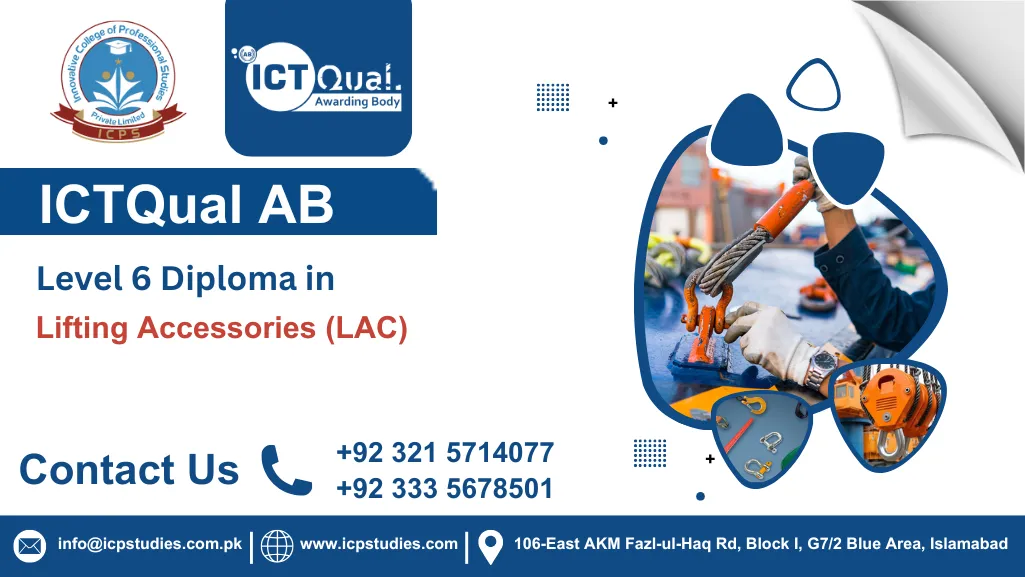
The ICTQual AB Level 6 Diploma in Lifting Accessories (LAC) is an advanced professional qualification designed to equip engineers, supervisors, and technical specialists with the skills and knowledge required to safely manage, inspect, and operate lifting accessories in industrial, offshore, and construction environments. Lifting accessories, including slings, shackles, hooks, chains, wire ropes, and eyebolts, are critical components in lifting operations, and their proper selection, maintenance, and inspection are essential for ensuring workplace safety and operational efficiency.
This diploma provides in-depth training on manual and mechanical lifting accessory types, material properties, load assessment, inspection procedures, preventive maintenance, and compliance with international safety standards. Participants will learn how to identify defects, calculate safe working loads, implement maintenance schedules, and mitigate operational risks while ensuring compliance with ISO, BS, and industry-specific regulations.
The ICTQual AB Level 6 Diploma in Lifting Accessories (LAC) is ideal for mechanical engineers, HSE professionals, maintenance personnel, and technical managers responsible for lifting operations. By completing this program, learners will gain the ability to select and inspect lifting accessories effectively, support safe lifting operations, and contribute to workplace safety and operational compliance. This course enhances career prospects in lifting accessory management, inspection, and workplace safety across industrial, offshore, and construction sectors.
All About ICTQual AB Level 6 Diploma in Lifting Accessories (LAC)
Course Overview
The ICTQual AB Level 6 Diploma in Lifting Accessories (LAC) is a comprehensive professional program designed to provide advanced knowledge and practical skills in the safe selection, inspection, operation, and management of lifting accessories across industrial, offshore, and construction environments. This qualification is delivered through 6 study units and spans 60 hours of training, combining theoretical learning with practical, industry-relevant applications.
The course covers essential topics including types of lifting accessories, material properties, load assessment, inspection techniques, preventive maintenance, operational safety, and regulatory compliance. Participants will gain expertise in evaluating the integrity of lifting accessories, identifying defects, and implementing maintenance strategies to prevent equipment failure.
Learners will develop competencies in risk assessment, safe handling practices, documentation, and adherence to ISO, BS, and industry-specific standards, ensuring lifting operations are conducted safely and efficiently. The program also emphasizes real-world scenarios and practical exercises to reinforce knowledge and skills.
By completing the ICTQual AB Level 6 Diploma in Lifting Accessories (LAC), participants will be prepared to oversee lifting accessory operations, conduct inspections, implement safety protocols, and support compliance initiatives. This course is ideal for engineers, supervisors, HSE professionals, and technical staff seeking advanced expertise in lifting accessory management, inspection, and workplace safety.
To enroll in the ICTQual AB Level 6 Diploma in Lifting Accessories (LAC), candidates should meet the following requirements to ensure they can fully benefit from this advanced training program:
- Age Requirement:
Participants must be 18 years or older at the time of enrollment. - Educational Background:
Candidates should hold a Level 5 qualification or equivalent in a relevant field such as mechanical engineering, industrial engineering, offshore engineering, or other technical disciplines related to lifting operations and material handling. Candidates with substantial practical experience in lifting accessory management or inspection may also be considered. - Experience:
Prior experience in lifting accessory operation, inspection, maintenance, or supervision roles is highly recommended. Professionals working in industrial, offshore, or construction sectors will benefit most from this course. - English Language Proficiency:
Learners must have a good command of English, both written and spoken.
The ICTQual AB Level 6 Diploma in Lifting Accessories (LAC) is designed for professionals seeking advanced knowledge and practical skills in the operation, inspection, and management of lifting accessories across industrial, offshore, and construction environments.
This course is suitable for:
- Mechanical, industrial, and offshore engineers involved in lifting operations
- Supervisors and technical managers overseeing lifting accessory usage
- HSE (Health, Safety, and Environment) professionals ensuring compliance with lifting safety standards
- Inspection and maintenance personnel responsible for lifting accessories
- Quality assurance and compliance specialists managing inspection, documentation, and maintenance schedules
- Operators of slings, shackles, hooks, chains, wire ropes, and other lifting accessories
- Professionals aiming to advance their careers in lifting accessory management, inspection, and workplace safety
By completing this course, participants will be equipped with the skills to select, inspect, and maintain lifting accessories safely, implement preventive measures, and ensure compliance with international safety standards. This course is particularly valuable for those looking to enhance expertise in lifting accessory safety, operational efficiency, and regulatory compliance, ensuring safe and reliable lifting operations in industrial, offshore, and construction sectors.
Study Units
This qualification, the ICTQual AB Level 6 Diploma in Lifting Accessories (LAC), consists of 6 mandatory units.
- Legislation, Standards & Regulatory Compliance
- Advanced Inspection Methods & Certification
- Complex Load Characteristics & Risk Assessment
- Asset Management, Maintenance Planning & Lifecycle Monitoring
- Technical Leadership & Supervision
- Quality Assurance, Auditing & Continuous Improvement
Learning Outcomes
Learning Outcomes for the Study Units:
1. Legislation, Standards & Regulatory Compliance
- Interpret and apply national and international lifting equipment regulations and codes of practice
- Evaluate legal responsibilities and liabilities associated with lifting operations and inspections
- Ensure organisational compliance with industry-specific legislation such as LOLER, PUWER, and international standards (e.g. ISO, BS EN)
- Develop and implement compliance strategies for lifting accessories used in high-risk environments
2. Advanced Inspection Methods & Certification
- Conduct detailed inspections using advanced diagnostic and non-destructive testing (NDT) techniques
- Assess equipment condition against manufacturer specifications and industry benchmarks
- Identify, classify, and document complex defects or mechanical failures in lifting accessories
- Lead certification processes, including compiling and reviewing inspection reports and certificates in accordance with regulatory standards
3. Complex Load Characteristics & Risk Assessment
- Analyse the physical and mechanical properties of complex and irregular loads
- Evaluate environmental and operational factors that impact lifting safety and equipment selection
- Perform comprehensive risk assessments for multi-point, heavy, or unconventional lifts
- Develop and communicate control measures to mitigate risk in complex lifting operations
4. Asset Management, Maintenance Planning & Lifecycle Monitoring
- Implement systematic asset tracking and inspection schedules for lifting accessories
- Monitor equipment performance, maintenance history, and usage trends to forecast lifespan
- Develop preventive and predictive maintenance strategies aligned with operational goals
- Ensure traceability, documentation, and full compliance with asset management standards
5. Technical Leadership & Supervision
- Demonstrate effective leadership in the supervision of lifting inspection teams
- Provide technical guidance and mentoring to junior inspectors and operatives
- Coordinate resources, schedules, and priorities across multiple inspection sites or projects
- Manage conflict, communication, and collaboration across interdisciplinary teams
6. Quality Assurance, Auditing & Continuous Improvement
- Develop and maintain quality assurance systems for lifting equipment inspection and certification processes
- Conduct internal audits and identify non-conformance issues and root causes
- Recommend and implement corrective actions to uphold operational standards and safety
- Promote a culture of continuous improvement, data analysis, and evidence-based decision-making
FAQs ICTQual AB Level 6 Diploma in Lifting Accessories (LAC)