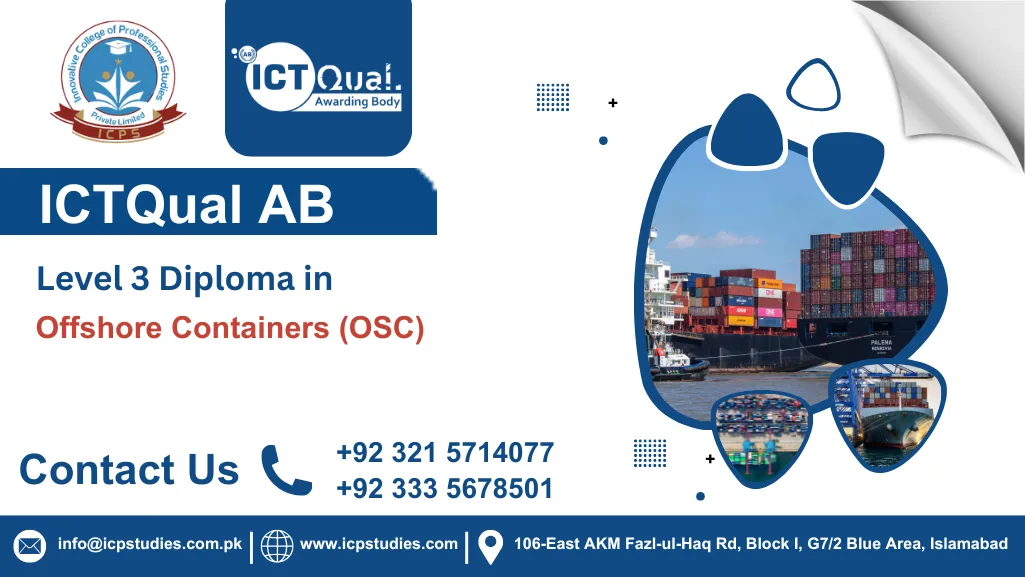
The ICTQual AB Level 3 Diploma In Offshore Containers (OSC) is a specialized training program designed to provide foundational knowledge and practical understanding of offshore containers used in the oil and gas, marine, and offshore energy industries. Offshore containers play a critical role in transporting equipment, materials, and supplies between offshore installations and supply vessels. Ensuring that these containers meet safety, inspection, and operational standards is essential for maintaining safe and efficient offshore operations.
This diploma introduces participants to the essential principles of offshore container design, handling, inspection, and safety requirements in accordance with recognized industry practices. Learners will gain an understanding of offshore container types, structural components, lifting arrangements, and the importance of proper maintenance and inspection procedures. The course also highlights key safety considerations and regulatory requirements that govern the use of offshore containers in demanding offshore environments.
The ICTQual AB Level 3 Diploma in Offshore Containers (OSC) is designed to support the professional development of individuals involved in offshore logistics, equipment handling, and operational safety. By completing this course, participants will develop the knowledge required to contribute to safe offshore container operations and support compliance with industry standards. This qualification is ideal for those seeking to build a career in offshore logistics, inspection support, and offshore equipment management.
All About ICTQual AB Level 3 Diploma in Offshore Containers (OSC)
Course Overview
The ICTQual AB Level 3 Diploma in Offshore Containers (OSC) is a structured training program designed to provide learners with the essential knowledge and practical understanding required for the safe handling, inspection, and management of offshore containers used in offshore operations. This qualification is delivered through 6 comprehensive study units and carries a total of 30 credits, offering a balanced combination of theoretical learning and industry-relevant knowledge.
The program focuses on the key operational and safety aspects associated with offshore containers, including container types, structural components, lifting arrangements, and safe handling procedures. Participants will explore the importance of proper inspection practices, routine maintenance, and compliance with offshore safety standards to ensure containers remain reliable in harsh offshore environments.
Throughout the training, learners will develop an understanding of offshore container operations, inspection principles, safety management practices, and documentation procedures used within offshore logistics and supply chain activities. The course also introduces industry guidelines and regulatory frameworks that support safe transportation of equipment and materials to offshore installations.
By completing the ICTQual AB Level 3 Diploma in Offshore Containers (OSC), participants will gain the fundamental competencies needed to support offshore container safety, contribute to inspection activities, and assist in maintaining compliance with industry requirements in offshore oil and gas and marine sectors. This qualification provides a strong foundation for individuals seeking to progress in offshore logistics, inspection support, and equipment handling roles.
To enroll in the ICTQual AB Level 3 Diploma in Offshore Containers (OSC), candidates are expected to meet the following requirements to ensure they can successfully engage with the training and assessments:
- Age Requirement:
Participants must be 18 years or older at the time of enrollment. - Educational Background:
Candidates are expected to have a Level 2 qualification or equivalent in a relevant discipline, such as mechanical engineering, marine studies, offshore operations, logistics, or industrial safety. Candidates with practical experience in offshore or marine operations may also be considered. - Experience:
While formal work experience is not mandatory, prior exposure to offshore operations, lifting equipment handling, container management, or inspection support roles is highly beneficial for understanding course concepts. - English Language Proficiency:
Learners must have a good command of English, both written and spoken.
The ICTQual AB Level 3 Diploma in Offshore Containers (OSC) is designed for individuals seeking foundational knowledge and practical skills in offshore container operations, safety, and inspection. It is ideal for professionals at the start of their career or those supporting offshore logistics and equipment handling activities.
This course is suitable for:
- Offshore logistics and supply chain personnel involved in container handling
- Junior engineers or technical staff in offshore oil, gas, and marine operations
- Offshore container inspectors or assistants supporting inspection teams
- HSE (Health, Safety, and Environment) officers seeking knowledge of offshore container safety
- Technical support staff in offshore installations or marine transport
- Individuals involved in lifting operations and equipment transportation
- Professionals seeking to build a career in offshore container management, inspection, or offshore operational safety
- Anyone looking to gain a strong foundation in offshore container types, inspection principles, handling practices, and safety compliance
This qualification is particularly valuable for those aiming to strengthen their expertise in offshore container operations, inspection support, and regulatory compliance, providing a pathway for career development in offshore logistics, inspection, and offshore operational roles.
Study Units
This qualification, the ICTQual AB Level 3 Diploma in Offshore Containers (OSC), consists of 6 mandatory units.
- Working on Site & Examiner Tool Use
- Types of Inspection & Examination for Offshore Containers
- Container Construction, Lifting Components & Pad-eyes
- Lifting Sets, Slings & Load Attachments
- Structural Integrity, Corrosion & Defect Detection
- Testing, Reporting & Certification Procedures
Learning Outcomes
Learning Outcomes for the Study Units:
1. Working on Site & Examiner Tool Use
- Follow correct safety procedures when conducting offshore container inspections
- Identify, prepare, and use examiner tools in line with offshore inspection standards
- Demonstrate awareness of access, rigging hazards, and PPE requirements for offshore environments
- Maintain tools and equipment used for container inspection and testing
2. Types of Inspection & Examination for Offshore Containers
- Distinguish between initial, periodic, thorough, and special inspections
- Apply appropriate inspection techniques based on the container type, condition, and operational setting
- Understand regulatory requirements such as DNV 2.7-1, ISO 10855-3, and industry best practices
- Determine the correct inspection frequency for offshore containers and accessories
3. Container Construction, Lifting Components & Pad-eyes
- Identify the main construction features of offshore containers including corner castings, pad-eyes, and frames
- Evaluate pad-eye wear, distortion, weld quality, and positioning
- Assess the integrity of lugs, shackles, and lifting points for conformance to design criteria
- Ensure compliance with structural design standards for lifting and loading
4. Lifting Sets, Slings & Load Attachments
- Inspect wire rope slings, chain assemblies, and shackles used in offshore container lifting
- Evaluate identification tags, wear, elongation, and safe working load limits
- Identify non-compliances such as corrosion, broken wires, and connector damage
- Understand how lifting set compatibility affects container safety and lifting performance
5. Structural Integrity, Corrosion & Defect Detection
- Examine offshore containers for signs of corrosion, mechanical damage, and fatigue
- Identify defects in welds, corner fittings, floors, and internal reinforcements
- Evaluate container condition using visual and functional inspection techniques
- Recommend remedial actions or removal from service based on defect severity
6. Testing, Reporting & Certification Procedure
- Perform and observe proof load testing, MPI/NDT, and functional inspections
- Complete inspection checklists and reporting templates in line with client and regulatory expectations
- Categorise defects and assign repair or re-certification outcomes
- Understand certification procedures and requirements for offshore container compliance documentation
FAQs ICTQual AB Level 3 Diploma in Offshore Containers (OSC)