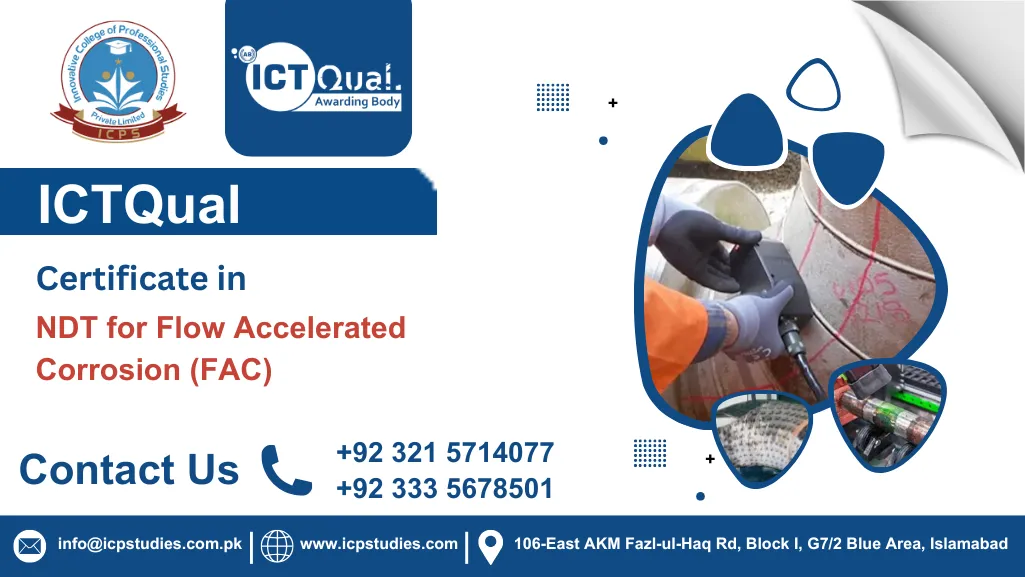
Enhance your expertise in industrial inspection with the ICTQual Certificate in NDT for Flow Accelerated Corrosion (FAC), a specialized program designed for engineers, inspectors, and maintenance professionals in the power, oil and gas, and chemical industries. Flow Accelerated Corrosion is a critical phenomenon that can lead to severe pipe wall thinning, structural failures, and safety hazards if undetected. This course equips participants with the knowledge and practical skills to identify, assess, and manage FAC risks using advanced non-destructive testing (NDT) techniques.
Participants will learn key methods such as ultrasonic thickness measurement, visual inspection, and other NDT approaches to detect and monitor corrosion in pipelines, bends, and critical components. The training emphasizes interpreting test results, assessing corrosion rates, and implementing preventive maintenance strategies to ensure operational reliability and safety.
Structured to combine theory and hands-on application, the course enables professionals to make informed decisions, minimize equipment downtime, and comply with international safety and quality standards. Certified by ICTQual AB, an internationally recognized awarding body, this program not only validates your technical expertise but also enhances your professional credibility and career opportunities in inspection, maintenance, and asset integrity management.
All About ICTQual Certificate in NDT for Flow Accelerated Corrosion (FAC)
Course Overview
The ICTQual Certificate in NDT for Flow Accelerated Corrosion (FAC) is a 3-day intensive training program designed to provide participants with practical and theoretical knowledge of FAC inspection in industrial piping systems. The course is structured into six detailed study units, covering key areas such as the fundamentals of flow accelerated corrosion, corrosion mechanisms, material susceptibility, NDT inspection methods, data interpretation, and maintenance strategies.
Through hands-on exercises and real-world case studies, participants will gain expertise in using ultrasonic thickness measurement, visual inspection techniques, and other non-destructive testing (NDT) tools to detect and assess corrosion in pipelines and associated components. The program also emphasizes risk evaluation, reporting, and implementing preventive measures to ensure long-term system integrity.
By completing this course, learners will be able to identify FAC-related issues, analyze inspection results, and support maintenance planning, ensuring operational safety and compliance with industry standards. This course is ideal for professionals seeking to strengthen their skills in industrial inspection, asset integrity management, and corrosion prevention, making it a critical training for those responsible for the reliability and safety of industrial piping systems.
To enroll in the ICTQual Certificate in NDT for Flow Accelerated Corrosion (FAC), candidates should meet the following criteria:
- Age Requirement:
Participants must be at least 18 years old. - Educational Background:
Minimum of a high school diploma or equivalent. Candidates with technical, engineering, or industrial qualifications in mechanical, chemical, or materials-related fields are preferred. - Experience:
At least 1 year of relevant industrial experience in piping systems, maintenance, inspection, corrosion monitoring, or related engineering roles.. - English Language Proficiency:
Learners must have a good command of English, both written and spoken.
The ICTQual Certificate in NDT for Flow Accelerated Corrosion (FAC) is ideal for professionals working in industries where pipeline integrity and corrosion prevention are critical. This course is suitable for:
- Inspection Technicians and NDT Inspectors responsible for monitoring pipework and detecting corrosion.
- Maintenance Engineers and Mechanical Technicians working with boilers, piping systems, and industrial process equipment.
- Asset Integrity and Safety Engineers overseeing operational reliability and preventive maintenance programs.
- Chemical, Power, and Oil & Gas Industry Professionals managing pipelines, heat exchangers, and high-pressure systems.
- Engineering Consultants and Project Managers who need a technical understanding of FAC risks to ensure safe design and operation.
By attending this course, participants will gain the skills to detect and assess flow accelerated corrosion, interpret NDT results, and implement effective maintenance strategies, ensuring the safety, reliability, and efficiency of critical industrial piping systems.
Study Units
This qualification, theICTQual Certificate in NDT for Flow Accelerated Corrosion (FAC), consists of 6 mandatory units.
- Introduction to Flow Accelerated Corrosion (FAC)
- Non-Destructive Testing (NDT) Principles
- Application of NDT Techniques for FAC Detection
- Regulatory Compliance and Standards
- Reporting and Documentation
- Continuous Professional Development
Learning Outcomes:
Learning Outcomes for the Study Units:
Introduction to Flow Accelerated Corrosion (FAC)
- Fundamental Understanding: Develop a comprehensive understanding of the principles, mechanisms, and contributing factors of Flow Accelerated Corrosion (FAC).
- Impact Awareness: Recognize the potential impacts of FAC on industrial infrastructure, safety, and operational efficiency.
- Case Studies: Analyze case studies to grasp real-world implications and lessons learned from historical and contemporary FAC incidents.
Non-Destructive Testing (NDT) Principles
- Comprehensive NDT Knowledge: Gain proficiency in various NDT methods applicable to FAC detection, including:
- Ultrasonic Testing (UT)
- Eddy Current Testing (ECT)
- Magnetic Particle Testing (MPT)
- Radiographic Testing (RT)
- Visual Testing (VT)
- Method Selection: Understand criteria for selecting appropriate NDT methods based on material properties, geometry, and inspection objectives.
Application of NDT Techniques for FAC Detection
- Hands-on Proficiency: Acquire practical skills in conducting NDT inspections specifically targeted at detecting FAC indications.
- Data Interpretation: Interpret inspection results accurately to assess the severity and extent of FAC, enabling informed decision-making for maintenance and repair.
- Safety Protocols: Implement safety protocols and best practices during NDT operations to ensure personnel and environmental safety.
Regulatory Compliance and Standards
- Regulatory Familiarity: Familiarize with industry codes, standards, and regulatory requirements governing FAC detection, inspection, and mitigation practices.
- Adherence to Standards: Ensure compliance with relevant regulatory frameworks to maintain operational integrity and meet legal obligations.
Reporting and Documentation
- Effective Communication: Develop skills in preparing clear, concise, and comprehensive reports detailing inspection findings, recommendations, and follow-up actions.
- Stakeholder Communication: Communicate findings effectively to stakeholders, including engineers, managers, and regulatory authorities, to facilitate informed decision-making and action.
Continuous Professional Development
- Career Advancement: Identify opportunities for continuous learning and professional growth within the field of NDT and FAC detection.
- Networking and Collaboration: Build networks within the NDT community to exchange knowledge, stay updated on industry advancements, and collaborate on best practices.
FAQs ICTQual Certificate in NDT for Flow Accelerated Corrosion (FAC)