
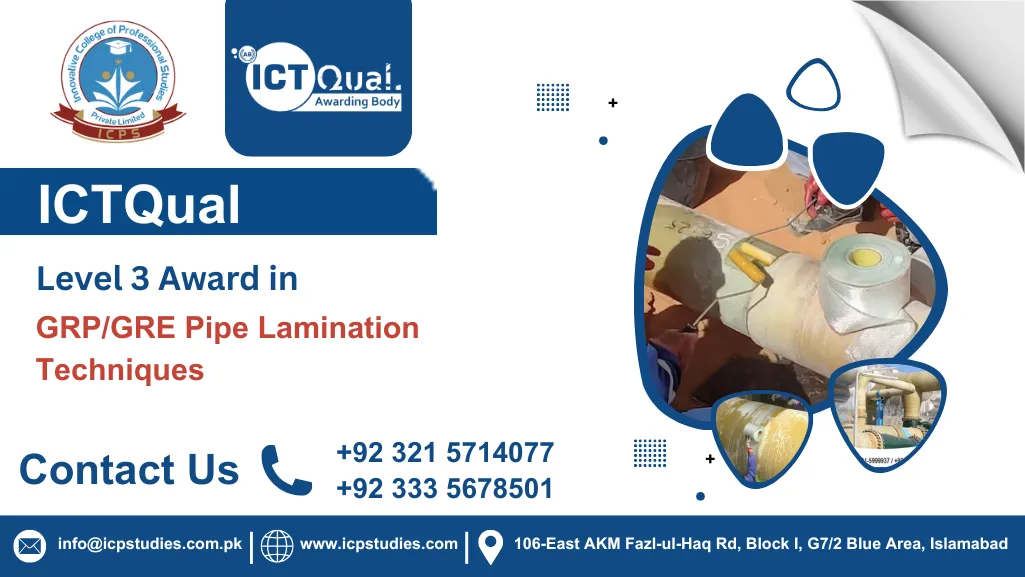
The ICTQual Level 3 Award in GRP/GRE Pipe Lamination Techniques is a specialized training program designed for professionals involved in the fabrication and production of GRP (Glass Reinforced Plastic) and GRE (Glass Reinforced Epoxy) pipes. This course provides comprehensive knowledge and hands-on experience in pipe lamination techniques, including fiber placement, resin application, curing processes, and quality assurance, ensuring participants gain practical expertise in producing high-quality composite pipes.
Participants will explore industry-standard lamination methods, understand material properties, and learn essential safety and quality control procedures relevant to GRP/GRE pipe manufacturing. The program is ideal for technicians, engineers, and production staff who want to specialize in composite pipe lamination, enhance their technical skills, and improve operational efficiency in manufacturing processes.
By completing the ICTQual Level 3 Award in GRP/GRE Pipe Lamination Techniques, professionals will be equipped to apply best practices in lamination, ensure compliance with industry standards, and advance their careers in GRP/GRE pipe fabrication and inspection across sectors such as water, oil and gas, chemical, and infrastructure projects.
All About ICTQual Level 3 Award in GRP/GRE Pipe Lamination Techniques
Course Overview
The ICTQual Level 3 Award in GRP/GRE Pipe Lamination Techniques is an intensive 3-day, 9-hour training program designed to equip professionals with advanced skills in composite pipe lamination. Structured into 8 study units, the course provides a comprehensive understanding of GRP (Glass Reinforced Plastic) and GRE (Glass Reinforced Epoxy) pipe lamination techniques, combining theoretical knowledge with practical hands-on sessions.
Participants will explore essential aspects of pipe lamination, including fiber winding, resin application, curing processes, surface finishing, and quality inspection. Emphasis is placed on applying industry-standard practices to ensure high-quality GRP/GRE pipe fabrication and compliance with safety and manufacturing regulations.
This program is ideal for technicians, engineers, production supervisors, and quality control personnel who want to enhance their expertise in GRP/GRE pipe lamination techniques. By completing the course, participants will gain the practical skills and technical knowledge needed to contribute effectively to composite pipe manufacturing operations, improve production efficiency, and maintain high-quality output in sectors such as water, oil and gas, chemical, and infrastructure projects.
To enroll in the ICTQual Level 3 Award in GRP/GRE Pipe Lamination Techniques, participants should meet the following criteria:
- Age Requirement:
Participants must be 18 years or older at the time of enrollment. - Educational Background:
A minimum of GCSEs or equivalent in Science, Mathematics, or Engineering is recommended. Candidates with hands-on experience in manufacturing or composite materials are also eligible. - Experience:
Prior exposure to pipe fabrication, lamination, or industrial manufacturing is advantageous but not mandatory. - English Language Proficiency:
Learners must have a good command of English, both written and spoken.
The ICTQual Lebvel 3 Award in GRP/GRE Pipe Lamination Techniques is designed for professionals seeking to specialize in composite pipe lamination and enhance their practical skills in GRP/GRE pipe fabrication. This course is ideal for:
- Technicians and operators involved in the production and lamination of GRP (Glass Reinforced Plastic) and GRE (Glass Reinforced Epoxy) pipes.
- Engineers working in manufacturing, oil & gas, water, chemical, and infrastructure projects who require practical knowledge of pipe lamination techniques.
- Quality control and inspection personnel responsible for ensuring compliance with industry standards in GRP/GRE pipe fabrication.
- Production supervisors and team leaders overseeing lamination processes and composite pipe manufacturing operations.
- Professionals seeking career advancement in the field of GRP/GRE pipe manufacturing, including roles in fabrication, inspection, and technical support.
By attending this course, participants will gain both theoretical understanding and hands-on experience in GRP/GRE pipe lamination techniques, enabling them to improve production efficiency, maintain high-quality standards, and excel in composite pipe manufacturing operations.
Study Units
This qualification, the ICTQual Level 3 Award in GRP/GRE Pipe Lamination Techniques, consists of 8 mandatory units.
- Introduction to Composite Materials and Pipes
- Fundamentals of Lamination Processes
- Filament Winding Technique
- Hand Lay-Up Process
- Spray-Up Lamination Method
- Pultrusion Technology
- Compression Molding Techniques
- Quality Control and Testing
Learning Outcomes
Here are the learning outcomes corresponding to each study unit:
Introduction to Composite Materials and Pipes
- Understand the fundamental properties of composite materials, including their mechanical strength, corrosion resistance, and thermal stability.
- Explain the advantages of GRP (Glass Reinforced Plastic) and GRE (Glass Reinforced Epoxy) Pipe Lamination Techniques in industrial, infrastructure, and water management applications.
- Recognize the critical role of lamination techniques in ensuring structural integrity, durability, and reliability of composite pipes.
- Identify various industry-specific applications of GRP/GRE pipes, including chemical processing, oil and gas, water distribution, and wastewater treatment.
- Analyze the performance benefits of composite pipes compared to traditional materials such as steel or concrete, focusing on weight reduction, flexibility, and maintenance efficiency.
Fundamentals of Lamination Processes
- Describe the principles of lamination, including resin infusion, fiber orientation, layering sequence, and curing methods.
- Compare different lamination techniques and determine the most suitable method based on pipe diameter, wall thickness, and intended application.
- Identify key factors that influence the quality and performance of laminated products, such as resin type, curing temperature, fiber alignment, and environmental conditions.
- Understand the importance of process control in lamination to prevent defects, ensure uniformity, and maintain product consistency.
- Evaluate the impact of material selection and process parameters on the mechanical, chemical, and thermal properties of composite pipes.
Filament Winding Technique
- Explain the filament winding process, including continuous and hoop winding, helical winding, and polar winding variations.
- Demonstrate proficiency in designing filament wound pipes to meet mechanical load requirements, pressure ratings, and structural standards.
- Evaluate the advantages of filament winding, including high strength-to-weight ratio, precise fiber placement, and automated production efficiency.
- Identify limitations of filament winding, such as material waste, tooling costs, and restrictions on complex geometries.
- Apply practical considerations for filament winding, including tension control, resin impregnation, and curing cycles.
Hand Lay-Up Process
- Perform the complete hand lay-up process, including mold preparation, surface treatment, resin application, and fiber placement.
- Assess the quality of hand lay-up laminates through visual inspection, thickness measurements, and mechanical testing.
- Implement measures to ensure uniform resin distribution, proper fiber wet-out, and elimination of voids or air pockets.
- Discuss practical applications of hand lay-up in small-scale production, repairs, or custom GRP/GRE pipe manufacturing.
- Understand safety protocols and best practices for handling resins, fibers, and chemicals during hand lay-up operations.
Spray-Up Lamination Method
- Understand the equipment setup and operation of spray-up machines for resin and fiber application.
- Analyze how process parameters such as spray pressure, nozzle angle, and fiber-to-resin ratio affect laminate quality and thickness.
- Implement post-processing steps such as trimming, sanding, and curing to enhance surface finish and mechanical properties.
- Evaluate the efficiency, versatility, and limitations of spray-up lamination for medium to large-scale pipe production.
- Monitor quality through visual inspections, thickness gauges, and adhesion testing.
Pultrusion Technology
- Describe the principles of pultrusion for producing continuous composite profiles and pipes with uniform cross-sections.
- Design pultruded GRP/GRE pipes considering reinforcement types, fiber orientation, resin systems, and surface finishes.
- Assess the advantages of pultrusion, including high productivity, dimensional accuracy, and consistent material properties.
- Understand limitations such as design flexibility constraints and initial tooling costs.
- Implement quality control measures during pultrusion to prevent defects such as warping, resin-rich or resin-poor areas, and delamination.
Compression Molding Techniques
- Explain the steps of compression molding, including mold preparation, fiber lay-up, resin injection, heat application, and curing.
- Design molds for complex geometries, internal features, and high-pressure applications, considering temperature, pressure, and curing cycles.
- Apply process optimization techniques to reduce cycle times while maintaining product quality.
- Implement quality assurance measures to ensure dimensional accuracy, surface finish, and structural integrity of molded pipes.
- Evaluate the advantages and limitations of compression molding in terms of cost, production speed, and applicability to various pipe sizes and shapes.
Quality Control and Testing
- Establish standard quality control procedures to assess dimensional accuracy, laminate integrity, and surface finish of GRP/GRE pipes.
- Apply non-destructive testing (NDT) methods such as ultrasonic testing, visual inspection, and hydrostatic testing to detect defects.
- Ensure compliance with industry standards and regulatory requirements for mechanical performance, pressure ratings, and chemical resistance.
- Monitor and document production processes to support traceability, audits, and continuous improvement initiatives.
- Analyze test results to implement corrective actions, improve process efficiency, and enhance the overall quality of composite pipe products.
FAQs ICTQual Level 3 Award in GRP/GRE Pipe Lamination Techniques