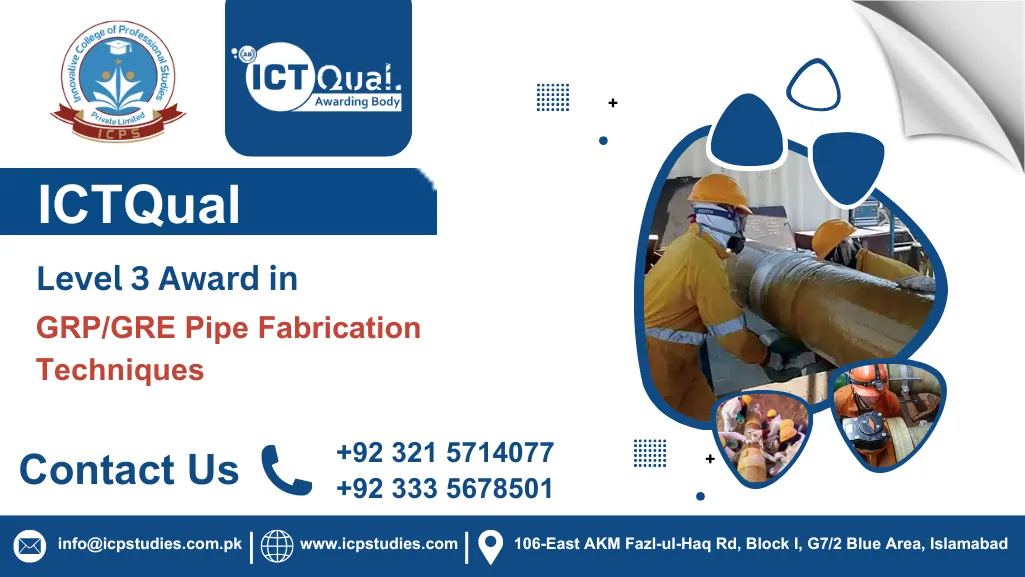
The ICTQual Level 3 Award in GRP/GRE Pipe Fabrication Techniques is a specialized professional training program designed for individuals involved in the fabrication, assembly, and quality assurance of composite piping systems. GRP (Glass Reinforced Plastic) and GRE (Glass Reinforced Epoxy) pipes are widely used in industries such as oil and gas, water treatment, chemical processing, and infrastructure projects, where durability, corrosion resistance, and compliance with industry standards are critical. This course equips participants with the practical skills and technical knowledge required to perform efficient, high-quality pipe fabrication while ensuring operational safety and long-term system performance.
The ICTQual Level 3 Award in GRP/GRE Pipe Fabrication Techniques focuses on key aspects of composite pipe production, including cutting, jointing, welding, bending, defect detection, and quality control procedures. Participants will also gain insights into fabrication best practices, material handling, and compliance with industry regulations, ensuring that GRP and GRE pipes are fabricated to meet stringent performance and safety requirements.
Through a combination of theoretical instruction, hands-on exercises, and real-world case studies, learners will develop the expertise needed to manage fabrication projects, oversee quality assurance, and optimize production processes. Completing the ICTQual Level 3 Award in GRP/GRE Pipe Fabrication Techniques prepares professionals to deliver safe, reliable, and high-performance composite piping systems across critical industrial and infrastructure applications.
All About ICTQual Level 3 Award in GRP/GRE Pipe Fabrication Techniques
Course Overview
The ICTQual Level 3 Award in GRP/GRE Pipe Fabrication Techniques is a 3-day, 9-hour intensive training program designed to provide professionals with comprehensive knowledge and practical skills in the fabrication of composite piping systems. This course focuses on Glass Reinforced Plastic (GRP) and Glass Reinforced Epoxy (GRE) pipes, which are widely used in industries such as oil and gas, water treatment, chemical processing, and infrastructure projects due to their strength, corrosion resistance, and durability.
Structured into 7 detailed study units, the program covers essential topics including material properties of GRP and GRE pipes, cutting and shaping techniques, jointing and welding methods, bending and assembly procedures, defect detection, quality assurance measures, and fabrication best practices. Participants will gain hands-on experience and technical expertise required to ensure that fabricated pipes meet stringent industry standards and performance requirements.
The ICTQual Level 3 Award in GRP/GRE Pipe Fabrication Techniques combines theoretical instruction, practical exercises, and real-world case studies, allowing learners to apply their skills directly to industrial and infrastructure projects. By the end of the program, participants will be able to oversee fabrication operations, implement quality control procedures, detect and rectify defects, and contribute to the production of safe, reliable, and high-performance GRP and GRE piping systems.
This course is ideal for fabrication engineers, production supervisors, quality control personnel, and technical specialists seeking to advance their expertise in composite pipe fabrication techniques.
To enroll in the ICTQual Level 3 Award in GRP/GRE Pipe Fabrication Techniques, participants should meet the following criteria to ensure they can fully benefit from the training:
- Age Requirement:
Participants must be 18 years or older at the time of enrollment. - Educational Background:
Participants should ideally have a technical diploma, vocational qualification, or degree in engineering, materials, manufacturing, or a related field. Candidates with relevant practical experience in pipe fabrication or industrial projects may also be considered. - Experience:
Some experience in pipe fabrication, jointing, welding, or industrial production processes is desirable. Knowledge of GRP and GRE materials, fabrication procedures, and quality control practices is advantageous. - English Language Proficiency:
Learners must have a good command of English, both written and spoken.
The ICTQual Level 3 Award in GRP/GRE Pipe Fabrication Techniques is ideal for professionals involved in the fabrication, assembly, and quality assurance of composite piping systems. This course is particularly suitable for:
- Fabrication Engineers and Technicians responsible for assembling, welding, and shaping GRP and GRE pipes.
- Site Supervisors and Project Managers overseeing pipe fabrication operations and quality control processes.
- Quality Assurance and Quality Control Personnel tasked with inspecting fabricated pipes, detecting defects, and ensuring compliance with industry standards.
- Materials Engineers and Technical Specialists seeking practical knowledge of jointing, bending, welding, and defect detection in composite pipes.
- Professionals working in industries such as oil and gas, water treatment, chemical processing, and infrastructure projects, where safe and durable GRP and GRE piping systems are critical.
This course is designed for individuals aiming to enhance fabrication skills, quality assurance practices, and production efficiency, contributing to the creation of safe, reliable, and high-performance GRP and GRE piping systems.
Study Units
This qualification, the ICTQual Level 3 Award in GRP/GRE Pipe Fabrication Techniques, consists of 7 mandatory units.
- Introduction to Composite Materials
- Fundamentals of Pipe Fabrication
- Composite Materials in Pipe Fabrication
- Fabrication Techniques
- Quality Control and Assurance
- Health and Safety in Pipe Fabrication
- Environmental Sustainability in Pipe Fabrication
Learning Outcomes
Here are the learning outcomes corresponding to each study unit:
1. Introduction to Composite Materials
- Understand the properties and advantages of composite materials, with emphasis on GRP and GRE pipes.
- Explain the role of composite materials in modern industry, including corrosion resistance and durability.
- Identify the differences between traditional piping systems and composite pipes.
- Demonstrate awareness of the lifecycle, performance benefits, and industrial applications of composite materials.
- Develop foundational knowledge to support advanced study of GRP/GRE Pipe Fabrication Techniques.
2. Fundamentals of Pipe Fabrication
- Gain an in-depth understanding of the core principles of pipe fabrication and installation.
- Learn about essential fabrication tools, equipment, and safety practices.
- Apply knowledge of industry standards to ensure accuracy in fabrication processes.
- Explore how fabrication fundamentals support the production of reliable GRP and GRE piping systems.
- Recognise fabrication errors and methods of prevention.
3. Composite Materials in Pipe Fabrication
- Analyse the behaviour of composite materials during the fabrication process.
- Understand the interaction of GRP and GRE materials with adhesives, resins, and reinforcement.
- Apply material science principles to achieve strong and reliable pipe joints.
- Identify best practices for handling composite materials to prevent damage or defects.
- Evaluate material suitability for diverse industry applications such as oil, gas, and water systems.
4. Fabrication Techniques
- Master a range of GRP/GRE Pipe Fabrication Techniques, including cutting, lamination, and jointing.
- Understand both manual and mechanised fabrication methods.
- Apply precision techniques to ensure structural integrity and compliance with international standards.
- Gain practical experience in assembling and finishing composite pipe systems.
- Troubleshoot common fabrication challenges and develop effective solutions.
5. Quality Control and Assurance
- Learn how to apply rigorous quality control procedures during fabrication.
- Conduct inspection and testing to ensure compliance with industry regulations.
- Understand the importance of documentation and reporting in QA/QC processes.
- Apply statistical methods to identify and correct deviations in fabrication.
- Ensure fabricated pipes meet durability, safety, and performance benchmarks.
6. Health and Safety in Pipe Fabrication
- Identify workplace hazards in pipe fabrication and apply appropriate risk management strategies.
- Implement best practices for safe handling of tools, resins, and composite materials.
- Understand health regulations and compliance requirements in fabrication workshops.
- Develop competence in the safe operation of fabrication machinery.
- Promote a culture of safety and responsibility in fabrication environments.
7. Environmental Sustainability in Pipe Fabrication
- Understand the environmental impact of composite material production and use.
- Apply sustainable practices in GRP/GRE fabrication to reduce waste and emissions.
- Explore eco-friendly alternatives in adhesives, resins, and recycling methods.
- Learn strategies for optimising resource efficiency in fabrication projects.
- Promote sustainability while ensuring compliance with environmental standards and policies.
FAQs ICTQual Level 3 Award in GRP/GRE Pipe Fabrication Techniques