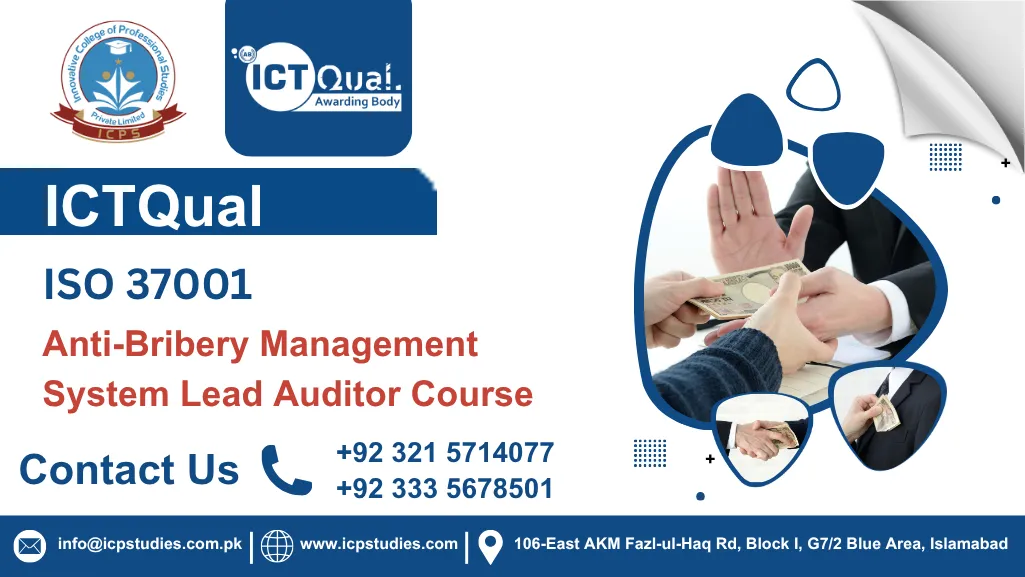
The ICTQual ISO 37001 Anti-Bribery Management System Lead Auditor Course is a professionally designed training program that equips learners with the expertise to audit and evaluate anti-bribery management systems in accordance with internationally recognized standards. In today’s global business environment, organizations face increasing pressure to demonstrate transparency, ethical conduct, and compliance with anti-corruption regulations. This course provides a comprehensive understanding of ISO 37001 requirements and the critical role of auditing in preventing, detecting, and addressing bribery risks.
Participants will develop in-depth knowledge of anti-bribery frameworks, including risk assessment, due diligence, internal controls, reporting mechanisms, and continual improvement processes. The course focuses on building practical auditing skills, enabling learners to plan, conduct, and manage audits effectively while ensuring compliance with ISO 37001 guidelines.
Designed for auditors, compliance officers, legal professionals, and governance specialists, this course combines theoretical concepts with real-world applications to ensure a practical learning experience. By completing this program, participants will be well-prepared to support organizations in strengthening ethical practices, enhancing corporate integrity, and mitigating bribery risks, ultimately contributing to sustainable business operations and global trust.
All About ICTQual ISO 37001 Anti-Bribery Management System Lead Auditor Course
Course Overview
The ICTQual ISO 37001 Anti-Bribery Management System Lead Auditor Course is a structured 5-day training program comprising 8 comprehensive study units, designed to develop advanced auditing expertise in anti-bribery management systems. This course provides a detailed understanding of how organizations establish, implement, maintain, and improve anti-bribery controls in line with ISO 37001 requirements.
Throughout the program, participants will explore key topics such as anti-bribery policies, risk assessment methodologies, due diligence procedures, financial and non-financial controls, reporting mechanisms, and investigation processes. The course also delivers in-depth knowledge of audit principles, audit planning, conducting on-site and remote audits, evidence collection, and reporting nonconformities.
Each of the 8 study units is carefully designed to ensure a balance between theoretical knowledge and practical application. Learners will engage in real-world case studies, audit simulations, and interactive exercises to strengthen their ability to assess compliance and identify potential bribery risks within organizational systems.
By the end of this intensive 5-day training, participants will be equipped with the skills to lead anti-bribery audits confidently, support regulatory compliance, and contribute to building transparent, ethical, and resilient organizations across various sectors.
To enroll in the ICTQual ISO 37001 Anti-Bribery Management System Lead Auditor Course, applicants should meet the following criteria:
- Age Requirement:
Learners must be at least 18 years of age at the time of enrollment. - Educational Background:
A minimum of a high school diploma or equivalent qualification is required. However, a background in business administration, law, finance, compliance, or a related field is highly recommended to effectively understand anti-bribery frameworks and auditing concepts. - Experience:
Prior knowledge or experience in compliance, auditing, risk management, governance, or legal advisory roles is beneficial but not mandatory. Professionals working as auditors, compliance officers, risk managers, or quality assurance personnel will gain the most value from this course. Familiarity with ISO management systems or regulatory compliance standards will be an added advantage. - English Language Proficiency:
Learners must have a good command of English, both written and spoken.
The ICTQual ISO 37001 Anti-Bribery Management System Lead Auditor Course is designed for professionals who are responsible for ensuring ethical practices, regulatory compliance, and anti-corruption measures within organizations. This course is particularly suitable for:
- Lead Auditors and Internal Auditors seeking to specialize in auditing anti-bribery management systems in line with ISO 37001
- Compliance Officers and Ethics Managers responsible for implementing and monitoring anti-bribery and anti-corruption frameworks
- Risk Management Professionals focused on identifying, assessing, and mitigating bribery and corruption risks
- Legal Advisors and Corporate Governance Professionals involved in regulatory compliance, corporate ethics, and legal risk management
- Quality Assurance and Management System Professionals looking to expand their expertise into anti-bribery auditing
- Finance and Procurement Professionals managing financial controls, vendor relationships, and due diligence processes
- Consultants and Advisors providing services in compliance, governance, and anti-bribery management systems
- Senior Managers and Decision-Makers aiming to strengthen transparency, accountability, and ethical business practices
- Graduates and Aspiring Professionals who want to build a career in auditing, compliance, or corporate governance
This course is ideal for individuals who want to lead anti-bribery audits, ensure compliance with international standards, and enhance organizational integrity in a competitive global environment.
Study Units
This qualification, the ICTQual ISO 37001 Anti-Bribery Management System Lead Auditor Course, consists of 8 mandatory units.
- Introduction to Anti-Bribery Management Systems (ABMS):
- ISO 37001 Requirements:
- Risk Assessment and Due Diligence:
- Compliance Measures and Controls:
- Auditing Principles and Practices:
- Audit Process for ISO 37001:
- Legal and Regulatory Framework:
- Continuous Improvement and Follow-up Audits:
Learning Outcomes:
Learning Outcomes for the Study Units:
- Introduction to Anti-Bribery Management Systems (ABMS):
- Understand the concept of bribery and corruption risks in business environments.
- Explain the significance of ISO 37001 in preventing bribery and promoting ethical business practices.
- Identify the benefits of implementing an Anti-Bribery Management System (ABMS) within organizations.
- ISO 37001 Requirements:
- Describe the structure, scope, and key clauses of the ISO 37001 standard.
- Interpret specific requirements related to anti-bribery policies, procedures, controls, and processes.
- Evaluate an organization’s compliance with ISO 37001 requirements.
- Risk Assessment and Due Diligence:
- Apply methods for identifying, assessing, and prioritizing bribery risks within organizations.
- Conduct due diligence processes to assess the integrity and reliability of business partners, suppliers, and third parties.
- Develop risk mitigation strategies to minimize the likelihood and impact of bribery incidents.
- Compliance Measures and Controls:
- Implement effective compliance measures and controls to prevent, detect, and address bribery.
- Design training, communication, and awareness programs to promote a culture of integrity and ethical behavior.
- Monitor and evaluate the effectiveness of compliance measures to ensure ongoing improvement.
- Auditing Principles and Practices:
- Explain the fundamental principles, methodologies, and techniques of auditing.
- Apply auditing principles to plan, conduct, and report on audits of anti-bribery management systems.
- Identify opportunities for improvement and provide recommendations based on audit findings.
- Audit Process for ISO 37001:
- Plan and prepare for ISO 37001 audits, considering scope, objectives, and audit criteria.
- Conduct on-site audits, including document reviews, interviews, and observations.
- Document audit findings, identify non-conformities, and develop corrective actions in accordance with ISO 37001 requirements.
- Legal and Regulatory Framework:
- Summarize relevant laws, regulations, and international conventions related to bribery and corruption.
- Assess the legal obligations and implications for organizations operating in different jurisdictions.
- Develop strategies for ensuring compliance with legal and regulatory requirements related to anti-bribery management.
- Continuous Improvement and Follow-up Audits:
- Implement processes for driving continuous improvement in anti-bribery management systems.
- Conduct follow-up audits to verify the effectiveness of corrective actions and improvements.
- Monitor performance metrics and key indicators to assess the ongoing effectiveness of anti-bribery measures.
FAQs ICTQual ISO 37001 Anti-Bribery Management System Lead Auditor Course