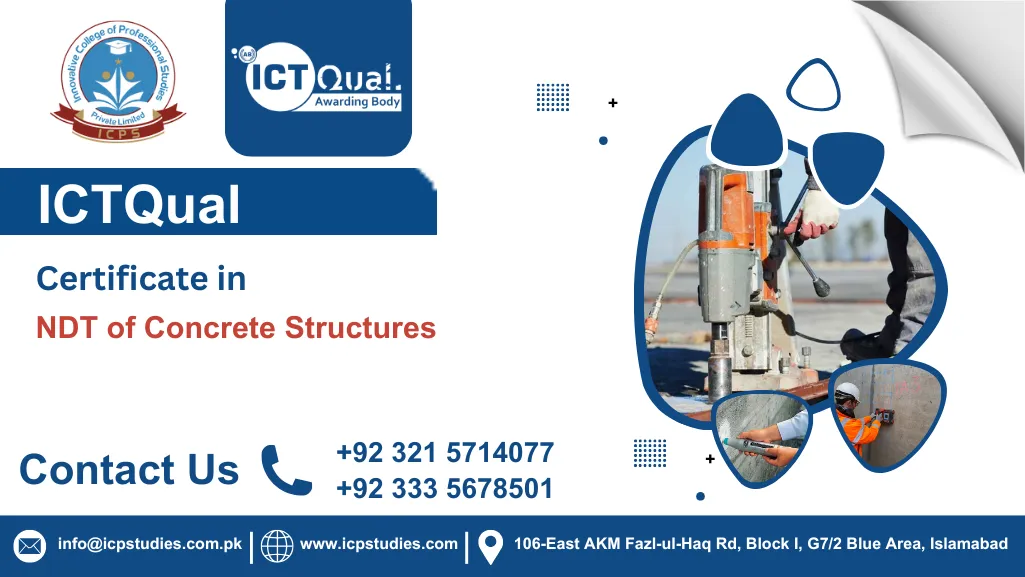
Advance your professional skills with the ICTQual Certificate in NDT of Concrete Structures, a specialized training program designed for engineers, construction inspectors, and quality assurance professionals. This course equips participants with the knowledge and practical skills to perform Non-Destructive Testing (NDT) on concrete structures, ensuring structural integrity, safety, and compliance with industry standards.
Through a combination of theoretical instruction and hands-on practice, learners gain expertise in advanced NDT techniques, including rebound hammer testing, ultrasonic pulse velocity, cover meter surveys, and visual inspections. The course emphasizes the identification of cracks, voids, corrosion, and other structural defects without compromising the integrity of the concrete, enabling accurate assessment of strength, durability, and maintenance requirements.
Delivered by ICTQual AB, an internationally recognized awarding body, this certification validates technical competency in concrete inspection and NDT methods, enhancing professional credibility and career opportunities in civil engineering, construction management, and structural safety. By the end of the program, participants will be able to effectively evaluate concrete quality, interpret test results, and support maintenance and safety decisions for critical infrastructure
All About ICTQual Certificate in NDT of Concrete Structures
Course Overview
The ICTQual Certificate in NDT of Concrete Structures is a 6-day intensive training program structured into six comprehensive study units, designed to provide both theoretical knowledge and practical expertise in the non-destructive testing of concrete. Each unit focuses on a critical aspect of concrete assessment, covering material properties, inspection standards, NDT methodologies, defect identification, structural evaluation, and safety procedures.
Participants will gain hands-on experience using industry-standard NDT equipment, including rebound hammers, ultrasonic pulse velocity devices, and cover meters, to accurately detect cracks, voids, corrosion, and other structural deficiencies. The program emphasizes real-world applications, ensuring learners can assess structural integrity, interpret test results, and provide actionable maintenance recommendations for a wide range of infrastructure, including buildings, bridges, dams, and industrial facilities.
By completing this course, attendees will acquire the technical competence to conduct reliable inspections, comply with international testing standards, and contribute to the safety and longevity of concrete structures. Ideal for engineers, quality inspectors, and construction professionals, this program strengthens practical skills, enhances career prospects, and provides essential knowledge for maintaining safe and durable concrete infrastructure.
To enroll in the ICTQual Certificate in NDT of Concrete Structures, candidates must meet the following criteria:
- Age Requirement:
Participants must be at least 18 years old. - Educational Background:
Minimum of high school diploma or equivalent. Candidates with technical or vocational qualifications in civil engineering, construction, or materials testing are preferred. - Experience:
Ideally, candidates should have at least 1 year of practical experience in construction, structural inspection, civil engineering projects, or related fields. - English Language Proficiency:
Learners must have a good command of English, both written and spoken.
The ICTQual Certificate in NDT of Concrete Structures is ideal for professionals involved in the construction, engineering, and infrastructure sectors who are responsible for structural integrity and safety. This course is particularly suited for:
- Civil Engineers and Structural Engineers seeking to enhance their skills in concrete evaluation and quality assurance.
- Construction Inspectors and Site Supervisors responsible for monitoring concrete quality and compliance with industry standards.
- Quality Assurance and Control Professionals involved in testing and verifying the durability and safety of concrete structures.
- Maintenance and Asset Management Personnel who oversee structural inspections and preventive maintenance programs.
- Consultants and Safety Officers working on bridges, dams, buildings, and industrial infrastructure where concrete integrity is critical.
By completing this program, participants gain the expertise to perform accurate non-destructive testing (NDT), interpret results, identify defects, and make informed decisions that ensure long-term structural safety and compliance with international standards.
Study Units
This qualification, the ICTQual Certificate in NDT of Concrete Structures, consists of 6 mandatory units.
- Introduction to Concrete Technology
- Fundamentals of Non-Destructive Testing (NDT)
- Specific NDT Techniques for Concrete Structures
- Quality Assurance and Standards
- Safety and Ethics in NDT
- Project Management and Reporting
Learning Outcomes:
Learning Outcomes for the Study Units:
Introduction to Concrete Technology
- Understanding Concrete Composition: Gain knowledge of the materials used in concrete and their properties.
- Behavior of Concrete: Learn about how concrete behaves under different conditions and over time.
- Role of NDT in Concrete Assessment: Understand the importance of non-destructive testing (NDT) in evaluating concrete quality and integrity.
Fundamentals of Non-Destructive Testing (NDT)
- Principles of NDT: Learn the basic principles and methodologies of non-destructive testing techniques.
- Wave Propagation: Understand how waves (such as sound waves or electromagnetic waves) interact with concrete to detect defects.
- Interpretation of Test Results: Develop skills in interpreting NDT results to identify defects and assess concrete condition.
Specific NDT Techniques for Concrete Structures
- Ultrasonic Testing (UT): Master the use of sound waves to detect internal flaws and measure thickness in concrete.
- Ground Penetrating Radar (GPR): Learn to use electromagnetic radiation to evaluate concrete condition and detect embedded objects.
- Impact-Echo Testing: Understand the analysis of acoustic responses to identify defects like voids or delaminations.
- Rebound Hammer Test: Gain proficiency in measuring concrete strength through surface hardness.
Quality Assurance and Standards
- Standards and Regulations: Understand national and international standards and regulations governing NDT in concrete structures.
- Quality Assurance Practices: Learn techniques to ensure quality and safety in concrete construction projects through rigorous inspection and testing.
Safety and Ethics in NDT
- Safety Protocols: Understand and adhere to safety protocols while performing NDT tests on concrete structures.
- Ethical Considerations: Learn about the ethical responsibilities of NDT professionals, including accuracy, integrity, and confidentiality of inspection results.
Project Management and Reporting
- Project Planning: Develop skills in planning NDT inspections, including scheduling and resource management.
- Reporting and Documentation: Learn to prepare clear and comprehensive inspection reports, documenting findings and recommendations for stakeholders.
FAQs ICTQual Certificate in NDT of Concrete Structures