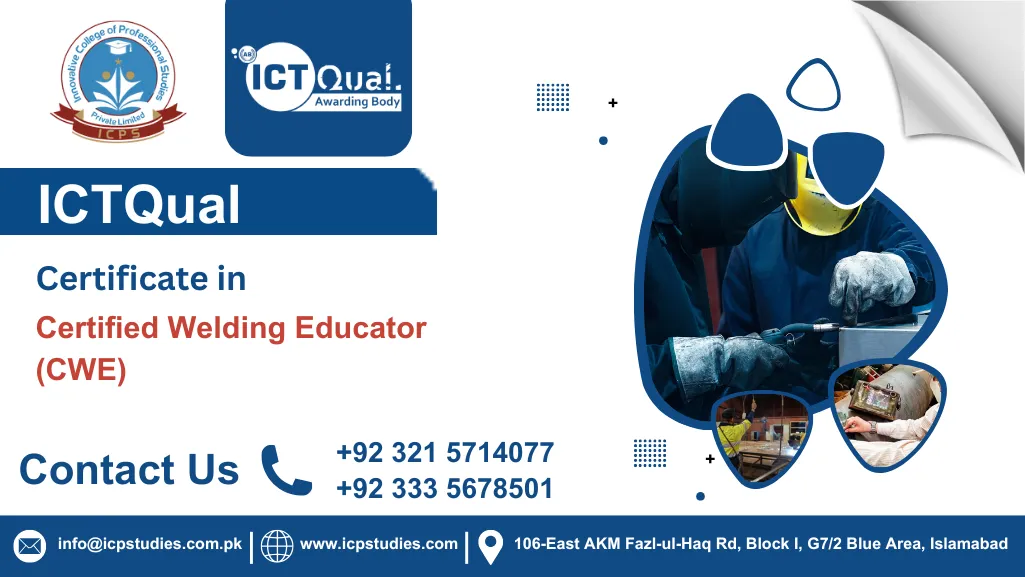
The ICTQual Certificate in Certified Welding Educator (CWE) is a specialized professional training program designed to equip instructors, trainers, and technical professionals with the skills and knowledge required to teach welding effectively. In industries where welding safety, quality, and efficiency are paramount, the role of a qualified welding educator has become essential for ensuring consistent workforce development and high standards in industrial welding training.
This course provides participants with comprehensive insights into welding principles, instructional techniques, curriculum development, and classroom management for practical welding education. Learners gain hands-on experience in demonstrating welding processes, evaluating student performance, and implementing safety and quality protocols. The program emphasizes effective communication, teaching methodologies, and assessment strategies to help participants deliver engaging, industry-relevant training programs.
The ICTQual Certificate in Certified Welding Educator (CWE) is ideal for welding instructors, technical trainers, supervisors, and professionals responsible for developing welding programs or training teams. By completing this course, participants enhance their ability to teach complex welding processes, improve learner outcomes, and contribute to workforce development in sectors such as manufacturing, fabrication, aerospace, automotive, and oil and gas. Graduates leave with the expertise, confidence, and credibility needed to excel as professional Certified Welding Educators (CWE).
All About ICTQual Certificate in Certified Welding Educator (CWE)
Course Overview
The ICTQual Certificate in Certified Welding Educator (CWE) is a comprehensive 12-day training program designed to develop advanced skills in welding education and instructor-led industrial training. Structured into 9 study units, the course combines theoretical knowledge with practical teaching experience, enabling participants to deliver effective and safe welding training programs in real-world industrial settings.
Participants will gain expertise in curriculum design, instructional strategies, safety management, and practical demonstration techniques. The program emphasizes hands-on teaching practice, assessment of learner performance, and application of industry-standard procedures, ensuring participants can manage workshops and training sessions confidently.
This course is ideal for welding instructors, technical trainers, supervisors, and professionals responsible for workforce development in manufacturing, fabrication, aerospace, automotive, and oil and gas industries. By completing the Certified Welding Educator (CWE) program, participants enhance their industrial welding skills, strengthen their ability to guide learners effectively, and contribute to high-quality workforce training, operational safety, and productivity.
The ICTQual Certificate in Certified Welding Educator (CWE) is designed for professionals seeking to enhance their expertise in welding education and deliver effective, industry-standard training to welders and technical personnel. To ensure participants fully benefit from this program, the following entry requirements are recommended:
- Age Requirement:
Participants must be at least 21 years old to enroll, ensuring sufficient maturity and professional experience for teaching and supervising welding operations. - Educational Background:
A high school diploma or equivalent is required, with a preference for candidates holding technical or engineering qualifications in welding, fabrication, or related disciplines. - Experience:
At least 2–3 years of practical experience in welding, fabrication, or industrial training is recommended. Prior experience in instructing, mentoring, or managing welding operations is an advantage. - English Language Proficiency:
Learners must have a good command of English, both written and spoken.
The ICTQual Certificate in Certified Welding Educator (CWE) is designed for professionals who want to enhance their ability to teach welding skills effectively and develop competent industrial personnel. It is ideal for individuals responsible for workforce development, training programs, and ensuring high-quality welding operations in industrial settings.
- Welding Instructors & Trainers: Professionals seeking to deliver structured, hands-on welding training programs.
- Technical Supervisors & Workshop Managers: Individuals overseeing welding teams who want to improve training standards and operational efficiency.
- Quality Assurance & Control Personnel: Professionals responsible for maintaining welding quality and compliance through proper instruction and guidance.
- Engineers & Technical Experts: Welding engineers and industrial specialists aiming to expand their teaching and mentoring capabilities.
- Career-Oriented Professionals: Individuals pursuing professional growth in welding education or aiming to become recognized as certified trainers in the welding industry.
By completing this course, participants gain the knowledge, practical teaching skills, and confidence to deliver professional welding education, improve learner outcomes, and contribute to safe, efficient, and high-quality industrial welding operations.
Study Units
This qualification, the ICTQual Certificate in Certified Welding Educator (CWE) consists of 9 mandatory units.
- Introduction to Welding Education
- Welding Processes and Techniques
- Materials and Metallurgy
- Welding Design and Symbols
- Welding Safety and Health
- Instructional Methods and Strategies
- Advanced Welding Topics
- Professional Development
- Capstone Project
Learning Outcomes
Learning Outcomes for the Study Units:
1. Introduction to Welding Education
- Understand the fundamental role and responsibilities of a welding educator.
- Analyze various educational philosophies and their application in welding instruction.
- Apply learning theories to enhance student engagement and retention in welding courses.
2. Welding Processes and Techniques
- Demonstrate proficiency in Shielded Metal Arc Welding (SMAW), Gas Metal Arc Welding (GMAW), Gas Tungsten Arc Welding (GTAW), and Flux-Cored Arc Welding (FCAW).
- Identify appropriate welding processes for different materials and applications.
- Troubleshoot and resolve common issues in various welding processes.
3. Materials and Metallurgy
- Explain the physical and mechanical properties of metals commonly used in welding.
- Understand the principles of metallurgy and their implications on welding practices.
- Analyze the effects of welding on metal properties and employ techniques to control these effects.
4. Welding Design and Symbols
- Apply welding design principles to create effective and safe welds and joints.
- Interpret welding symbols and blueprints accurately.
- Utilize structural welding codes and standards in design and instructional settings.
5. Welding Safety and Health
- Implement comprehensive safety practices in welding environments.
- Identify and mitigate health hazards associated with welding processes.
- Ensure proper selection and use of personal protective equipment (PPE) in welding operations.
6. Instructional Methods and Strategies
- Develop and design effective welding curricula that meet industry standards.
- Employ a variety of teaching techniques, including lectures, demonstrations, and hands-on training, tailored to welding education.
- Manage classroom dynamics effectively to foster a positive and productive learning environment.
7. Advanced Welding Topics
- Understand and apply non-destructive testing (NDT) methods such as ultrasonic testing, radiographic testing, and magnetic particle testing.
- Explore the applications and benefits of welding automation and robotics.
- Stay informed about emerging technologies in the welding industry, including additive manufacturing and advanced materials.
8. Professional Development
- Recognize the importance of continuing education and lifelong learning in welding education.
- Identify additional certifications and credentials that can enhance career prospects.
- Develop strategies for building professional networks and staying engaged with industry developments.
9. Capstone Project
- Apply theoretical knowledge and practical skills in a comprehensive capstone project.
- Demonstrate competency in designing and executing a real-world welding education scenario.
- Present the capstone project effectively, showcasing readiness to become a Certified Welding Educator.
FAQs ICTQual Certificate in Certified Welding Educator (CWE)