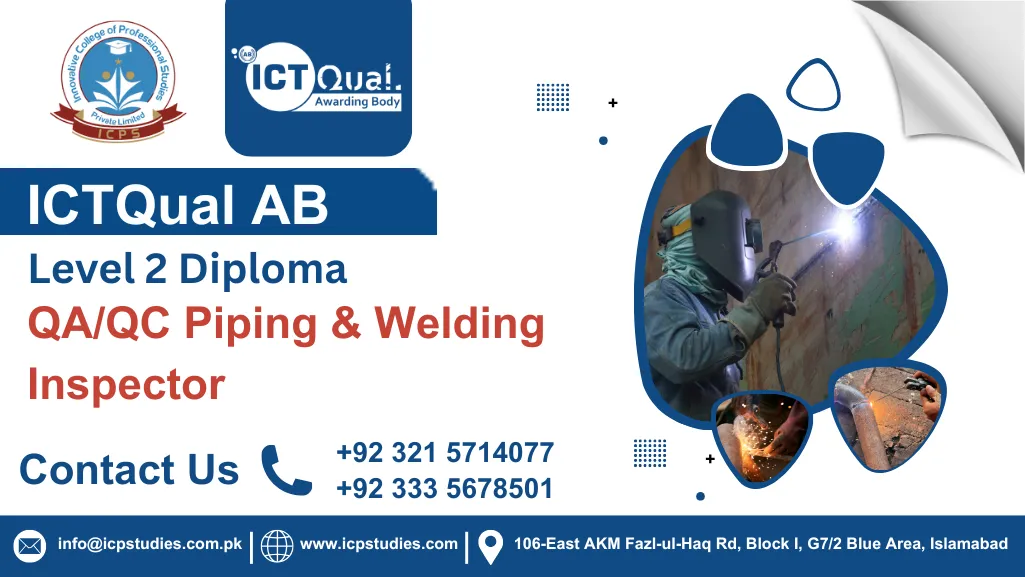
Every strong engineering project begins with a commitment to quality. Before pipelines are commissioned or welded structures are put into service, every component must be carefully inspected to ensure it meets the required standards. The ICTQual AB Level 2 Diploma in QA/QC Piping & Welding Inspector is a professional certification that introduces the essential principles of quality assurance and quality control within piping and welding inspection. It provides a practical understanding of how inspection contributes to safe, reliable, and consistent engineering operations.
This certification covers the fundamental concepts of QA/QC, including piping inspection, welding inspection, quality control procedures, inspection methods, quality documentation, material verification, and recognised industry practices. Learners explore how inspection activities support fabrication, installation, testing, and commissioning processes while developing an understanding of inspection records, quality monitoring, and compliance requirements. The course is designed to present these topics in a clear, structured, and easy-to-follow format that reflects current industrial practices.
The ICTQual AB Level 2 Diploma in QA/QC Piping & Welding Inspector also highlights the importance of accuracy, consistency, and professional responsibility in maintaining quality standards. By combining core inspection knowledge with practical quality management concepts, this certification helps learners understand the role of effective QA/QC in reducing defects, supporting compliance, and contributing to dependable engineering projects across a wide range of industrial environments.
All About ICTQual AB Level 2 Diploma in QA/QC Piping & Welding Inspector
Course Overview
The ICTQual AB Level 2 Diploma in QA/QC Piping & Welding Inspector is an assignment based certification awarded by ICTQual AB. The certification is organised into 5 mandatory units and carries a total of 20 credits, providing a clear and structured programme for learning and assessment. The course follows a well-defined framework that supports consistent progress throughout the certification.
The programme consists of 5 mandatory units, with each unit contributing to the overall 20 credit structure. Assessment is completed through assignments, allowing learners to demonstrate their understanding of the course content without formal examinations. The assignment-based format provides an organised approach to completing each unit and the overall certification.
Awarded by ICTQual AB, the ICTQual AB Level 2 Diploma in QA/QC Piping & Welding Inspector combines 5 mandatory units, a 20-credit programme, and assignment based assessment within a single certification structure. This organised framework provides a clear learning and assessment pathway while maintaining consistency throughout the programme.
Entery Requirment
To enrol in the ICTQual AB Level 2 Diploma in QA/QC Piping & Welding Inspector, learners are expected to meet the following entry requirements:
- Age Requirement: Applicants must be at least 16 years of age at the time of enrolment.
- Educational Background: Learners should hold a Level 1 Diploma or an equivalent qualification related fields.
- English Language Proficiency: Learners should have basic command of the English language.
- Work Experience: No prior work experience is required.
Study Units
This qualification, the ICTQual AB Level 2 Diploma in QA/QC Piping & Welding Inspector, consists of 5 mandatory units.
- Intermediate Inspection Techniques: Tolerances & Dimensional Checks
- Piping Layouts, Joint Types & Welding Processes
- Non‑Destructive Testing Basics: Dye Penetrant & Magnetic Particle
- Inspection Planning: Test Plans, Checklists & Corrective Actions
- Industry Standards & Regulatory Compliance for Welding & Piping
Learning Outcomes:
Learning Outcomes for the ICTQual AB Level 2 Diploma in QA/QC Piping & Welding Inspector:
Intermediate Inspection Techniques: Tolerances & Dimensional Checks
- Apply tolerance measurement methods to ensure components meet specified design criteria.
- Conduct dimensional checks using appropriate inspection tools and instruments.
- Interpret engineering drawings and specifications to verify accuracy in fabrication.
- Identify and report deviations or non-conformities in piping and welding assemblies.
- Demonstrate practical inspection skills for maintaining quality standards in industrial projects.
Piping Layouts, Joint Types & Welding Processes
- Understand piping layouts and their relevance to system design and installation.
- Differentiate between joint types and select suitable methods for specific applications.
- Explain welding processes commonly used in piping fabrication and construction.
- Assess the quality of welds based on visual inspection and technical standards.
- Relate layout and joint selection to overall project efficiency and safety.
Non‑Destructive Testing Basics: Dye Penetrant & Magnetic Particle
- Describe the principles of non-destructive testing (NDT) in welding inspection.
- Apply dye penetrant testing to detect surface cracks and discontinuities.
- Perform magnetic particle testing for identifying subsurface defects in welds.
- Evaluate test results and document findings according to inspection protocols.
- Recognize the limitations and applications of each NDT method in industry.
Inspection Planning: Test Plans, Checklists & Corrective Actions
- Develop inspection test plans aligned with project requirements and standards.
- Utilize checklists to ensure systematic and consistent inspection practices.
- Identify non-conformities and recommend corrective actions to maintain quality.
- Coordinate inspection activities with project teams for effective implementation.
- Demonstrate competence in reporting and documentation of inspection outcomes.
Industry Standards & Regulatory Compliance for Welding & Piping
- Interpret international welding and piping standards (e.g., ASME, API, ISO).
- Apply regulatory compliance requirements in inspection and quality assurance.
- Ensure safety and environmental considerations are integrated into inspection practices.
- Evaluate projects against legal and contractual obligations for quality control.
- Promote adherence to best practices and ethical standards in industrial inspection.
Ideal Candidate
Every successful quality professional starts with a strong understanding of the basics. The ICTQual AB Level 2 Diploma in QA/QC Piping & Welding Inspector is designed for individuals who want to develop practical knowledge of inspection processes and quality control in piping and welding. It provides a structured starting point for understanding how quality contributes to safe and reliable engineering operations.
- Individuals interested in learning the fundamentals of QA/QC piping and welding inspection.
- Beginners who want to develop knowledge of quality assurance and quality control practices.
- New entrants to the engineering, fabrication, or manufacturing sectors.
- Personnel involved in piping, welding, or fabrication support activities.
- Site assistants who contribute to inspection and quality-related tasks.
- Team members responsible for maintaining inspection records and quality documentation.
- Individuals working in construction, oil and gas, petrochemical, manufacturing, or infrastructure projects.
- Professionals who want to strengthen their understanding of quality standards and inspection procedures.
- Employees supporting quality control activities within engineering environments.
- Anyone seeking a recognised certification in QA/QC piping and welding inspection.
FAQs ICTQual AB Level 2 Diploma in QA/QC Piping & Welding Inspector