
Quality Assurance in Education and Training: A Practical Guide
Education and training quality assurance is essential for ensuring that learners receive effective teaching, relevant learning materials, fair assessments and meaningful opportunities to develop their knowledge and skills. Whether an organisation operates a school, college, vocational training centre, professional development programme or online learning platform, a structured approach to quality helps maintain educational standards and identify areas for improvement.
Quality assurance in education and training is the systematic process of checking whether teaching, learning, assessment and educational management meet defined standards and achieve their intended outcomes. It involves reviewing performance, collecting evidence, listening to learner feedback, monitoring assessment practices and taking corrective action when improvements are needed.
For education providers, quality assurance is not simply a documentation exercise or a process completed before an inspection. It should form part of everyday management and professional practice. Effective quality assurance helps organisations understand what works, recognise weaknesses, improve learner experiences and make informed decisions about future development.
This practical guide explains the principles of education quality assurance, the methods used to evaluate training programmes, the importance of learner feedback and the steps organisations can follow to establish a continuous improvement process. It also explores how learners interested in education and training management can develop the knowledge needed to contribute to quality improvement.
Key Takeaways
- Quality assurance helps education and training providers maintain consistent standards.
- Effective quality assurance examines teaching, assessment, learner progress and educational management.
- Learner feedback provides valuable evidence for improving educational provision.
- Performance indicators and evaluation methods help organisations identify strengths and weaknesses.
- Continuous improvement requires clear responsibilities, reliable evidence and regular reviews.
- Quality assurance practices must reflect the relevant regulatory, accreditation and awarding-body requirements.
- Professional development helps teachers, trainers and education managers improve their quality assurance knowledge and skills.
What is Quality Assurance in Education and Training?
Education quality assurance is a structured approach to maintaining and improving the quality of educational provision. It involves establishing expectations, monitoring performance, evaluating evidence and making changes to ensure that teaching, learning and assessment remain effective.
In practice, quality assurance helps an organisation answer several important questions:
- Are learners receiving the education or training described in the programme?
- Are learning outcomes appropriate and clearly communicated?
- Are teaching and training methods effective?
- Are assessments fair, valid and consistent?
- Are learners making appropriate progress?
- Are staff adequately qualified, supported and developed?
- Are identified problems addressed promptly?
- Is the organisation using evidence to improve its services?
For example, a vocational training centre may introduce a new programme designed to develop workplace safety skills. Its quality assurance process could involve reviewing the course materials, observing training sessions, checking assessment decisions, collecting learner feedback and evaluating whether learners can apply their learning in practical situations.
If the evidence identifies weaknesses, the centre can revise its teaching materials, provide additional staff training or introduce more practical learning activities.
The purpose is to establish whether the programme is meeting its objectives and what should happen next.
Quality Assurance Versus Quality Improvement
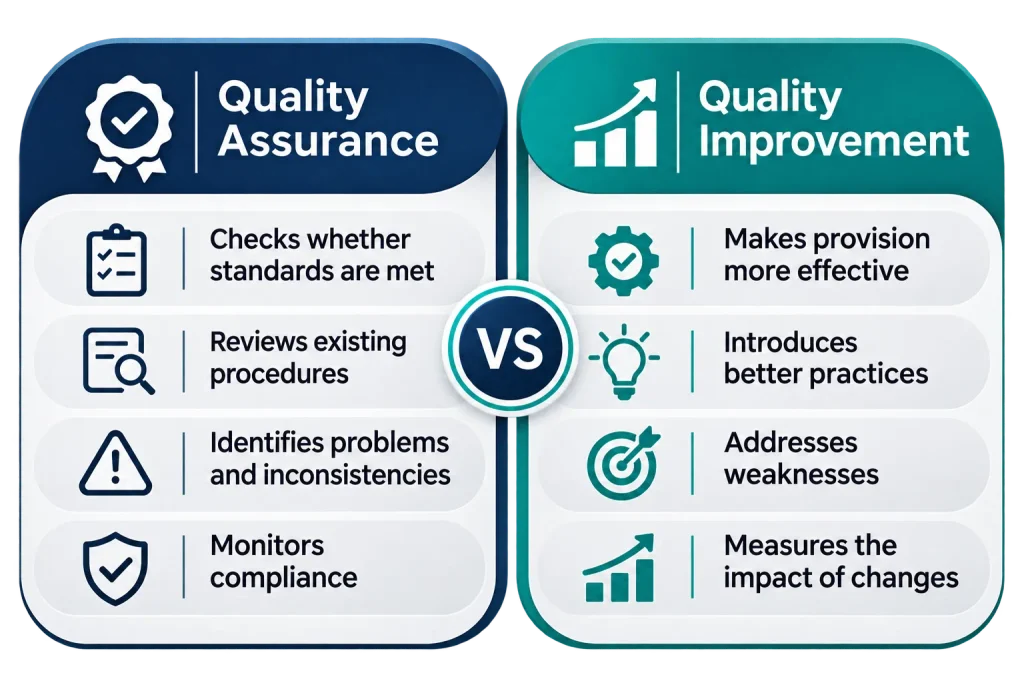
Quality assurance checks whether educational standards are being met, while quality improvement focuses on making teaching, learning and assessment more effective.
Key differences include:
- Quality assurance: Monitors standards and checks compliance.
- Quality improvement: Addresses weaknesses and enhances performance.
- Quality assurance: Reviews existing procedures and practices.
- Quality improvement: Introduces changes to improve outcomes.
Both approaches are essential for maintaining standards and achieving continuous improvement. Organisations should monitor performance, identify problems, implement corrective actions and review the effectiveness of changes.
Why is Quality Assurance Important in Education and Training?
Quality assurance helps educational organisations maintain consistent standards, improve teaching practices and enhance the learner experience. It provides a structured approach to evaluating educational activities, identifying weaknesses and implementing improvements.
The main benefits of quality assurance include:
- Maintaining consistent educational standards.
- Improving teaching and learning methods.
- Supporting fair and reliable assessment.
- Increasing learner satisfaction and engagement.
- Demonstrating accountability and compliance.
- Supporting organisational development and continuous improvement.
1. Maintaining Consistent Educational Standards
Learners should receive an appropriate standard of education regardless of their trainer, learning location or delivery method. Quality assurance establishes common expectations for teaching, assessment, learning resources and learner support.
For example, a training provider operating across multiple locations can use shared assessment procedures, staff guidance and observation criteria to maintain consistency. However, consistency does not mean that every lesson must be identical. Teachers and trainers should adapt their approaches to meet learner needs and subject requirements.
Quality assurance supports consistency through:
- Establishing clear teaching and learning standards.
- Using common assessment procedures and criteria.
- Reviewing learning resources regularly.
- Monitoring programme delivery across different locations.
- Allowing appropriate flexibility to support different learner needs.
2. Improving Teaching and Learning
Quality assurance helps identify effective teaching practices and areas where improvement is needed. Classroom observations, learner assessments, lesson evaluations and feedback surveys provide evidence about whether teaching methods support the achievement of learning outcomes.
For instance, if learners consistently struggle with a technical topic, an evaluation may reveal that the teaching materials are too theoretical. The provider can introduce practical demonstrations, worked examples and guided activities to improve understanding.
Effective quality assurance encourages organisations to:
- Observe teaching sessions and evaluate delivery methods.
- Review learner performance and assessment results.
- Collect feedback from learners and teaching staff.
- Identify gaps in learning resources and practical activities.
- Introduce targeted improvements based on evaluation findings.
The purpose is not simply to produce reports but to use evidence to improve teaching quality and learner achievement.
3. Supporting Fair and Reliable Assessment
Assessment provides evidence of what learners know, understand and can do. Quality assurance helps ensure that assessment methods are appropriate to the learning outcomes, assessment criteria are clear and decisions are supported by sufficient evidence.
Assessment processes should be applied consistently while allowing assessors to exercise professional judgement. Learners should understand what is expected of them and receive feedback that helps them improve.
Important assessment quality checks include:
- Reviewing assessment tasks against the intended learning outcomes.
- Checking that assessment criteria are clear and appropriate.
- Sampling completed learner work.
- Comparing assessment decisions to identify inconsistencies.
- Reviewing the quality and usefulness of learner feedback.
- Maintaining accurate assessment records.
- Following applicable internal and external quality assurance procedures.
For example, if two assessors reach different decisions when evaluating similar learner work, a standardisation meeting can help clarify how the assessment criteria should be interpreted. This supports greater consistency without removing professional judgement.
4. Increasing Learner Satisfaction and Engagement
Learners are more likely to engage with their studies when teaching is well organised, learning resources are accessible and expectations are clearly communicated. Quality assurance helps providers understand the learner experience and identify issues that may affect participation, progress and achievement.
Learner feedback can reveal problems such as unclear instructions, limited tutor availability, inaccessible materials or insufficient practical activities. Addressing these concerns can create a more supportive learning environment.
Organisations can improve learner engagement by:
- Collecting feedback through surveys and evaluations.
- Providing clear information about course requirements.
- Reviewing the accessibility of learning materials.
- Improving communication between learners and tutors.
- Responding to concerns about teaching and learner support.
- Monitoring learner progress and achievement.
However, learner satisfaction should not be the only measure of quality. Providers should also evaluate assessment standards, curriculum coverage and achievement of learning outcomes to develop a balanced understanding of educational performance.
5. Supporting Accountability and Compliance
Education and training providers may need to demonstrate that they meet relevant regulatory, accreditation, contractual or awarding-body requirements. Quality assurance supports this process by helping organisations maintain accurate records, review procedures and identify areas requiring corrective action.
The requirements vary according to the provider’s status, the qualification being delivered and the relevant jurisdiction. Organisations should therefore identify the specific rules and standards applicable to their activities.
Quality assurance can support compliance through:
- Maintaining accurate learner and assessment records.
- Reviewing policies and procedures regularly.
- Preparing evidence for audits, inspections or external reviews.
- Monitoring compliance with applicable requirements.
- Addressing identified weaknesses through corrective action.
- Keeping staff informed about relevant procedures and responsibilities.
In England, Ofsted provides inspection guidance for relevant further education and skills provision. In Pakistan, the Higher Education Commission’s Quality Assurance Agency supports quality assurance within the higher education sector. The requirements applicable to an individual provider depend on its status and the programmes it delivers.
6. Supporting Organisational Development
Quality assurance contributes to long-term organisational development by providing evidence for planning, decision-making and resource allocation. Evaluation findings can help managers identify whether improvements are needed in staff development, digital learning platforms, equipment, curriculum design or learner support.
When organisations regularly review their performance, they can prioritise resources according to identified needs rather than relying solely on assumptions. This encourages a culture of continuous improvement and supports the delivery of more effective educational programmes.
Quality assurance findings can help organisations to:
- Identify staff training and professional development needs.
- Improve digital learning systems and educational technology.
- Update learning materials, equipment and facilities.
- Review curriculum content and programme delivery.
- Allocate resources to areas requiring improvement.
- Establish measurable targets and monitor progress.
By using quality assurance evidence to guide strategic decisions, education and training providers can strengthen their systems, improve learner outcomes and support sustainable organisational growth.

What are the Main Components of Education Quality Assurance?
An effective quality assurance system should cover the main activities that influence the quality of education and training.
| Component | What it examines | Practical example |
|---|---|---|
| Curriculum review | Relevance, structure and coverage of learning outcomes | Reviewing a course to ensure that content reflects its stated objectives |
| Teaching and training | Delivery methods, engagement and teaching effectiveness | Observing a training session and providing constructive feedback |
| Assessment quality | Validity, reliability, fairness and consistency | Sampling assessed work and reviewing assessment decisions |
| Learner feedback | Satisfaction, accessibility and learning experience | Analysing feedback surveys and identifying recurring concerns |
| Learner progress | Attendance, achievement and completion | Reviewing progress records to identify learners requiring support |
| Staff development | Professional competence and development needs | Arranging training on assessment practices or digital teaching |
| Learning resources | Accuracy, accessibility and suitability | Updating outdated materials and improving online resources |
| Management and leadership | Responsibilities, planning and accountability | Reviewing quality improvement actions during management meetings |
| Record keeping | Accuracy, completeness and accessibility of evidence | Maintaining observation records, assessment documentation and action plans |
| Continuous improvement | Effectiveness of corrective and preventive action | Checking whether an intervention has improved learner outcomes |
These components should operate together. Reviewing learner progress, for example, is more useful when the findings can inform teaching decisions, learner support and curriculum development.
How to Implement Quality Assurance in Education and Training
Education providers can establish a practical quality assurance system by following a structured process.
Step 1: Establish Quality Objectives and Standards
The first step is to determine what quality means for the organisation and the programme being delivered.
Quality objectives should reflect the organisation’s purpose, learner needs, qualification requirements and applicable regulations or accreditation conditions.
Examples include:
- Ensuring that all programme learning outcomes are covered.
- Maintaining consistent assessment procedures.
- Improving the quality and timeliness of learner feedback.
- Ensuring that learning materials remain accurate and relevant.
- Identifying and addressing barriers to learner progress.
- Maintaining complete and reliable programme records.
Objectives should be specific enough to monitor.
For example, an organisation could aim to ensure that all assessment briefs are reviewed against the relevant learning outcomes before being issued to learners.
The responsible manager should identify the evidence required to demonstrate that the objective has been achieved.
Step 2: Assign Roles and Responsibilities
Effective quality assurance requires clearly defined responsibilities to ensure that educational standards are maintained and improvement activities are completed efficiently. Each staff member should understand their role in monitoring performance, addressing concerns and supporting quality improvement.
Key responsibilities may include:
- Senior management: Establish quality policies and approve improvement priorities.
- Programme managers: Coordinate quality reviews and monitor action plans.
- Teachers and trainers: Evaluate teaching practices and respond to learner needs.
- Assessors: Maintain accurate assessment records and follow assessment procedures.
- Internal quality assurers: Review assessment practices and promote consistency.
- Administrative staff: Maintain relevant records and documentation.
- Learners: Contribute feedback through surveys, evaluations and consultations.
A clear responsibility framework prevents tasks from being overlooked, improves accountability and ensures that identified quality issues are addressed by the appropriate individuals.

Step 3: Review Curriculum and Learning Materials
Curriculum review helps ensure that programme content remains appropriate and aligned with its intended learning outcomes.
A review may examine whether:
- Learning outcomes are clearly stated.
- Teaching content covers the required subject matter.
- Learning activities support the development of relevant knowledge and skills.
- Assessment tasks allow learners to demonstrate the required outcomes.
- Examples and case studies remain relevant.
- Resources are accessible to the intended audience.
- Digital learning materials function correctly.
- Any applicable qualification or awarding-body requirements are addressed.
For example, an online training provider may discover that its course materials refer to outdated workplace procedures. The provider should verify the current requirements, revise the materials and communicate the changes to relevant staff.
Curriculum reviews should occur at appropriate intervals and whenever significant changes make an earlier review necessary.
Step 4: Monitor Teaching and Training Delivery
Monitoring teaching and training helps ensure that programmes are delivered effectively and consistently. Regular reviews enable education providers to identify effective practices, recognise weaknesses and improve the overall learning experience.
Common monitoring methods include:
- Lesson observations and peer reviews.
- Learner evaluations and feedback.
- Reviews of lesson plans and teaching materials.
- Reflection on teaching practices.
- Checks of learner participation and understanding.
For example, if an observation identifies limited practical activities, the trainer can introduce demonstrations and structured exercises. Follow-up observations can then assess whether these changes have improved teaching effectiveness and learner engagement.
Step 5: Evaluate Assessment Practices
Assessment quality assurance should examine whether assessment methods are appropriate, decisions are consistent and evidence supports the conclusions reached.
For vocational programmes, the assessment process may need to establish whether learners can apply their knowledge in realistic or workplace-related situations.
Quality assurance activities can include:
- Checking assessment tasks against learning outcomes.
- Reviewing the clarity of assessment instructions.
- Sampling completed assessments.
- Comparing assessment decisions against the relevant criteria.
- Reviewing feedback for accuracy and usefulness.
- Recording findings and required actions.
- Checking whether agreed improvements have been implemented.
The exact process will depend on the qualification and the requirements of the relevant awarding organisation.
Where external verification or moderation is required, internal procedures should complement rather than replace it.
Step 6: Collect and Analyse Learner Feedback
Learner feedback provides direct insight into how a programme is experienced.
Providers can collect feedback through surveys, interviews, focus groups, course evaluations and learner representative meetings.
Useful questions might include:
- Are the learning outcomes clear?
- Are teaching materials easy to understand?
- Do assessment instructions explain what is expected?
- Is feedback received in time to support improvement?
- Are online learning resources accessible?
- Which parts of the programme are most useful?
- What changes would improve the learning experience?
Collecting responses is only the beginning. Providers must analyse the findings, identify recurring themes and decide which concerns require action.
Feedback should be interpreted alongside other evidence because a small number of responses may not represent the entire learner group.
Where appropriate, providers should also explain what changes have been made in response to feedback. This demonstrates that learner participation is taken seriously.
Step 7: Measure Performance and Review Results
Quality assurance needs evidence to determine whether educational objectives are being achieved.
Performance indicators can help providers monitor progress over time.
Examples include:
- Attendance and participation.
- Assessment achievement.
- Course completion.
- Learner progression.
- Learner satisfaction.
- Assessment turnaround times.
- Staff development participation.
- Number and type of identified quality issues.
- Completion of improvement actions.
Indicators should be interpreted carefully. A high completion rate, for instance, does not automatically prove that learners have developed the intended knowledge and skills.
Providers should examine the reasons behind performance patterns and consider relevant differences between programmes, learner groups and delivery methods.
Step 8: Take Corrective Action and Review Its Effectiveness
When quality assurance identifies a weakness, the organisation should determine the cause and agree on an appropriate response.
An action plan should normally identify:
- The issue requiring attention.
- The evidence supporting the finding.
- The action to be taken.
- The person responsible.
- The target completion date.
- The evidence required to demonstrate completion.
- The method for checking effectiveness.
Consider a training centre where learners repeatedly submit incomplete assessment evidence.
A superficial response might be to remind learners to read the instructions. A more effective investigation could reveal that assessment guidance is unclear or that learners have not received sufficient preparation.
The organisation could revise the guidance, provide an explanatory session and review subsequent submissions.
The final step is to check whether the intervention has reduced the problem. If the issue continues, further investigation may be necessary.
This approach turns quality assurance into a practical improvement process rather than a record-keeping exercise.
Quality Assurance Methods Used by Education and Training Providers
Education and training providers use different quality assurance methods to evaluate teaching effectiveness, monitor learner progress and maintain educational standards. Combining these methods helps organisations collect reliable evidence, identify weaknesses and make informed decisions about improving educational provision.
1. Internal Quality Reviews
Internal quality reviews assess whether educational activities meet organisational objectives and applicable external requirements. These reviews help management evaluate existing procedures, identify gaps and determine whether corrective action is necessary.
Key areas of review include:
- Course planning and curriculum delivery.
- Learner support and educational resources.
- Assessment procedures and documentation.
- Staff competence and professional development.
- Compliance with relevant quality requirements.
- Identification of weaknesses and improvement actions.
2. Lesson and Training Observations
Lesson and training observations allow reviewers or colleagues to evaluate teaching practices in real learning environments. They help identify effective teaching methods and areas where trainers may need additional guidance or professional development.
Observation activities may focus on:
- Lesson planning and organisation.
- Subject knowledge and explanation techniques.
- Learner participation and engagement.
- Questioning techniques and checks of understanding.
- Appropriate use of learning materials and resources.
- Constructive feedback and recommendations for improvement.
Observations should follow clear criteria and support professional development rather than simply assigning performance ratings.
3. Assessment Sampling and Standardisation
Assessment sampling involves reviewing selected assessment decisions and the evidence submitted by learners. Standardisation helps assessors interpret assessment criteria consistently, particularly when several assessors deliver or assess the same qualification.
Common activities include:
- Reviewing completed learner assessments.
- Checking assessment decisions against established criteria.
- Examining the quality of assessor feedback.
- Identifying inconsistencies in assessment decisions.
- Discussing assessment approaches during standardisation meetings.
- Recording findings and implementing necessary improvements.
These methods help strengthen assessment consistency and support fair, evidence-based decisions.
4. Surveys and Learner Consultations
Learner surveys and consultations help providers understand learners’ experiences and identify issues that may not be apparent through formal assessments or observations. Surveys can reveal common concerns, while interviews and focus groups provide opportunities to explore those concerns in greater detail.
Education and training providers can use these methods to:
- Evaluate learner satisfaction with teaching and resources.
- Identify difficulties with assessment instructions.
- Review the timeliness and usefulness of feedback.
- Understand barriers to participation and engagement.
- Collect suggestions for improving learning activities.
- Investigate recurring concerns through follow-up discussions.
For example, learners may report delays in receiving assessment feedback. Further consultation can help determine whether the cause relates to staff workload, unclear procedures or an inefficient submission process.
5. Data Analysis and Performance Monitoring
Data analysis enables education providers to monitor performance, identify trends and evaluate whether educational objectives are being achieved. However, figures should always be interpreted in context, as changes in results may reflect differences in learner needs, programme difficulty, assessment design or available support.
Useful performance monitoring activities include:
- Reviewing attendance and learner participation records.
- Analysing assessment results and achievement patterns.
- Monitoring course completion and learner progression.
- Comparing performance across relevant programmes or periods.
- Identifying recurring concerns and areas requiring investigation.
- Using evaluation findings to guide improvement decisions.
Effective performance monitoring combines numerical data with learner feedback, observations and professional judgement. This provides a more balanced understanding of educational quality and helps organisations determine which improvements are most appropriate.
How Does Learner Feedback Support Continuous Improvement?
Learner feedback is an important source of information because it helps education providers understand what is working well and what may need to change.
However, effective feedback systems require more than distributing questionnaires at the end of a course.
A practical approach includes the following stages:
- Identify the questions that will provide useful information.
- Choose suitable methods for collecting feedback.
- Explain the purpose of the consultation to learners.
- Collect responses fairly and, where appropriate, confidentially.
- Analyse the responses for recurring themes.
- Compare feedback with other performance evidence.
- Agree on appropriate improvement actions.
- Communicate relevant changes to learners and staff.
- Review whether the changes have improved the experience.
For example, an online learning provider might discover that learners find its course materials difficult to navigate on mobile devices.
The provider could review the platform, simplify the menu structure and test the revised design with learners. Feedback and platform usage data could then help establish whether the changes have made the materials easier to access.
Learner feedback should inform decisions, but it does not automatically determine them. Providers must balance learner preferences with educational objectives, accessibility needs, assessment standards and applicable requirements.
Common Quality Assurance Challenges and Practical Solutions
Even organisations with established procedures can experience difficulties when implementing quality assurance.
| Challenge | Potential consequence | Practical solution |
|---|---|---|
| Unclear quality objectives | Staff interpret expectations differently | Define measurable objectives and communicate them clearly |
| Inconsistent assessment decisions | Learners may be assessed unfairly | Introduce assessment standardisation and appropriate sampling |
| Limited learner participation | Important concerns remain unidentified | Offer accessible feedback methods and explain how responses are used |
| Excessive paperwork | Staff focus on documentation rather than improvement | Remove unnecessary duplication and prioritise meaningful evidence |
| Outdated learning resources | Teaching content may no longer be appropriate | Establish scheduled reviews and update materials when requirements change |
| Insufficient staff development | Teaching and assessment practices may remain weak | Identify development needs and provide relevant support |
| Delayed corrective action | Identified problems continue | Assign responsibility, deadlines and follow-up checks |
| Poor use of performance data | Decisions may be based on incomplete assumptions | Combine quantitative data with feedback, observations and professional judgement |
One of the most important challenges is ensuring that quality assurance becomes part of normal working practice.
If staff see it only as a compliance requirement, they may concentrate on completing forms instead of understanding the underlying problems. Managers should therefore explain the purpose of quality activities and demonstrate how findings lead to meaningful improvements.
The Role of Professional Development in Education Quality Assurance
Quality assurance depends on the knowledge and judgement of the people responsible for educational delivery and management.
Teachers and trainers need to understand effective teaching practices, while assessors need to apply assessment criteria appropriately. Education managers must be able to review performance, interpret evidence, coordinate improvement activities and support staff development.
Professional development can help these individuals strengthen their contribution to educational quality.
Useful development activities include:
- Participating in teaching and assessment workshops.
- Reviewing current educational guidance.
- Observing experienced colleagues.
- Attending standardisation meetings.
- Evaluating personal teaching practice.
- Studying learner feedback and performance trends.
- Developing skills in curriculum planning and programme evaluation.
- Maintaining records of professional development and reflecting on its impact.
Professional development should be linked to identified needs rather than treated as a collection of unrelated training activities.
For example, if quality reviews reveal that trainers struggle to evaluate learner progress, targeted development in assessment and feedback may be more useful than a general workshop unrelated to the problem.
How Can Education and Training Management Qualifications Help?
Education and training management qualifications help learners develop the knowledge and practical skills required to support effective teaching, manage educational programmes and maintain quality standards. They provide a foundation for understanding how educational activities can be planned, delivered, monitored and evaluated to meet learners’ needs and organisational objectives.
These qualifications can help learners develop key competencies in:
- Understanding the principles and practices of education and training.
- Designing and organising effective learning programmes.
- Improving learner engagement and participation.
- Planning, allocating and monitoring work within educational settings.
- Evaluating teaching quality and training programme effectiveness.
- Applying quality assurance principles to support continuous improvement.
- Reflecting on professional practice and identifying development needs.
- Using feedback and performance information to improve educational outcomes.
By developing these competencies, learners can strengthen their understanding of educational management and contribute to maintaining consistent standards across teaching, learning and assessment. The knowledge gained may also support career development in education, vocational training, learning coordination and training management.
However, completing a qualification does not automatically guarantee employment, professional recognition or career progression. Opportunities depend on the learner’s experience, individual capabilities and the requirements of employers or further education providers.
Conclusion
Quality assurance in education and training is essential for maintaining educational standards, improving teaching practices and ensuring a positive learner experience. By implementing effective monitoring, assessment, feedback and evaluation processes, education providers can identify weaknesses, strengthen performance and promote continuous improvement.
Developing knowledge of education and training management helps learners understand how to maintain quality standards and contribute to effective educational practices. Applying these principles supports professional development, improves organisational performance and helps create a more effective learning environment.