
Environmental Impact Assessment Explained: Stages, Methods and Real-World Applications
Environmental Impact Assessment (EIA) is an essential process in environmental management that helps organisations, governments and project developers identify, evaluate and manage the potential environmental consequences of proposed activities. It supports responsible decision-making by examining how construction projects, industrial operations, infrastructure development and other activities may affect ecosystems, natural resources, communities and public health.
Understanding the EIA process is particularly important for environmental management professionals, sustainability practitioners, engineers, project managers and learners interested in environmental protection. By following structured assessment methods, organisations can identify environmental risks before projects begin, consider alternative solutions and introduce appropriate impact mitigation measures.
This guide explores the main stages of Environmental Impact Assessment, commonly used environmental assessment methods, the preparation of an EIA report and practical applications across different industries.
What is Environmental Impact Assessment (EIA)?
Environmental Impact Assessment is a systematic process used to identify, predict, evaluate and manage the potential environmental effects of a proposed project before major decisions are made or development begins.
It examines both positive and negative impacts associated with activities such as construction, manufacturing, mining, transportation, energy production and infrastructure development.
An EIA considers several environmental and social factors, including:
- Air quality: Potential emissions, dust generation and atmospheric pollution.
- Water resources: Effects on groundwater, rivers, lakes, drainage systems and water quality.
- Land and soil: Soil erosion, land degradation, contamination and changes in land use.
- Biodiversity: Impacts on wildlife, vegetation, habitats and protected ecosystems.
- Noise and vibration: Disturbances caused by construction equipment, industrial machinery and transportation.
- Human health: Potential health risks associated with pollution, hazardous materials and environmental changes.
- Social and cultural conditions: Effects on local communities, livelihoods, cultural heritage and public resources.
The main purpose of EIA is not simply to identify environmental problems. It also helps project developers make informed decisions, compare alternative approaches and introduce preventive measures before environmental damage occurs.
According to the Convention on Biological Diversity, environmental assessment should consider interconnected socioeconomic, cultural and human health impacts alongside environmental effects. Public participation is also an important element of an effective assessment.
Why is Environmental Impact Assessment Important?
Environmental Impact Assessment plays an important role in sustainable development because it integrates environmental considerations into project planning and decision-making.
Without an appropriate assessment, development activities may create pollution, damage natural habitats, increase pressure on water resources and expose nearby communities to environmental risks.
The major benefits of EIA include:
- Environmental protection: Identifies potential environmental damage and helps prevent unnecessary harm to ecosystems and natural resources.
- Better project planning: Allows developers to identify environmental constraints before selecting project locations, technologies and construction methods.
- Pollution prevention: Supports effective controls for air emissions, wastewater, industrial waste and noise pollution.
- Regulatory compliance: Helps project proponents understand applicable environmental approval requirements and regulatory responsibilities.
- Community involvement: Provides opportunities for affected communities, environmental organisations and other stakeholders to express concerns.
- Financial risk reduction: Identifying environmental problems early can reduce unexpected costs, project delays, redesign requirements and remediation expenses.
- Sustainable development: Encourages development decisions that consider long-term environmental, social and economic consequences.
For environmental management professionals, EIA provides a practical framework for connecting environmental protection with organisational planning and operational performance.
What Are the Main Stages of Environmental Impact Assessment?
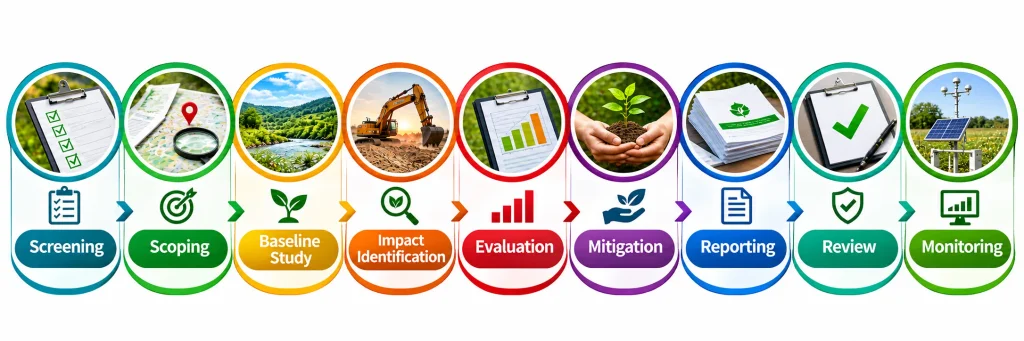
The EIA process generally follows a sequence of interconnected stages. Although the exact procedure differs between countries and regulatory systems, the main activities include screening, scoping, baseline studies, impact prediction, mitigation, reporting, review, decision-making and monitoring.
1. Screening
Screening is the initial stage of Environmental Impact Assessment. It determines whether a proposed project requires a formal environmental assessment and identifies the appropriate level of assessment.
During screening, environmental authorities or responsible project organisations consider the project’s nature, size, location and potential environmental consequences.
For example, constructing a small commercial building in an established urban area may have different environmental implications from developing a large industrial complex near a protected natural habitat.
Typical screening considerations include:
- Project size, type and development capacity.
- Proximity to environmentally sensitive locations.
- Potential pollution and waste generation.
- Possible effects on biodiversity and water resources.
- Expected environmental and community impacts.
- Applicable legal and regulatory requirements.
The screening outcome determines whether a project requires a full EIA, an initial environmental examination or another level of environmental review, depending on the relevant jurisdiction.
2. Scoping
Scoping identifies the most important environmental issues that need detailed investigation during the assessment.
Rather than examining every possible environmental factor in equal detail, this stage focuses resources on impacts that could significantly affect the environment or local communities.
For example, a proposed road development passing through an ecologically sensitive area may require detailed investigations into habitat disturbance, wildlife movement, vegetation clearance and noise pollution.
Important scoping activities include:
- Identifying potential environmental impacts.
- Defining the geographical boundaries of the assessment.
- Identifying affected communities and stakeholders.
- Establishing the terms of reference for the assessment.
- Determining the required environmental surveys and technical studies.
- Selecting appropriate environmental assessment methods.
Effective scoping improves the quality of the assessment by ensuring that important issues receive sufficient attention.
3. Baseline Environmental Study
A baseline environmental study establishes the existing environmental conditions before the proposed project begins.
It provides reference information against which future environmental changes can be assessed.
Environmental professionals collect information through field surveys, laboratory testing, geographical analysis, historical records and consultation with relevant stakeholders.
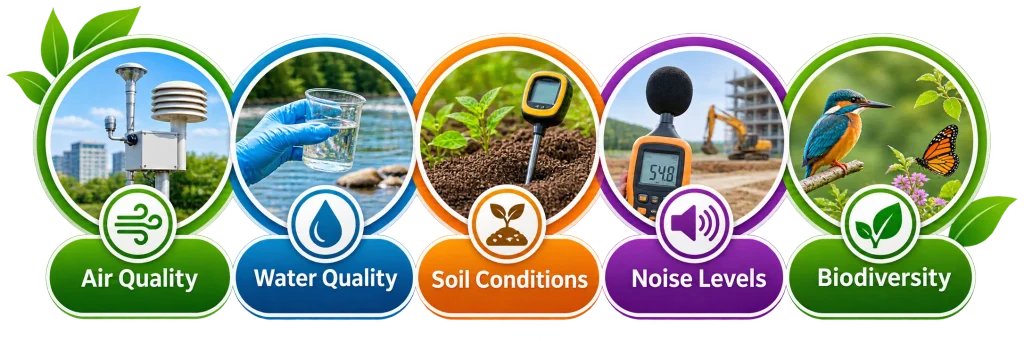
The baseline study commonly examines:
| Environmental component | Information collected |
|---|---|
| Air quality | Existing pollution levels, dust and atmospheric conditions |
| Water quality | Groundwater, surface water and contamination indicators |
| Soil conditions | Soil composition, fertility, erosion and contamination |
| Biodiversity | Wildlife, vegetation, habitats and ecological sensitivity |
| Noise levels | Existing environmental noise and vibration |
| Land use | Residential, agricultural, industrial and protected areas |
| Social conditions | Population, livelihoods, community facilities and cultural resources |
For instance, before constructing a manufacturing facility, environmental specialists may collect groundwater samples, measure existing air pollution and examine nearby residential areas.
This information helps establish whether environmental changes occur because of the project or were already present before development.
4. Impact Identification and Prediction
This stage identifies and predicts the environmental effects that may result from the proposed project.
Environmental specialists examine how construction, operation, maintenance and eventual closure could affect the surrounding environment.
Impacts are generally considered in several categories:
- Direct impacts: Effects that result immediately from project activities, such as vegetation removal during construction.
- Indirect impacts: Secondary consequences, such as increased traffic and air pollution resulting from a new industrial facility.
- Cumulative impacts: Combined environmental effects resulting from the proposed development alongside other existing or planned activities.
- Short-term impacts: Temporary effects, such as construction noise and dust.
- Long-term impacts: Effects that continue over an extended period, such as groundwater depletion or habitat fragmentation.
- Positive impacts: Environmental or social improvements, such as improved wastewater treatment or reduced pollution through cleaner technologies.
Impact prediction also considers the magnitude, geographical extent, duration, frequency, reversibility and significance of each potential effect.
5. Evaluation of Environmental Impacts
After identifying potential impacts, the assessment team evaluates their significance to determine which effects require preventive action or additional management.
Impact significance is not determined by project size alone. It also depends on the sensitivity of the affected environment, the likelihood of an impact and the severity of its consequences.
For example, removing a small area of vegetation in an ordinary developed location may have limited consequences. However, removing the same area from a habitat supporting threatened species could create a significant ecological impact.
Environmental professionals may consider:
- Magnitude and intensity of the impact.
- Duration and frequency.
- Geographical extent.
- Environmental sensitivity.
- Reversibility or permanence.
- Probability of occurrence.
- Cumulative effects.
The findings help decision-makers prioritise environmental risks and establish appropriate mitigation requirements.
6. Development of Impact Mitigation Measures
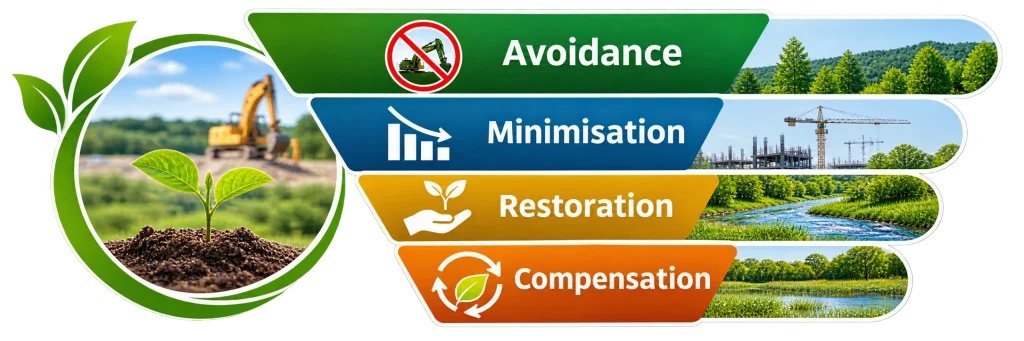
Impact mitigation involves identifying measures to avoid, minimise, restore or compensate for adverse environmental effects.
The preferred approach is to prevent environmental damage wherever possible rather than relying entirely on corrective action after damage occurs.
A commonly used mitigation hierarchy includes:
| Mitigation approach | Explanation | Practical example |
|---|---|---|
| Avoidance | Prevent the impact from occurring | Relocating construction away from a protected habitat |
| Minimisation | Reduce the intensity or extent of an impact | Installing dust suppression equipment |
| Restoration | Repair environmental damage | Replanting vegetation in disturbed areas |
| Compensation | Address remaining unavoidable impacts through appropriate compensatory measures | Supporting habitat restoration elsewhere where permitted |
Mitigation measures should be practical, measurable and appropriate to the project’s environmental risks.
For example, a construction project may introduce controlled working hours, wastewater treatment facilities, sediment barriers, designated waste storage areas and regular environmental inspections.
7. Preparation of the Environmental Impact Assessment Report
The EIA report, often called an Environmental Impact Statement in certain regulatory systems, presents the assessment findings in a structured format.
It provides decision-makers, regulatory authorities and stakeholders with information about the proposed development and its likely environmental consequences.
A comprehensive EIA report generally includes:
- Executive summary.
- Project description and objectives.
- Applicable environmental legislation and regulatory requirements.
- Project location and surrounding environmental conditions.
- Baseline environmental assessment.
- Identification and prediction of environmental impacts.
- Evaluation of impact significance.
- Assessment of alternative project options.
- Proposed mitigation measures.
- Environmental Management Plan.
- Public consultation findings.
- Environmental monitoring arrangements.
- Conclusions and recommendations.
The report should communicate technical findings clearly and provide sufficient evidence to support environmental decision-making.
8. Review and Decision-Making
Once the EIA report is submitted, the relevant authority reviews its technical quality, completeness and suitability for decision-making.
The review may examine whether:
- Important environmental impacts have been identified.
- Baseline information is reliable and sufficient.
- Assessment methods are appropriate.
- Mitigation measures are realistic.
- Stakeholder concerns have been considered.
- Monitoring arrangements are adequate.
- Applicable environmental requirements have been addressed.
Depending on the regulatory framework and assessment findings, the project may be approved subject to conditions, returned for additional information or modifications, or refused.
Public consultation is particularly important because it allows affected communities and other stakeholders to contribute relevant information before a decision is finalised.
9. Environmental Monitoring and Auditing
Environmental monitoring continues after project approval and during relevant stages of construction and operation.
Its purpose is to establish whether mitigation measures are working and whether actual environmental impacts correspond with the predictions made in the EIA report.
Common monitoring activities include:
- Measuring air pollution and dust levels.
- Testing wastewater discharge quality.
- Monitoring noise and vibration.
- Inspecting waste management practices.
- Checking biodiversity and habitat conditions.
- Reviewing environmental incidents and complaints.
- Assessing compliance with approval conditions.
Environmental auditing provides a systematic review of environmental performance, implementation of management measures and compliance commitments.
If monitoring identifies unexpected impacts, corrective measures may be required.
The EIA process therefore does not end when a project receives approval. Effective follow-up is necessary to ensure that environmental commitments are implemented throughout the project lifecycle.
What Methods Are Used in Environmental Impact Assessment?
Environmental assessment methods help specialists identify, compare, predict and evaluate potential environmental impacts. The selection of a method depends on the nature of the project, available information, environmental sensitivity and assessment objectives.
The following are widely used environmental assessment methods.
1. Checklist Method
The checklist method uses a structured list of environmental factors to ensure that important issues are considered during an assessment.
A checklist may include air quality, water resources, soil conditions, biodiversity, noise, waste generation and community health.
It is particularly useful during preliminary assessments and screening because it provides a straightforward way to identify potential environmental concerns.
Example: A construction company uses an environmental checklist before starting a housing development to identify possible impacts on drainage, vegetation, nearby residents and local traffic.
2. Matrix Method
The matrix method establishes relationships between project activities and environmental components.
A commonly recognised example is the Leopold Matrix, which helps identify and evaluate interactions between development activities and environmental conditions.
For instance, construction activities such as excavation, transportation and material storage can be compared against environmental factors such as soil quality, air pollution, water resources and noise.
This method helps assessment teams organise potential impacts and identify activities that require additional investigation.
3. Environmental Impact Networks
Network analysis examines the relationships between direct, indirect and secondary environmental impacts.
It helps specialists understand how one project activity may trigger a sequence of environmental consequences.
Example: Clearing vegetation may increase soil exposure, which can cause erosion, sediment movement into nearby waterways and deterioration of aquatic habitats.
This method is particularly useful for understanding interconnected environmental problems that may not be identified through simple checklists.
4. Geographic Information System (GIS) and Overlay Method
GIS and overlay techniques use geographical information to examine the spatial distribution of environmental features and potential project impacts.
Different environmental maps can be combined to identify sensitive locations and evaluate alternative project sites.
Typical information layers include:
- Land use and land cover.
- Rivers, lakes and groundwater features.
- Protected habitats and biodiversity areas.
- Population distribution.
- Soil characteristics.
- Flood-prone locations.
- Existing infrastructure and transportation networks.
Example: Before constructing a new highway, GIS mapping can help identify routes that avoid protected forests, agricultural land and densely populated communities.
5. Environmental Modelling and Simulation
Environmental modelling uses scientific data, mathematical relationships and computer-based simulations to predict possible environmental changes.
Depending on the project, specialists may use:
- Air dispersion models to predict pollutant distribution.
- Hydrological models to evaluate runoff and drainage.
- Water quality models to examine pollution movement.
- Noise propagation models to estimate sound levels.
- Ecological models to investigate habitat and species responses.
These techniques are particularly valuable for large infrastructure, industrial and energy projects where environmental impacts may extend beyond the immediate project site.
6. Cost-Benefit Analysis
Cost-benefit analysis compares the expected economic benefits of a proposed project with its financial, environmental and social costs.
Environmental considerations may include pollution prevention expenditure, resource consumption, ecosystem damage, restoration costs and public health implications.
However, not all environmental values can be accurately expressed in monetary terms. Irreplaceable biodiversity, cultural heritage and serious ecological damage should not be treated as automatically acceptable simply because projected financial benefits are high.
7. Expert Judgement and Public Consultation
Environmental assessments frequently require specialist knowledge from ecologists, engineers, hydrologists, environmental scientists and other relevant professionals.
Expert judgement helps interpret technical findings and evaluate complex environmental conditions.
Public consultation adds local knowledge and allows affected communities to communicate concerns that may not be apparent through technical studies alone.
These approaches strengthen the overall assessment when combined with reliable baseline data and appropriate scientific methods.
Comparison of Environmental Assessment Methods
| Method | Main purpose | Suitable application |
|---|---|---|
| Checklist | Identify potential impacts systematically | Initial project assessment |
| Matrix | Examine project and environmental interactions | Construction and industrial projects |
| Network | Identify indirect and secondary impacts | Ecosystem and pollution studies |
| GIS and overlay | Examine geographical environmental sensitivity | Roads, housing and infrastructure |
| Modelling | Predict environmental changes | Air, water and noise assessments |
| Cost-benefit analysis | Compare economic and environmental considerations | Project planning and alternatives |
| Expert judgement | Interpret technical evidence | Complex environmental assessments |
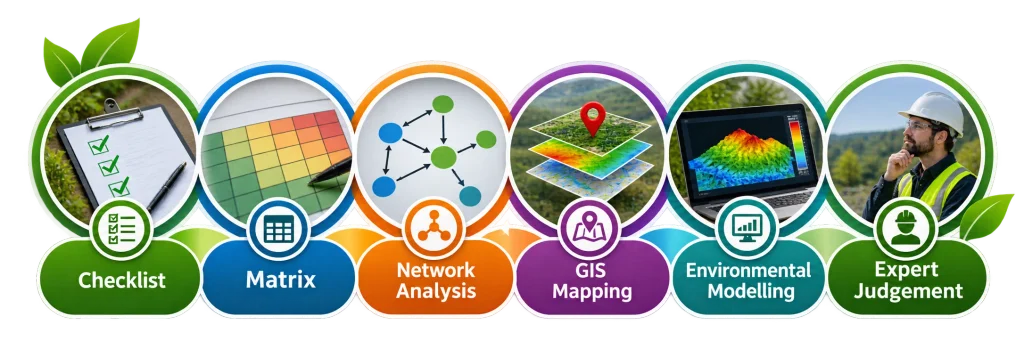
A comprehensive EIA may combine several methods rather than relying on one technique. This improves the assessment’s coverage and helps ensure that important environmental relationships are not overlooked.
Real-World Applications of Environmental Impact Assessment
Environmental Impact Assessment is used across different industries to support environmentally responsible development.
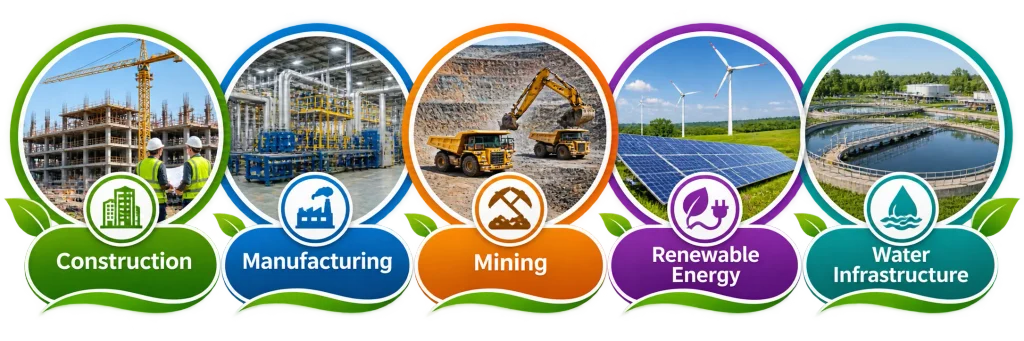
1. Construction and Infrastructure Development
Large construction projects can affect soil stability, drainage systems, air quality, noise levels and nearby communities.
Before developing housing schemes, commercial buildings, highways or bridges, an EIA can identify environmental constraints and recommend suitable mitigation measures.
Practical application: A highway development project may require alternative route assessment, noise barriers, wildlife crossing structures, erosion controls and appropriate construction waste management.
2. Industrial and Manufacturing Projects
Manufacturing facilities can generate air emissions, industrial wastewater, solid waste, noise and hazardous materials.
An EIA helps identify potential pollution sources and evaluate the effectiveness of proposed environmental controls.
Practical application: Before establishing a chemical manufacturing facility, environmental specialists assess wastewater treatment requirements, air emission controls, hazardous material storage and emergency response arrangements.
3. Energy and Power Generation
Energy projects can create different environmental impacts depending on their technology, location and operational requirements.
Thermal power stations may require assessments of air emissions, cooling water requirements and waste management. Renewable energy projects may require studies of land use, biodiversity, landscape impacts and wildlife interactions.
Practical application: A proposed wind farm may require bird and bat surveys, habitat assessment, noise evaluation and consideration of alternative turbine locations.
4. Mining and Quarrying
Mining and quarrying can disturb natural habitats, alter landscapes, generate dust and affect surface and groundwater resources.
EIA supports the identification of environmental risks associated with excavation, mineral processing, waste rock storage and site rehabilitation.
Practical application: A mining project may introduce groundwater monitoring, controlled blasting, dust suppression, tailings management and progressive land restoration.
5. Water Supply and Wastewater Projects
Water infrastructure developments can affect river systems, aquatic habitats, groundwater availability and local communities.
Environmental assessments help evaluate the impacts of dams, reservoirs, water supply systems, sewage treatment facilities and drainage networks.
Practical application: A wastewater treatment plant assessment may examine discharge quality, odour control, sludge management and potential impacts on downstream water users.
Common Challenges in Environmental Impact Assessment
Although EIA provides a structured approach to environmental protection, its effectiveness depends on the quality of information, technical expertise and implementation arrangements.
Some common challenges include:
- Inadequate baseline information: Limited environmental data can make it difficult to predict the actual consequences of development. Regular surveys and reliable data collection help address this issue.
- Limited technical expertise: Complex projects may require specialists from several environmental disciplines. Multidisciplinary assessment teams improve the quality of technical investigations.
- Insufficient public participation: Excluding affected communities can result in overlooked environmental and social concerns. Early consultation helps identify local priorities.
- Poor impact prediction: Inappropriate assessment methods or incomplete information may lead to inaccurate predictions. Using suitable modelling techniques and expert evaluation can improve reliability.
- Weak mitigation implementation: Environmental recommendations may not deliver expected results if responsibilities and resources are unclear. Project-specific Environmental Management Plans help establish accountability.
- Inadequate environmental monitoring: Without regular monitoring, unexpected environmental impacts may remain undetected. Defined monitoring indicators, reporting procedures and corrective actions are essential.
Role of Environmental Management Professionals in EIA
Environmental management professionals play an important role in ensuring that environmental considerations are integrated into organisational and project decisions.
Their responsibilities may include:
- Conducting preliminary environmental reviews and identifying potential risks.
- Coordinating baseline environmental surveys and technical investigations.
- Evaluating environmental assessment findings.
- Supporting the development of environmental mitigation strategies.
- Preparing and reviewing Environmental Management Plans.
- Coordinating environmental monitoring and compliance activities.
- Communicating environmental requirements to project teams and stakeholders.
- Reviewing environmental performance and recommending improvements.
These responsibilities require an understanding of environmental legislation, sustainability principles, pollution prevention, environmental risk assessment and organisational environmental management systems.
Advanced environmental management education can help learners develop the knowledge needed to understand these responsibilities and apply environmental management principles in professional settings.
How Does Environmental Impact Assessment Support Sustainable Development?
Environmental Impact Assessment supports sustainable development by ensuring that environmental consequences are considered alongside economic and social objectives.
It encourages organisations to evaluate alternative project designs, use resources responsibly and introduce measures that reduce pollution and protect biodiversity.
For example, an infrastructure developer may compare two potential construction locations. Although both locations may offer similar financial benefits, one may create greater disturbance to natural habitats and local water resources.
Through EIA, the developer can identify these differences and consider an alternative that reduces environmental damage.
EIA also supports wider environmental management objectives, including:
- Responsible natural resource utilisation.
- Climate change risk consideration.
- Biodiversity protection.
- Pollution prevention and control.
- Sustainable land use.
- Environmental accountability.
- Long-term environmental performance improvement.
It is therefore an important component of responsible project planning and environmental governance.
Professional Development in Environmental Management
Understanding Environmental Impact Assessment is essential for developing advanced knowledge of environmental management and sustainable development. It enables professionals to understand how environmental risks are identified, assessed and controlled across construction, engineering, manufacturing, sustainability and environmental consultancy sectors.
Professional development in this field helps learners strengthen their understanding of key environmental management areas, including:
- Environmental Risk Assessment: Identifying and evaluating potential environmental hazards and their consequences.
- Environmental Impact Management: Understanding strategies to prevent, minimise and control environmental damage.
- Sustainable Development: Applying responsible practices to protect natural resources and ecosystems.
- Environmental Compliance: Understanding organisational environmental responsibilities and regulatory requirements.
- Environmental Sustainability: Developing knowledge of environmental protection and long-term resource management.
Advanced knowledge of these areas supports professional understanding of environmental challenges and responsible organisational practices. It also helps learners develop the knowledge required to contribute to environmental planning, sustainability initiatives and effective environmental management systems.
Conclusion
Environmental Impact Assessment is an essential tool for identifying, evaluating and managing the environmental effects of development projects. Its systematic stages and assessment methods help organisations reduce environmental risks, protect natural resources and promote responsible decision-making.
Developing knowledge of EIA and environmental management principles enables professionals to better understand environmental challenges, implement effective mitigation measures and contribute to sustainable development.