
Education and Training Management vs Teaching Qualifications: What is the Difference?
Choosing the right education qualification is an important step towards achieving your professional goals and advancing your career in the education and training sector. However, understanding the difference between education and training management qualifications and teaching qualifications is essential before deciding which pathway best suits your needs. Although both support professional development and effective learning, they focus on different skills, responsibilities and career objectives.
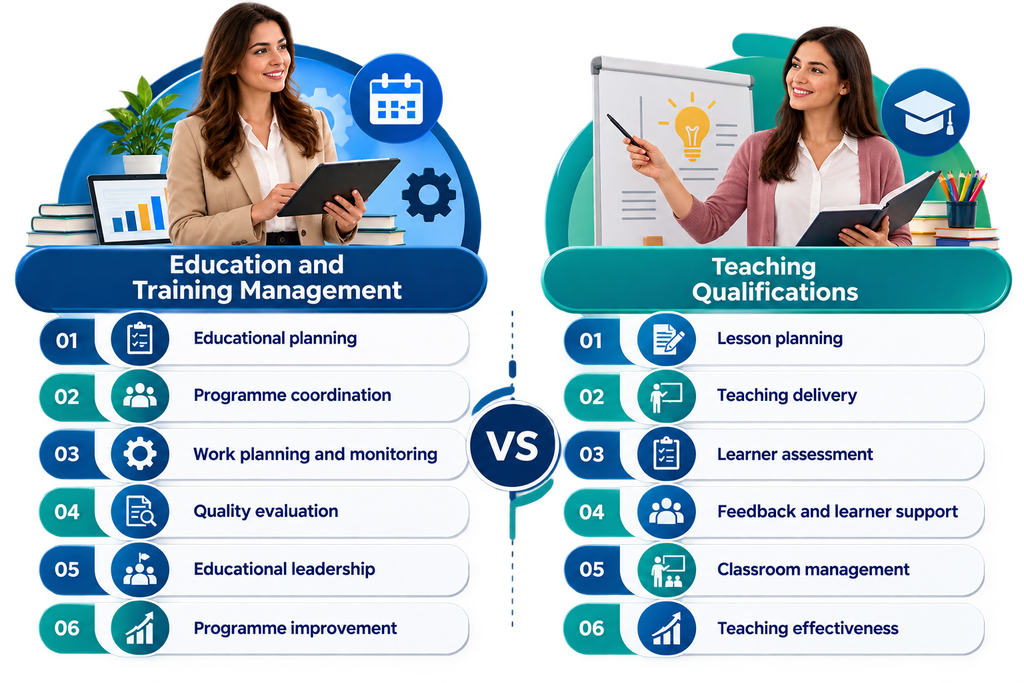
Education and training management qualifications focus on educational planning, programme coordination, quality evaluation and leadership, whereas teaching qualifications develop the skills required for lesson planning, teaching delivery, learner assessment and effective learner support. Some qualifications combine elements of both areas, making it important to review their curriculum, learning outcomes and professional relevance before enrolling.
For teachers, trainers, education administrators and aspiring academic managers in the UK, Pakistan and worldwide, understanding these differences can help identify the most appropriate qualification for their career aspirations. This guide explores education management versus teaching qualifications, comparing their course content, practical applications, potential career opportunities and professional development pathways to help you make an informed decision.
Key Differences Between Education and Training Management and Teaching Qualifications
Education and training management qualifications and teaching qualifications support the development of professionals working in educational environments. However, they generally differ in their primary focus, responsibilities and intended outcomes.
Education and training management qualifications are concerned with how learning programmes and educational activities are planned, organised, monitored and improved. Teaching qualifications focus more directly on how educators prepare lessons, deliver learning activities, assess performance and support learners.
The following table summarises the main differences.
| Comparison factor | Education and training management qualifications | Teaching qualifications |
|---|---|---|
| Primary purpose | Develop knowledge of managing and improving education and training provision | Develop the knowledge and skills required for effective teaching |
| Main focus | Planning, coordination, evaluation, quality and organisational responsibilities | Lesson planning, teaching methods, assessment and learner support |
| Typical responsibilities | Coordinating programmes, monitoring provision and supporting educational teams | Delivering lessons, assessing learners and providing feedback |
| Curriculum emphasis | Education management, programme design, work planning and evaluation | Teaching practice, instructional methods, classroom management and assessment |
| Intended learners | Aspiring education managers, coordinators, trainers and education professionals | Aspiring teachers, lecturers, trainers and other teaching professionals |
| Practical application | Improving educational operations and the quality of learning provision | Improving teaching delivery and individual learner outcomes |
| Potential career directions | Education coordination, academic administration, training coordination and management support | Teaching, training, lecturing and instructional support, depending on the qualification |
| Professional development | Builds understanding of educational systems and management responsibilities | Builds pedagogical knowledge and teaching competence |
| Best suited to | Learners interested in educational organisation and programme improvement | Learners whose primary objective is to develop or formalise their teaching practice |
These are general distinctions rather than universal rules. Some education management qualifications include teaching-related units, while some teaching qualifications introduce leadership, programme planning and quality improvement.
The qualification specification should therefore be the deciding factor.
What is an Education and Training Management Qualification?
An education and training management qualification develops a learner’s understanding of how educational activities are organised, delivered, monitored and improved.
Educational organisations need more than effective teachers. They also need professionals who can coordinate programmes, plan resources, support teaching staff, review educational provision and contribute to organisational objectives.
Education and training management qualifications help learners understand these wider responsibilities.
What does education and training management involve?
Education and training management can involve several interconnected areas.
1. Education and training programme planning
Educational programmes must be designed around learning objectives, learner needs and the resources available.
Management-related responsibilities may include:
- Planning educational activities and training programmes.
- Identifying learner needs and development priorities.
- Organising appropriate learning resources.
- Supporting curriculum implementation.
- Coordinating programme delivery.
For example, a training centre introducing a new professional qualification may need to organise its delivery schedule, allocate responsibilities, prepare learning resources and establish procedures for reviewing learner progress.
These activities require an understanding of both educational principles and organisational planning.
2. Staff coordination and work planning
Education and training managers may be involved in coordinating staff responsibilities and monitoring work within their area of responsibility.
This can include organising activities, allocating tasks, monitoring progress and helping colleagues work towards agreed objectives.
Consider a vocational training centre employing several trainers. The centre needs to coordinate teaching schedules, arrange assessment activities and monitor whether planned programmes are progressing effectively.
An education and training management qualification can help learners understand the principles behind these responsibilities.
3. Evaluating educational provision
Educational provision should be reviewed to determine whether it meets its intended objectives and supports positive learning outcomes.
Evaluation may involve reviewing feedback, examining assessment results, identifying delivery problems and recommending improvements.
For example, if learners consistently struggle with a particular training unit, the organisation may need to review its learning materials, teaching methods or support arrangements.
Education and training management therefore involves not only organising activities but also understanding how their effectiveness can be evaluated.
4. Professional development and reflective practice
Educational professionals need to review their own performance, identify development needs and maintain relevant professional knowledge.
Reflection can help teachers, trainers and managers recognise what works well, identify weaknesses and make informed improvements.
These skills are particularly relevant to professionals who want to develop from individual teaching or training responsibilities into wider coordination and management roles.
Example of an education and training management qualification
The OTHM Level 4 Diploma in Education and Training Management is designed to develop knowledge and skills across education and training practice, programme design, learner engagement, work planning, evaluation and professional development.
According to the published qualification specification, its six mandatory units cover:
- Principles of Education and Training
- Design Education and Training Provision
- Engage Learners in Education and Training
- Plan, Allocate and Monitor Work in Own Area of Responsibility
- Evaluate Education and Training Provision
- Professional Development and Reflection in Education and Training
This structure demonstrates that education and training management is not limited to administrative work. It also includes understanding the learning process, supporting learners and evaluating the effectiveness of educational activities.
The qualification may be relevant to teachers, trainers, education coordinators and professionals seeking a broader understanding of educational provision.
What is a Teaching Qualification?
A teaching qualification is designed to develop the knowledge and skills required to plan, deliver and assess learning effectively.
Teachers and trainers help learners acquire knowledge, develop practical abilities and achieve defined learning outcomes. To perform these responsibilities effectively, they need an understanding of teaching methods, learner needs, assessment principles and inclusive learning practices.
Teaching qualifications help develop these capabilities, although the specific requirements vary according to the education sector, qualification level, subject and country.
What does a teaching qualification cover?
Teaching qualifications may include several important areas.
1. Lesson planning and preparation
Effective teaching begins with planning.
Teachers need to identify learning objectives, select appropriate teaching methods, prepare resources and organise learning activities.
A lesson plan might include:
- Intended learning outcomes.
- Key subject concepts.
- Teaching and learning activities.
- Required resources.
- Assessment methods.
- Opportunities for learner feedback.
Planning helps ensure that teaching activities are structured, relevant and appropriate for the intended learners.
2. Teaching methods and instructional strategies
Teaching qualifications commonly develop an understanding of how different instructional methods can support learning.
Depending on the programme, learners may explore presentations, demonstrations, discussions, group activities, practical exercises and digital learning resources.
For example, a trainer teaching workplace safety may combine an explanation of safety procedures with demonstrations, practical scenarios and knowledge checks.
The objective is to select methods that support understanding rather than simply deliver information.
3. Learner engagement and support
Effective teaching requires an understanding of the different needs, experiences and learning barriers that learners may bring to an educational setting.
Teaching professionals may need to adapt their approaches to support different levels of prior knowledge, learning preferences, confidence and accessibility requirements.
This may involve providing additional explanations, using varied learning materials or giving learners opportunities to ask questions and practise new skills.
4. Assessment and feedback
Assessment helps educators determine whether learners have achieved the intended learning outcomes.
Teaching qualifications may develop knowledge of formative and summative assessment, assessment criteria, feedback methods and the importance of fair assessment practices.
For example, a trainer might use questioning during a lesson to identify misunderstandings and a final assessment to determine whether the learner has met the required standard.
Constructive feedback can then help learners recognise their strengths and understand what they need to improve.
5. Managing the learning environment
Teachers need to establish an environment in which learners can participate, ask questions and complete learning activities appropriately.
This may involve setting expectations, managing time, encouraging respectful communication and addressing barriers to participation.
The exact practical requirements vary between teaching qualifications. Some programmes require supervised teaching practice, while others focus more heavily on theoretical knowledge or particular forms of educational delivery.
Teaching qualifications in the UK
In England, teaching requirements depend on the setting.
For example, the Department for Education identifies the Level 5 Diploma in Teaching (Further Education and Skills) as a full teaching qualification for the further education sector. Other routes, including specified higher-level teaching programmes, may also be available.
For maintained primary, secondary and special schools in England, Qualified Teacher Status (QTS) is generally required. Requirements differ for further education, independent institutions and other education settings.
A teaching qualification should therefore be selected according to the role a learner intends to pursue, rather than by qualification level alone.
Education Management vs Teaching: How Do Their Responsibilities Differ?
Although education management and teaching are closely connected, the two areas generally involve different levels and types of responsibility.
A teacher or trainer concentrates primarily on supporting learning. An education manager or coordinator may focus on how teaching and training activities are planned, organised, monitored and improved across a programme or department.
Responsibilities of a teacher or trainer
A teacher or trainer may be responsible for:
- Preparing lessons and learning materials.
- Delivering teaching sessions.
- Explaining subject knowledge and practical concepts.
- Assessing learner progress.
- Providing feedback and additional support.
- Maintaining appropriate learning records.
- Reflecting on teaching effectiveness.
These responsibilities place the learning experience at the centre of professional practice.
Responsibilities of an education or training manager
An education or training manager may be responsible for:
- Coordinating educational programmes.
- Planning and monitoring work.
- Supporting teaching and training staff.
- Reviewing the quality of educational provision.
- Organising resources and delivery arrangements.
- Evaluating feedback and identifying improvements.
- Contributing to educational planning and organisational objectives.
The precise scope depends on the organisation and the role.
Can one professional perform both roles?
Yes. In educational settings, teaching and management responsibilities overlap.
A training coordinator might deliver lessons while also arranging training schedules and reviewing programme performance. A senior teacher might support colleagues, contribute to curriculum planning and help improve assessment practices.
For this reason, education and training management qualifications may complement teaching qualifications, particularly for professionals who want to combine classroom experience with coordination or leadership responsibilities.
However, studying an education management qualification does not automatically satisfy the formal teaching requirements for a particular job. Those requirements must be checked separately.

Which Qualification Is Better for Your Career Goals?
Neither qualification type is universally better. The right option depends on your current responsibilities, professional interests and intended career direction.
Choose an education and training management qualification if you want to:
- Develop an understanding of how educational programmes are planned and coordinated.
- Move towards education administration or programme coordination.
- Build knowledge of work planning and monitoring.
- Understand how educational provision can be evaluated and improved.
- Develop broader responsibilities within a college or training centre.
- Combine teaching experience with an understanding of educational operations.
For example, a trainer who wants to help coordinate several training programmes may benefit from studying education and training management.
The qualification can provide a foundation for understanding programme design, staff coordination, evaluation and professional development.
Choose a teaching qualification if you want to:
- Develop your teaching knowledge and practical skills.
- Learn how to plan and deliver structured lessons.
- Improve your approaches to assessment and feedback.
- Prepare for a teaching role that requires a recognised teaching qualification.
- Develop subject-specific or sector-specific teaching competence.
- Meet relevant professional requirements for a teaching position.
For example, an industry professional who wants to teach a vocational subject may need a combination of subject expertise, relevant professional experience and an appropriate teaching qualification.
The exact requirements depend on the subject, employer and education sector.
Consider both if you want to progress into educational leadership
Some professionals benefit from developing both teaching and management capabilities.
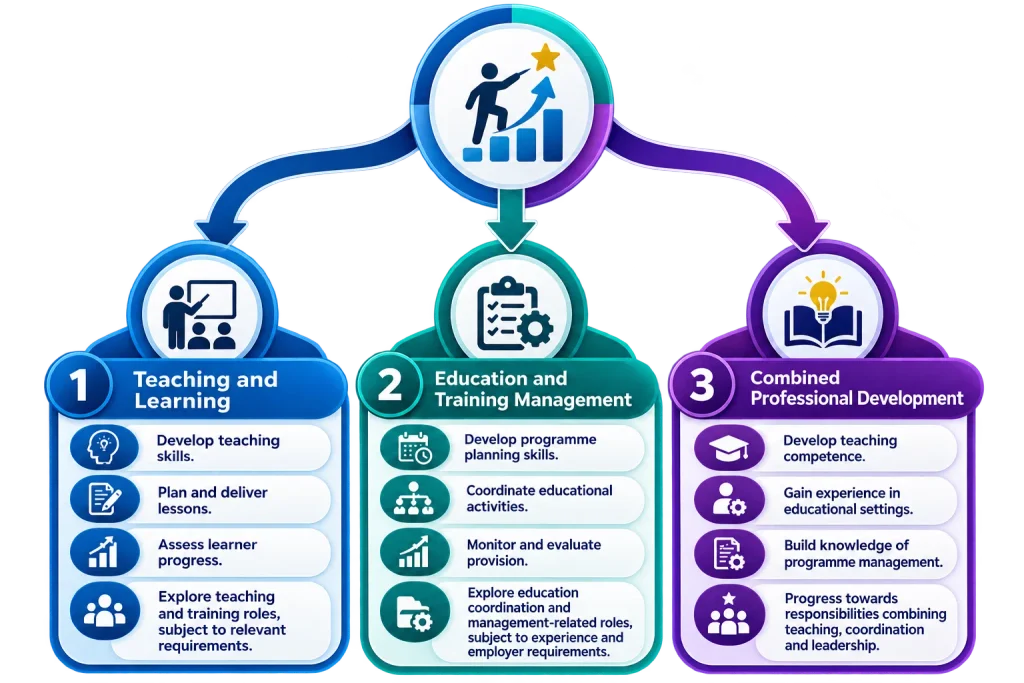
A teacher who understands effective teaching methods and educational programme management may be better prepared to take on responsibilities that combine teaching, coordination and quality improvement.
Similarly, a training manager with teaching experience may have a useful understanding of the practical challenges trainers face when delivering learning programmes.
The best sequence depends on your starting point. If you have not yet obtained the teaching qualification required for your intended role, that may need to take priority. If you already teach and want to broaden your responsibilities, a management-focused qualification may be a logical next step.
Is Education and Training Management Suitable for Teachers?
Education and training management qualifications may be suitable for teachers who want to broaden their professional knowledge beyond classroom teaching and training delivery. These qualifications help develop an understanding of educational planning, programme coordination, learner engagement and the evaluation of educational provision.
The curriculum may cover teaching and training principles, programme design, work planning, learner engagement, evaluation and reflective professional development. These areas can help teachers understand how individual teaching activities contribute to wider educational objectives and organisational improvement.
For example, teachers who already have experience in lesson planning and learner assessment may benefit from developing additional knowledge of programme design and educational evaluation. This can help them understand how learning activities are organised, monitored and improved at programme level.
Education and training management qualifications may also be relevant to:
- Trainers working in vocational education.
- Education coordinators.
- Academic support professionals.
- Training centre staff.
- Professionals responsible for organising learning programmes.
- Individuals aspiring to take on education management responsibilities.
However, completing a qualification does not automatically guarantee professional recognition or eligibility for a specific role. Learners should check the qualification’s suitability against their intended employer’s requirements, relevant professional standards and the admission criteria of institutions offering further study..
Career Opportunities After Education Management and Teaching Qualifications
Both qualification types may support professional development, but career outcomes depend on the qualification, previous experience, practical competence and employer requirements.
Potential career directions after education and training management study
Depending on their experience and the requirements of the role, learners may pursue opportunities such as:
- Education coordinator.
- Training coordinator.
- Academic administration officer.
- Programme support officer.
- Learning and development coordinator.
- Education management support professional.
- Training operations assistant.
Some positions require additional experience or qualifications, particularly those involving responsibility for budgets, staff performance, institutional strategy or regulatory compliance.
An education and training management qualification should therefore be viewed as part of a wider professional development pathway rather than a guarantee of appointment to a management position.
Potential career directions after teaching study
Depending on the qualification and relevant professional requirements, teaching-related opportunities may include:
- Teacher.
- Vocational trainer.
- Further education lecturer.
- Workplace learning trainer.
- Learning support professional.
- Subject specialist instructor.
- Instructional or learning content developer.
Some roles require specific teaching credentials, subject qualifications, supervised teaching experience or professional registration. The relevant requirements should be checked before enrolling.
Career progression is not always linear
A professional’s career may develop from teaching into coordination, from training into learning and development management, or from educational administration into programme leadership.
For example, a vocational trainer might first develop teaching competence, gain experience delivering training and then study education and training management to build knowledge of programme coordination and evaluation.
Another professional might already work in academic administration and choose a management qualification to strengthen their understanding of educational delivery.
The most appropriate route depends on the skills the individual needs to develop next.
What Should Learners Check Before Enrolling?
Before choosing between education and training management and teaching qualifications, consider the following factors.
1. Identify your intended job role
Start by identifying the position you want to pursue.
If your primary objective is to teach in a particular school, college or training environment, investigate the teaching qualifications required for that role.
If you want to coordinate educational programmes or develop management responsibilities, consider qualifications that cover programme planning, work monitoring and evaluation.
2. Review the course curriculum
Read the official specification rather than relying solely on the course title.
Look for the subjects, learning outcomes and practical requirements included in the programme.
For management-focused study, check whether the curriculum includes programme design, educational evaluation, work planning and professional development.
For teaching-focused study, examine the coverage of lesson planning, teaching methods, assessment, learner support and any required teaching practice.
3. Verify recognition and professional requirements
A qualification’s level does not automatically determine whether it is accepted for a particular job, professional status or further study opportunity.
In the UK, check the relevant requirements for the nation and education sector. In Pakistan and other countries, verify local employer, institutional and regulatory expectations.
International learners should also check whether the receiving institution accepts the qualification for their intended purpose.
4. Consider your previous experience
Your existing experience can influence which qualification is most appropriate.
A person with substantial teaching experience may benefit from management-focused study. Someone with strong subject knowledge but limited teaching experience may need a teaching qualification that develops practical instructional skills.
Some programmes also have specific entry requirements, so confirm your eligibility with the approved training centre.
5. Check assessment and study arrangements
Review the assessment methods, expected study time, delivery format and available learner support.
Understand whether the programme uses assignments, examinations, practical assessments or teaching practice.
If you plan to study while working, consider how the course requirements fit your professional commitments.
6. Compare the qualification with your long-term goals
Choose a qualification that addresses a clear development need.
For instance, if you want to improve how you teach, prioritise teaching competence. If you want to understand how educational programmes operate and improve, consider education and training management.
If your long-term objective combines both areas, you may wish to plan a sequence of relevant qualifications and professional experience.
Conclusion
Choosing between education and training management and teaching qualifications depends on your career goals and professional aspirations. Teaching qualifications focus on developing teaching, assessment and learner support skills, while education and training management qualifications emphasise programme planning, coordination, evaluation and educational leadership.
Selecting the right qualification can help you develop relevant knowledge, strengthen your professional skills and prepare for future opportunities in the education and training sector. Consider your current experience, career objectives and desired responsibilities to identify the learning pathway that best supports your professional development.