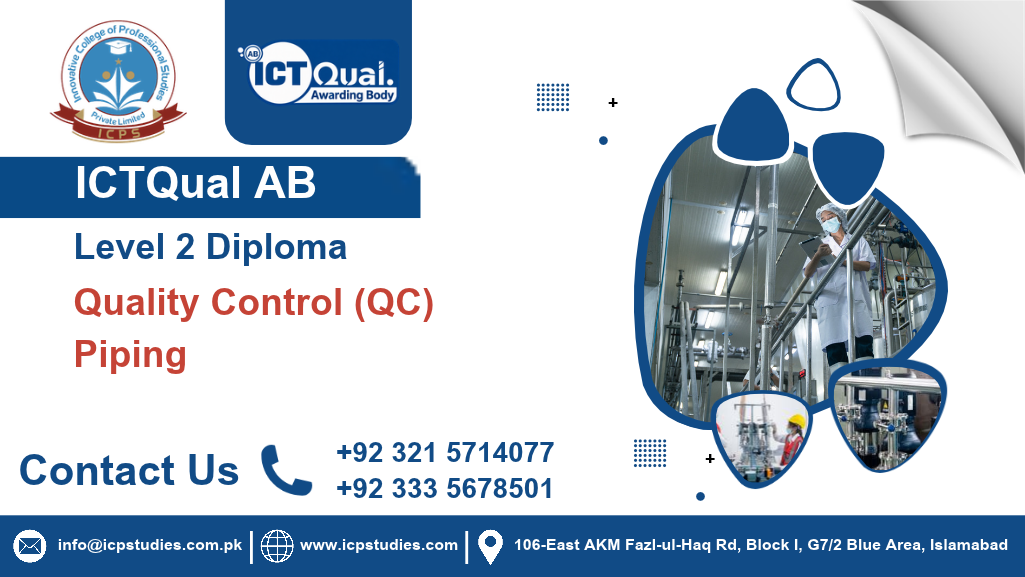
The ICTQual AB Level 2 Diploma in Quality Control (QC) Piping is a vocational qualification designed to introduce learners to the fundamental principles of piping quality control, inspection procedures, and quality assurance in industrial environments. The course provides an introduction to the quality requirements involved in piping fabrication, installation, and inspection across industries such as oil and gas, petrochemicals, construction, power generation, and industrial manufacturing. It helps learners understand why quality control is essential for maintaining piping integrity, ensuring compliance with project specifications, and supporting safe and reliable industrial operations.
This Level 2 Diploma in QC Piping is suitable for individuals who want to begin developing their knowledge of piping inspection and quality management, including aspiring quality control assistants, piping inspection trainees, fabrication workers, construction personnel, and entry-level professionals seeking career development in industrial projects. Learners can build an understanding of piping materials, dimensional checks, fabrication quality, welding inspection fundamentals, inspection documentation, and the importance of following approved procedures and technical specifications.
By studying the ICTQual AB Level 2 Diploma in Quality Control (QC) Piping, learners can develop foundational knowledge relevant to quality inspection, defect identification, documentation practices, and compliance monitoring. These learning benefits can support improved workplace awareness, more effective communication with technical teams, and a clearer understanding of quality requirements in piping projects. The qualification may provide a starting point for further study in piping quality control, mechanical inspection, and industrial quality assurance.
All About ICTQual AB Level 2 Diploma in Quality Control (QC) Piping
Course Overview
The ICTQual AB Level 2 Diploma in Quality Control (QC) Piping is a vocational qualification structured to develop learners’ understanding of quality requirements, technical procedures, and inspection practices associated with industrial piping systems. Comprising 5 units and 20 credits, the course provides a foundation for understanding how quality control contributes to accurate fabrication, reliable installation, and compliance with engineering specifications. It introduces learners to the importance of maintaining consistent workmanship and following established quality procedures throughout piping-related operations.
The course explores key concepts relevant to piping quality control, including material verification, dimensional accuracy, fabrication checks, welding quality awareness, inspection records, and the identification of potential defects. Learners can develop an understanding of technical drawings, project specifications, quality documentation, and the role of inspection activities in meeting defined acceptance criteria. The programme also highlights the importance of communication, attention to detail, procedural compliance, and coordination between quality personnel, engineers, supervisors, and fabrication teams. These subject areas are relevant to piping projects in oil and gas, petrochemical facilities, power generation, construction, and industrial manufacturing.
The ICTQual AB Level 2 Diploma in Quality Control (QC) Piping is suitable for individuals seeking foundational knowledge for entry-level responsibilities in piping fabrication, quality inspection support, and industrial quality assurance. It may also benefit workers who want to improve their understanding of quality procedures and technical requirements in engineering environments. Successful completion can support further vocational learning and professional development in piping inspection and quality control. However, employment eligibility and progression depend on practical competence, employer requirements, project-specific standards, and any additional technical training or certifications required for particular positions. Learners should consult the current qualification specification for the official unit titles, learning outcomes, and assessment requirements.
Entry Requirement
The ICTQual AB Level 2 Diploma in Quality Control (QC) Piping is suitable for individuals who want to develop foundational knowledge of piping inspection, industrial quality control, and engineering quality procedures.
- Age: Applicants should meet the minimum age requirements specified by the awarding body and approved training centre.
- Educational Background: Basic secondary education or an equivalent qualification is recommended. A background in engineering, construction, mechanical studies, or a related technical subject may be beneficial.
- Relevant Experience: Previous experience in piping, fabrication, welding, construction, or quality control is helpful but may not be essential for entry level learners, subject to the official requirements.
- English Language Proficiency: Learners should have sufficient English reading, writing, and comprehension skills to understand technical materials, follow instructions, and complete assessments.
- Technical Knowledge: Basic awareness of industrial operations, engineering drawings, piping systems, or workshop safety is advantageous but may not be mandatory.
Study Units
This qualification, the ICTQual AB Level 2 Diploma in Quality Control (QC) Piping, consists of 5 mandatory units.
- Piping Fabrication and Installation Techniques
- Visual Inspection and Common Defects
- Dimensional Inspection Procedures
- Introduction to Welding Processes in Piping
- Piping Codes and Standards
Learning Outcomes:
Learning Outcomes for the Study Units:
1. Piping Fabrication and Installation Techniques
- Understand the processes involved in piping fabrication and field installation.
- Identify key stages in pipe cutting, beveling, fitting, and welding.
- Monitor compliance with fabrication drawings, specifications, and work procedures.
2. Visual Inspection and Common Defects
- Conduct detailed visual inspections of piping systems, welds, and joints.
- Identify and classify surface defects such as cracks, undercuts, porosity, and misalignments.
- Record inspection findings using appropriate documentation and quality reports.
3. Dimensional Inspection Procedures
- Apply standard measurement techniques to verify pipe alignment, elevation, and spacing.
- Use dimensional inspection tools such as callipers, gauges, and measuring tapes accurately.
- Ensure dimensional conformity according to piping drawings and tolerance limits.
4. Introduction to Welding Processes in Piping
- Understand the fundamentals of common welding processes used in piping systems (e.g. SMAW, GTAW, GMAW).
- Recognise welding symbols and interpret basic weld procedure specifications (WPS).
- Relate welding parameters to quality requirements in piping applications.
5. Piping Codes and Standards
- Identify internationally recognised piping codes and standards such as ASME B31.3, API, and ISO.
- Understand the role of codes and standards in ensuring safety, quality, and compliance.
- Apply relevant code requirements to inspection, fabrication, and testing processes.
Ideal Candidate:
The ICTQual AB Level 2 Diploma in Quality Control (QC) Piping is designed for individuals who want to develop foundational knowledge of piping quality control, inspection procedures, and industrial engineering standards.
This course is particularly suitable for:
- Aspiring QC Piping Assistants: Individuals interested in starting a career in piping quality control and inspection support.
- Piping and Fabrication Workers: Personnel seeking to improve their understanding of piping fabrication quality and inspection procedures.
- Welding and Mechanical Trainees: Learners who want to develop awareness of welding quality, piping components, and technical specifications.
- Construction Industry Beginners: Individuals interested in quality requirements for piping installation and industrial construction projects.
- Oil and Gas Industry Job Seekers: Aspiring professionals who want foundational knowledge relevant to piping activities in oil and gas and petrochemical environments.
- Engineering and Technical Students: Learners with an interest in mechanical engineering, industrial operations, or piping systems.
- Quality Control Trainees: Individuals seeking an introduction to inspection documentation, defect identification, and quality monitoring.
- Industrial Maintenance Personnel: Workers who want to strengthen their understanding of piping integrity and quality requirements.
- Career Changers: Individuals exploring opportunities in piping inspection, fabrication support, or industrial quality assurance.
- Further Study Seekers: Learners who want to build a foundation for additional vocational training in piping quality control and related technical disciplines.
FAQs ICTQual AB Level 2 Diploma in Quality Control (QC) Piping