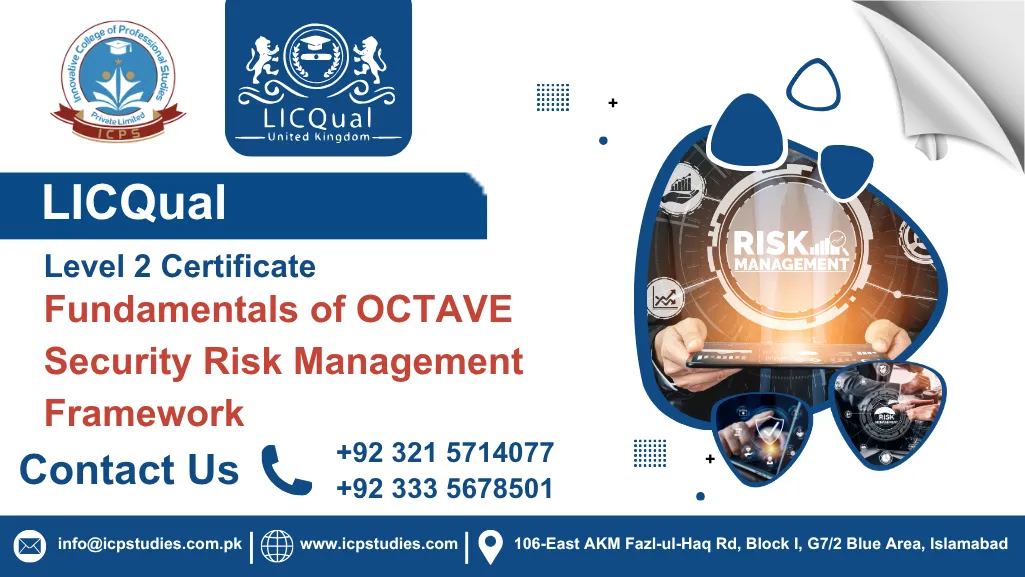
The LICQual Level 2 Certificate in Fundamentals of OCTAVE Security Risk Management Framework is a practical foundation-level qualification designed to introduce Learners to structured information security risk management and the OCTAVE framework. It helps Learners understand how organisations can identify information assets, recognise security threats, assess risks and develop appropriate strategies to strengthen organisational security.
Information security risks can affect data, systems, business processes and critical operations. A structured risk management approach enables organisations to understand their security exposures and make informed decisions about appropriate risk treatment. This qualification provides Learners with essential knowledge of OCTAVE-based security risk assessment and the principles used to understand organisational information security risks.
Throughout the programme, Learners explore key concepts including information assets, security requirements, threats, vulnerabilities, risk identification, risk analysis, risk evaluation and risk treatment. The course also develops awareness of how organisational knowledge and business processes can contribute to effective security risk management.
The LICQual Level 2 Certificate in Fundamentals of OCTAVE Security Risk Management Framework is suitable for IT support personnel, cybersecurity beginners, information security staff, risk management personnel, system administrators and professionals seeking foundational knowledge of security risk frameworks.
By completing this qualification, Learners can develop a practical foundation for recognising information security risks and supporting structured risk management activities within modern organisations.
All About LICQual Level 2 Certificate in Fundamentals of OCTAVE Security Risk Management Framework
Course Overview
The LICQual Level 2 Certificate in Fundamentals of OCTAVE Security Risk Management Framework is a foundation-level qualification designed to develop Learners’ knowledge of information security risk management and the core principles of the OCTAVE framework. It provides a structured understanding of how organisations can identify, assess and manage risks affecting information assets, systems and business operations.
The qualification consists of 6 units, carries 18 credits and includes 72 Guided Learning Hours (GLH). Its comprehensive structure enables Learners to explore fundamental security risk management concepts and understand how a structured framework can support organisational decision-making and security improvement.
Key areas include information assets, security requirements, threat identification, vulnerabilities, risk assessment, risk analysis, risk evaluation and risk treatment. Learners also develop awareness of organisational security practices and how risk information can be used to support appropriate security controls and improvement activities.
Entry Requirement:
The LICQual Level 2 Certificate in Fundamentals of OCTAVE Security Risk Management Framework is designed for Learners seeking foundational knowledge of information security and risk management.
- Age: Normally 18 years or above.
- Experience: Previous IT, cybersecurity or risk management experience is beneficial but not essential.
- Educational Background: Basic secondary education or equivalent is recommended.
- Language Proficiency: Basic English proficiency is required to understand course materials and complete assessments.
- Digital Skills: Basic computer and internet skills are recommended.
- Technical Knowledge: Basic awareness of information security is helpful but not mandatory.
- Resources: Access to a computer, internet and required learning materials is recommended.
Study Units
This qualification, the LICQual Level 2 Certificate in Fundamentals of OCTAVE Security Risk Management Framework, consists of 6 mandatory units.
- Introduction to Advanced OCTAVE Framework
- Risk Assessment Tools and Techniques
- Design of Security Controls
- Threat and Vulnerability Analysis
- Strategies for Risk Mitigation
- OCTAVE Implementation and Monitoring
Learning Outcomes:
By the end of this course, learners will be able to:
Introduction to Advanced OCTAVE Framework
- Demonstrate an advanced understanding of the OCTAVE Framework and its key components.
- Analyze how the OCTAVE framework supports the identification, assessment, and management of security risks in complex environments.
- Apply the OCTAVE methodology to assess risks associated with organizational assets and processes.
Risk Assessment Tools and Techniques
- Identify and use various tools and techniques for conducting detailed risk assessments.
- Implement both qualitative and quantitative risk assessment approaches based on organizational needs.
- Apply appropriate risk assessment methods to evaluate threats, vulnerabilities, and potential impacts on assets.
Design of Security Controls
- Design and implement effective security controls to mitigate identified risks.
- Understand the role of security controls in reducing vulnerabilities and preventing potential threats.
- Develop security control strategies that are aligned with the organization’s risk management goals and compliance requirements.
Threat and Vulnerability Analysis
- Conduct thorough threat and vulnerability analyses to identify potential risks to organizational assets.
- Evaluate the likelihood and impact of identified threats and vulnerabilities.
- Apply risk analysis techniques to assess the potential impact of various threat scenarios on organizational security.
Strategies for Risk Mitigation
- Develop and implement effective risk mitigation strategies to reduce or eliminate identified risks.
- Understand and apply risk treatment strategies such as avoidance, transfer, acceptance, and mitigation.
- Evaluate the effectiveness of mitigation efforts and adjust strategies to address emerging threats.
OCTAVE Implementation and Monitoring
- Apply continuous monitoring strategies to ensure the long-term resilience of security frameworks and compliance with evolving regulations.
- Implement the OCTAVE framework within an organization to conduct continuous risk assessments.
- Monitor the effectiveness of risk management practices and security controls over time.
Ideal Candidate:
The LICQual Level 2 Certificate in Fundamentals of OCTAVE Security Risk Management Framework is suitable for Learners who want to develop foundational knowledge of information security risk assessment, risk management and the OCTAVE framework.
- IT Support Professionals: Learners involved in supporting information systems and digital infrastructure.
- Cybersecurity Beginners: Individuals seeking foundational knowledge of security risk management.
- Information Security Staff: Professionals supporting organisational information security activities.
- Risk Management Personnel: Individuals involved in identifying and managing organisational risks.
- System Administrators: Professionals responsible for supporting secure and reliable IT systems.
- IT Operations Staff: Learners involved in managing technology-enabled business operations.
- Security Support Staff: Individuals assisting with security assessments and risk controls.
- Career Starters: Learners seeking practical knowledge of information security risk management frameworks.
FAQs LICQual Level 2 Certificate in Fundamentals of OCTAVE Security Risk Management Framework