
How to Conduct an ISO 9001 Audit: A Practical Guide for Aspiring Lead Auditors
Conducting an ISO 9001 audit requires much more than comparing documents with a checklist. An effective auditor needs to understand the organisation’s Quality Management System (QMS), examine how processes operate in practice, gather reliable objective evidence, evaluate that evidence against defined audit criteria, identify valid findings and communicate conclusions clearly.
For aspiring Lead Auditors, learning the complete audit process is particularly important because the role involves both technical auditing skills and the ability to coordinate audit activities professionally.
This practical guide explains how to conduct an ISO 9001 audit from preparation through follow-up. It covers audit planning, evidence collection, interviews, process auditing, nonconformity identification, reporting, corrective-action follow-up and the skills needed to perform effective QMS audits.
What Is an ISO 9001 Audit?
An ISO 9001 audit is a systematic and documented process used to evaluate whether a Quality Management System meets defined audit criteria and is effectively implemented within its intended scope.
ISO 9001:2015 provides requirements for a Quality Management System that organisations can use to consistently provide products and services that meet customer and applicable requirements while enhancing customer satisfaction.
An audit does not simply ask whether an organisation has documented procedures. It examines whether relevant requirements are understood, implemented and supported by appropriate evidence.
For example, an organisation may have a documented procedure describing how customer complaints should be handled. During an audit, the auditor may examine whether:
- Employees understand the complaint-handling process.
- Complaints are recorded consistently.
- Complaints are investigated appropriately.
- Actions are taken where necessary.
- Trends are monitored.
- Records demonstrate what actually happened.
- The organisation evaluates whether corrective actions were effective.
The auditor therefore looks at the relationship between requirements, processes, implementation and evidence.
What Is the Purpose of an ISO 9001 Audit?
An ISO 9001 audit provides an evidence-based evaluation of a QMS. Depending on the audit purpose, it can help an organisation understand whether its management system is conforming to defined criteria and whether processes are achieving their intended results.
Key purposes can include:
Evaluating conformity
The auditor determines whether relevant processes and arrangements conform to applicable requirements.
Assessing implementation
A documented system has limited value if it is not implemented. Auditing provides an opportunity to determine whether planned arrangements are actually being followed.
Identifying nonconformities
Where evidence demonstrates that an applicable requirement has not been fulfilled, the auditor can document an appropriate finding.
Identifying improvement opportunities
An audit can provide useful information about process performance, recurring problems, inefficient controls and areas where improvements may be beneficial.
Supporting management decision-making
Clear audit findings provide management with information about the condition and effectiveness of the QMS.
Supporting continual improvement
Audit results can contribute to corrective action, risk-based thinking, process improvement and broader QMS development.
An important principle is that auditors should base conclusions on verifiable evidence rather than assumptions, personal preferences or unsupported opinions.
Types of ISO 9001 Audits
ISO 9001 audits can take different forms depending on who conducts the audit and its purpose.
First-Party or Internal Audits
A first-party audit is conducted by or on behalf of the organisation itself. Internal audits are commonly used to evaluate the organisation’s own QMS.
Internal auditors may examine whether processes conform to planned arrangements and applicable requirements and whether the management system is effectively implemented.
Second-Party or Supplier Audits
A second-party audit is generally conducted by an organisation on another organisation, such as a supplier or service provider.
The purpose may include evaluating supplier capability, contractual requirements, quality controls or performance.
Third-Party or Certification Audits
A third-party audit is conducted by an independent conformity-assessment organisation within the applicable certification framework.
These audits may be associated with certification or surveillance activities.
Although the context differs, all effective audits depend on structured planning, appropriate evidence and objective evaluation.
ISO 9001 Audit Process: An Overview
A professional ISO 9001 audit can generally be understood as a sequence of connected activities:
Define objectives → establish scope and criteria → review information → prepare the audit → conduct the opening meeting → gather evidence → evaluate processes → record findings → conduct the closing meeting → prepare the report → follow up corrective actions
Each stage contributes to the quality of the final audit conclusion.
Skipping preparation can lead to poor evidence collection. Weak evidence can result in unclear findings. Poorly written findings can create confusion during corrective-action follow-up.
For this reason, aspiring Lead Auditors should learn to treat the audit as a complete process rather than a collection of separate tasks.
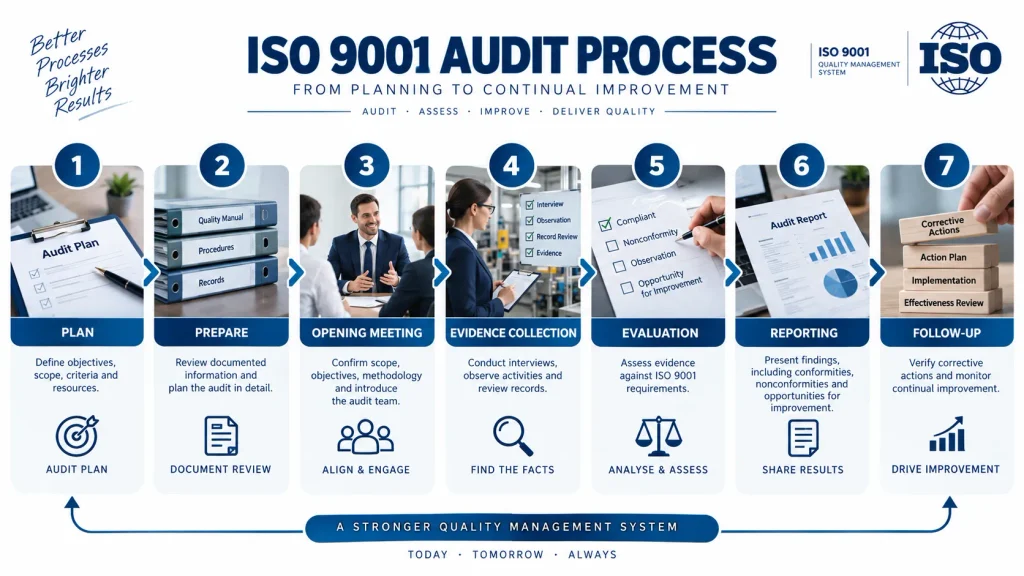
How to Conduct an ISO 9001 Audit Step by Step
Step 1: Define the Audit Objectives
Before beginning the audit, establish exactly what the audit is intended to accomplish.
The audit objective should provide direction to the audit team and help determine what evidence needs to be collected.
Depending on the audit, objectives may include evaluating:
- QMS conformity.
- Implementation of defined processes.
- Effectiveness of selected controls.
- Specific processes or locations.
- Corrective-action implementation.
- Supplier controls.
- Areas affected by significant organisational changes.
A clear objective prevents the audit from becoming unfocused.
For example, an audit objective might be to evaluate whether the organisation’s customer-related processes are implemented as planned and whether relevant performance information is monitored.
This gives the auditor a clear direction for the audit.
Step 2: Establish the Audit Scope
The audit scope defines the boundaries of the audit.
It may identify:
- Organisational locations.
- Departments.
- Processes.
- Products or services.
- Activities.
- Functions.
- Relevant QMS boundaries.
The scope should be sufficiently clear that everyone involved understands what is and is not being examined.
An auditor should avoid allowing the audit to expand informally into unrelated areas unless the change is appropriately managed.
For example, if an audit is focused on purchasing and supplier controls, the auditor may examine supplier selection, evaluation, purchasing information and supplier performance. However, unrelated processes should not automatically become part of the audit simply because an interesting issue appears during an interview.
Step 3: Determine the Audit Criteria
Audit criteria are the requirements or reference points against which evidence is evaluated.
Depending on the audit context, criteria can include:
- Applicable ISO 9001:2015 requirements.
- The organisation’s QMS requirements.
- Policies.
- Procedures.
- Process arrangements.
- Contractual requirements.
- Other applicable requirements included within the audit scope.
The auditor must understand the criteria before evaluating evidence.
A finding should not be based merely on the auditor’s preferred way of doing something. The auditor needs a relevant requirement or agreed audit criterion against which the evidence can be evaluated.
Step 4: Review Relevant QMS Information Before the Audit
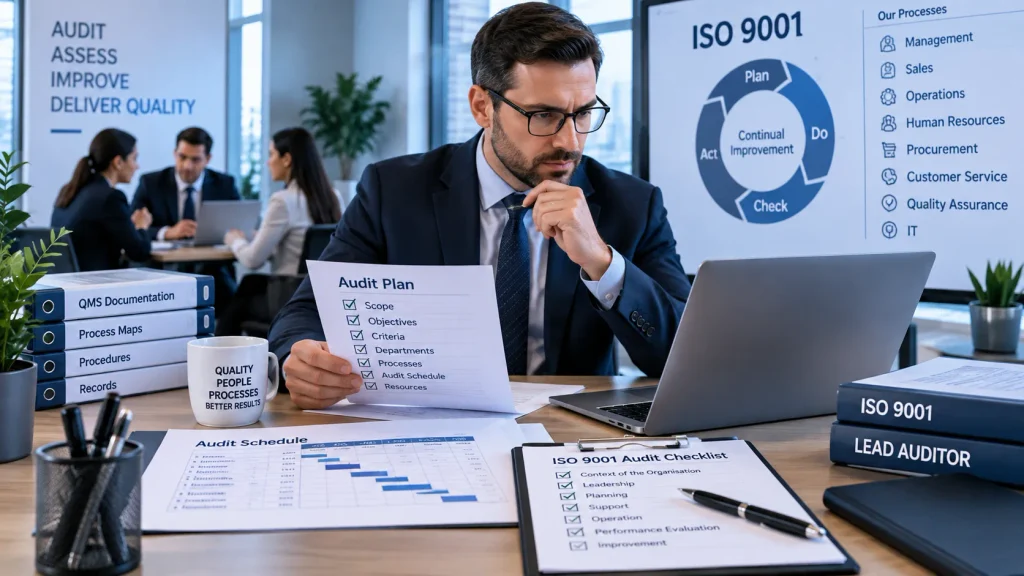
Preparation begins before the auditor enters the process area.
Relevant information may include:
- Quality policies.
- Quality objectives.
- Process information.
- Procedures and documented information.
- Previous audit reports.
- Previous nonconformities.
- Corrective-action records.
- Customer complaints.
- Performance indicators.
- Management review outputs.
- Internal audit results.
- Supplier performance information.
- Significant organisational changes.
The purpose of this review is not to decide the audit conclusion in advance.
Instead, it helps the auditor understand the organisation and identify areas that may require attention during the audit.
For example, if previous audit results indicate repeated issues with supplier performance, the auditor can consider this information when planning the purchasing and supplier-control audit activities.
Step 5: Prepare the ISO 9001 Audit Plan
An audit plan provides a structured timetable and helps the audit team use available time effectively.
A practical audit plan can include:
| Audit Element | Information to Define |
|---|---|
| Audit objective | What the audit needs to establish |
| Audit scope | Processes, locations and activities |
| Audit criteria | Requirements used for evaluation |
| Dates | When audit activities will take place |
| Audit team | Assigned auditors and responsibilities |
| Process sequence | Order in which areas will be assessed |
| Methods | Interviews, observation, sampling and review |
| Participants | Relevant personnel and process owners |
| Reporting | Arrangements for communicating findings |
The plan should be realistic.
If an auditor allocates too little time to a complex process, evidence collection may become superficial. If excessive time is allocated to low-risk areas, important processes may not receive adequate attention.
An experienced Lead Auditor therefore balances the audit schedule according to scope, complexity, risk, previous results and available resources.
Step 6: Conduct the Opening Meeting
The opening meeting establishes the working framework for the audit.
The Lead Auditor can introduce the audit team and explain:
- Audit objectives.
- Audit scope.
- Audit criteria.
- Audit methods.
- Audit timetable.
- Communication arrangements.
- Responsibilities.
- Reporting arrangements.
- How questions or concerns can be raised.
The opening meeting should establish a professional and cooperative tone.
Auditing is not an exercise in confrontation. The purpose is to gather and evaluate evidence objectively.
A Lead Auditor should communicate clearly, remain impartial and ensure participants understand how the audit will be conducted.
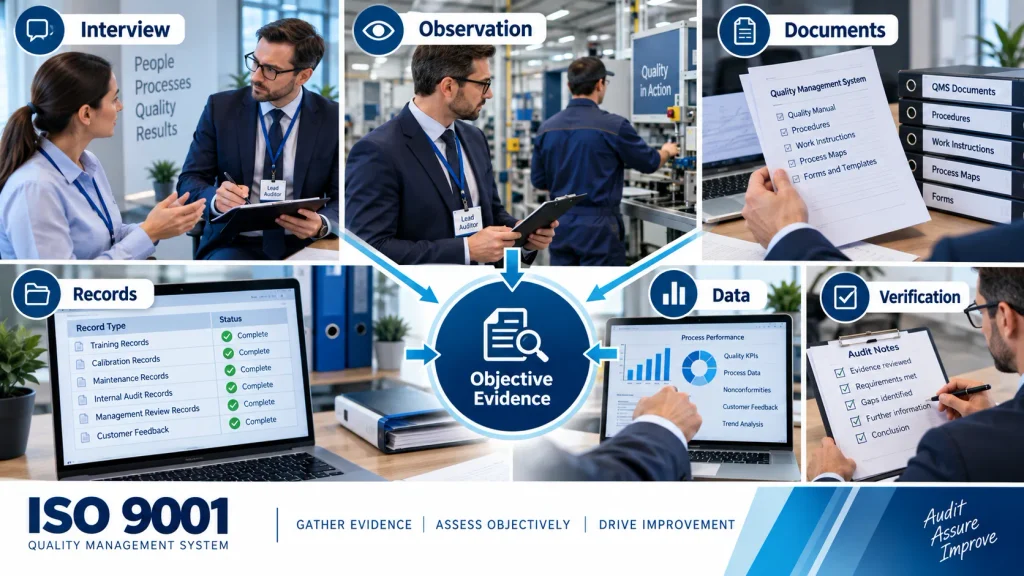
Step 7: Gather Objective Audit Evidence
Objective evidence is one of the most important concepts in effective auditing.
Objective evidence consists of information that can be verified and is relevant to the audit criteria.
Common evidence sources include:
Interviews
Employees and process owners can explain how activities are performed.
Observation
The auditor can observe processes being performed.
Documents
Procedures, specifications and other documented information can demonstrate planned arrangements.
Records
Records can demonstrate that activities have been performed and provide evidence of results.
Performance information
KPIs, measurements, monitoring results and other data can provide information about process performance.
Sampling
Auditors generally cannot examine every transaction, record or activity. Appropriate sampling allows the auditor to evaluate selected evidence while maintaining a structured approach.
A useful evidence trail may look like:
Employee explanation → documented process → observed activity → record → performance result
If these sources consistently support each other, the auditor can develop greater confidence in the conclusion.
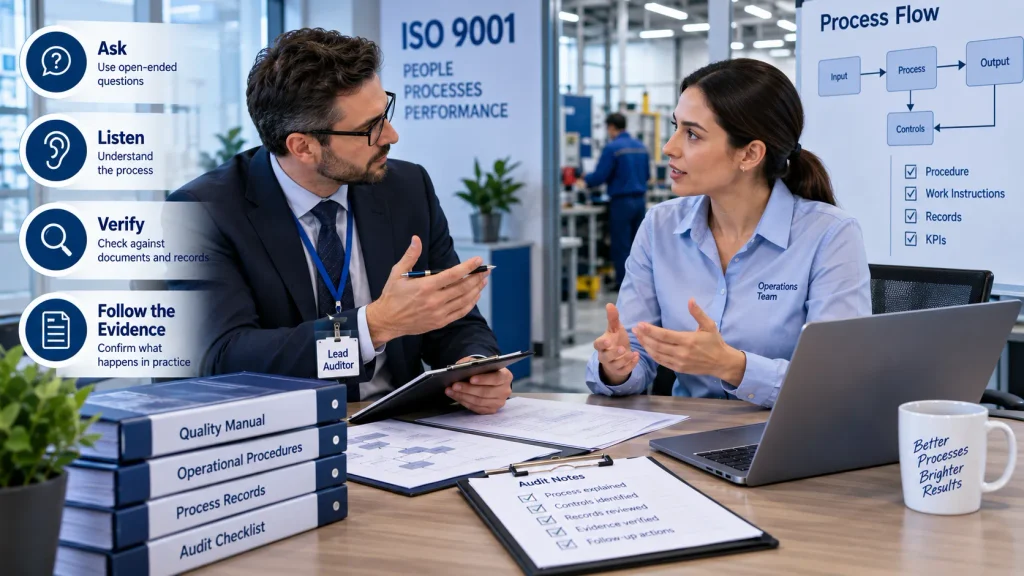
Step 8: Interview Personnel and Process Owners
Interviews are a fundamental audit technique.
However, effective auditing is not simply about asking a large number of questions. The quality of the questions matters.
Avoid questions that encourage a simple yes or no answer
Instead of:
“Do you follow the procedure?”
An auditor could ask:
“Can you explain how this activity is normally performed?”
The second question encourages the person to describe the actual process.
The auditor can then follow up:
“What happens if the expected result is not achieved?”
Or:
“Can you show me the record that demonstrates this activity?”
This approach moves the conversation from claims to verifiable evidence.
Good audit questions are generally:
- Open-ended where appropriate.
- Neutral.
- Relevant to the audit scope.
- Focused on the process.
- Designed to identify evidence.
- Free from unnecessary assumptions.
Auditors should also listen carefully. Sometimes an employee’s answer identifies an area that requires additional verification.
Step 9: Observe Processes in Practice
One of the most valuable auditing techniques is observing how work is actually performed.
Suppose a procedure states that incoming materials must be inspected before acceptance.
Rather than reviewing only the procedure, the auditor can examine:
- How materials arrive.
- Who performs the inspection.
- What criteria are used.
- How acceptance decisions are made.
- What happens when materials fail inspection.
- What records are generated.
- How nonconforming materials are controlled.
This allows the auditor to compare the planned process with the implemented process.
The objective is not to criticise differences automatically. The auditor must evaluate whether the difference represents a failure to meet an applicable requirement or simply reflects an acceptable and controlled way of implementing the process.
Step 10: Audit Processes Instead of Just Checking Clauses
Effective QMS auditing requires process thinking.
A process can be considered through a sequence such as:
Inputs → Activities → Controls → Outputs → Monitoring → Results → Improvement
For example, a purchasing process may involve:
Purchase requirement → supplier selection → purchase information → receipt → verification → supplier performance monitoring
The auditor can investigate how each part connects.
Questions may include:
- What triggers the process?
- Who is responsible?
- What information is required?
- What controls are applied?
- What could go wrong?
- How is performance monitored?
- What records demonstrate implementation?
- What happens when results do not meet expectations?
This process-based approach helps the auditor understand how different QMS requirements interact rather than treating every requirement as an isolated checkbox.
What Evidence Should an ISO 9001 Auditor Look For?
The specific evidence depends on the organisation and audit scope, but an auditor may consider areas such as:
| QMS Area | Examples of Evidence |
|---|---|
| Organisational context | Relevant internal/external issues and interested-party information |
| Leadership | Quality policy, responsibilities and leadership involvement |
| Planning | Quality objectives, risks and opportunities |
| Competence | Training, experience and competency evidence |
| Documented information | Controlled documents and records |
| Operations | Process controls, work instructions and process records |
| Customer processes | Customer requirements, communications and feedback |
| Suppliers | Supplier evaluation and monitoring information |
| Monitoring and measurement | KPIs, inspection results and analysis |
| Internal audit | Audit programme, plans, reports and findings |
| Management review | Review inputs, decisions and actions |
| Improvement | Nonconformities, corrective actions and effectiveness evidence |
The auditor should not assume that one particular record is mandatory simply because it existed in another organisation.
The important question is whether appropriate evidence demonstrates conformity and effective implementation within the organisation’s QMS.
Step 11: Evaluate Audit Evidence
Once evidence has been collected, the auditor evaluates it against the audit criteria.
Several characteristics are useful when assessing evidence.
Relevance
Is the information directly related to the audit criteria and scope?
Reliability
Can the evidence be verified or corroborated?
Sufficiency
Is there enough evidence to support the conclusion?
Traceability
Can the auditor identify where the evidence came from?
Consistency
Do interviews, observations, records and other evidence support the same conclusion?
For example, if an employee states that equipment is inspected monthly, the auditor may verify the relevant inspection records and check whether the inspection process observed in practice aligns with the stated arrangement.
This process helps prevent premature conclusions.
Step 12: Identify and Record Audit Findings
Audit findings should be based on evaluated evidence.
A useful way to understand a finding is:
Requirement + Objective Evidence + Evaluation = Audit Finding
If the evidence demonstrates conformity, the auditor records the appropriate conclusion.
If evidence demonstrates that a requirement has not been fulfilled, the auditor can document a nonconformity according to the applicable audit and certification framework.
If the evidence is insufficient, the auditor should gather additional information rather than immediately making an unsupported conclusion.
What Is an ISO 9001 Nonconformity?
A nonconformity occurs when a requirement has not been fulfilled.
A professional auditor should be able to identify:
- The applicable requirement.
- The evidence examined.
- The nature of the gap.
- The basis for the finding.
For example, a vague statement such as:
“Training needs improvement.”
does not provide enough information.
A more useful finding would identify the applicable requirement and explain the specific evidence demonstrating the gap.
The finding should allow the organisation to understand what was identified without relying on the auditor’s personal interpretation.
How to Write a Clear ISO 9001 Audit Finding
A strong audit finding should be:
- Specific.
- Factual.
- Evidence-based.
- Traceable.
- Clearly related to an applicable criterion.
- Written in professional language.
Avoid emotional language such as “poor,” “bad,” “unacceptable” or “careless” unless the applicable terminology specifically requires it.
Instead, describe what was verified.
For example, rather than:
“The purchasing process is poorly controlled.”
an evidence-based finding would identify the relevant purchasing requirement and describe the records or activities that demonstrated the specific gap.
The purpose of audit reporting is clarity, not criticism.
Understanding Major and Minor Nonconformities
Terms such as “major” and “minor” nonconformity may be used within particular certification and auditing schemes, but classification should not be applied using a simplistic universal formula.
The auditor should consider the applicable certification rules, audit methodology and significance of the finding.
Factors that may be relevant include:
- Extent of the issue.
- Effect on the QMS.
- Whether the issue is isolated or systemic.
- Evidence of repeated failure.
- Effectiveness of controls.
- Risk and potential consequences.
Aspiring Lead Auditors should therefore learn the classification rules applicable to the audit context rather than relying on informal definitions.
Step 13: Conduct the Closing Meeting
The closing meeting brings the audit activities together.
The Lead Auditor should communicate the audit conclusions clearly and professionally.
The meeting may cover:
- Audit objectives.
- Audit scope.
- Summary of activities.
- Positive findings or conformities.
- Nonconformities.
- Evidence supporting findings.
- Corrective-action expectations.
- Reporting arrangements.
- Follow-up activities.
The Lead Auditor should avoid introducing completely new unsupported findings during the meeting.
If a disagreement arises, the auditor should return to the audit criteria and objective evidence.
Professional communication is particularly important because audit findings can have significant implications for an organisation.
Step 14: Prepare the ISO 9001 Audit Report
The audit report should provide a clear record of what was audited and what was concluded.
A professional report may include:
- Audit identification.
- Audit objectives.
- Audit scope.
- Audit criteria.
- Audit team.
- Audit dates and locations.
- Processes or areas assessed.
- Audit methods.
- Summary of evidence.
- Findings.
- Nonconformities.
- Audit conclusion.
- Follow-up requirements.
The level of detail should reflect the audit context.
The report should be clear enough that relevant stakeholders can understand the audit outcome without needing to reconstruct the entire audit from memory.
How to Follow Up on ISO 9001 Corrective Actions
The audit process does not necessarily end when the report is issued.
When a nonconformity is identified, the organisation may need to determine an appropriate response.
A useful corrective-action sequence is:
Nonconformity → Correction → Root-cause analysis → Corrective action → Implementation → Verification → Effectiveness
Correction
The immediate action taken to address the identified issue.
Root-cause analysis
The organisation investigates why the nonconformity occurred.
Corrective action
Action intended to eliminate the cause and prevent recurrence.
Implementation
The organisation puts the agreed action into practice.
Verification
Evidence is reviewed to determine whether the action was implemented as intended.
Effectiveness
Where applicable, the auditor evaluates whether the action has effectively addressed the underlying issue.
Simply closing an action because someone says it was completed is not necessarily sufficient. Appropriate evidence should support the conclusion.
Common ISO 9001 Audit Mistakes to Avoid
Auditing Only the Documentation
A QMS should not be evaluated solely by reading documents. Auditors should also examine implementation and results.
Asking Only Yes-or-No Questions
Closed questions can be useful in some situations, but relying on them exclusively can limit the evidence obtained.
Accepting Answers Without Verification
An employee’s explanation is useful evidence, but additional verification may be necessary.
Collecting Insufficient Evidence
A conclusion should be supported by sufficient relevant evidence.
Writing Vague Findings
Statements such as “process needs improvement” do not clearly explain the actual issue.
Allowing Personal Preferences to Influence Findings
Auditors evaluate conformity against defined criteria. They should not require organisations to adopt the auditor’s preferred method when that method is not an applicable requirement.
Losing Control of Audit Time
Spending excessive time on one issue can prevent other areas within the audit scope from being adequately examined.
Failing to Follow the Evidence Trail
An unexpected piece of information may require follow-up. The auditor should investigate appropriately without losing sight of the audit objective and scope.
Poor Communication
Even technically accurate findings can become difficult to manage when communicated poorly.
Failing to Follow Up Corrective Actions
A finding should be followed through according to the applicable audit process so that its status and effectiveness can be appropriately evaluated.
Essential Skills for an ISO 9001 Lead Auditor
Technical knowledge is only one part of effective Lead Auditor performance.
ISO 9001 Knowledge
The auditor needs a strong understanding of applicable QMS requirements and how they relate to organisational processes.
Audit Planning
Lead Auditors need to organise resources, time, scope and audit activities effectively.
Analytical Thinking
Auditors must connect evidence, requirements and process performance to reach defensible conclusions.
Interviewing
Good auditors know how to ask questions that encourage useful explanations and evidence.
Active Listening
Important information is often contained in what interviewees explain about exceptions, problems or process changes.
Observation
Auditors need to notice how activities are actually performed.
Evidence Evaluation
The ability to distinguish reliable evidence from assumptions is fundamental.
Communication
Auditors must explain findings clearly to employees, process owners and management.
Report Writing
Audit reports need to be accurate, concise and understandable.
Time Management
A Lead Auditor must maintain progress without sacrificing evidence quality.
Professional Judgement
Not every unusual situation represents a nonconformity. Auditors need to evaluate evidence carefully against applicable criteria.
Impartiality
Auditors should remain objective and avoid conflicts of interest or personal bias.
Leadership
Lead Auditors may coordinate other auditors, manage meetings, allocate activities and bring different pieces of evidence together into a coherent conclusion.
Practical ISO 9001 Audit Scenario
Consider a manufacturing organisation where employees operating production equipment are expected to have appropriate competence.
During the audit, the auditor begins by asking the production supervisor how employee competence is determined.
The supervisor explains that employees receive training before performing the activity independently.
The auditor then asks to see relevant competency information.
The records show that several employees have completed training.
However, one employee’s record does not contain evidence of the required competency evaluation.
The auditor does not immediately conclude that a nonconformity exists.
Instead, the auditor may:
- Identify the applicable requirement.
- Confirm how competence is supposed to be evaluated.
- Speak with the employee or responsible supervisor.
- Review relevant records.
- Determine whether another valid record provides the missing evidence.
- Evaluate the evidence against the audit criteria.
- Document the conclusion appropriately.
This example demonstrates an important auditing principle:
Do not turn an initial observation into a finding before verifying the evidence.
ISO 9001 Audit Checklist for Aspiring Lead Auditors
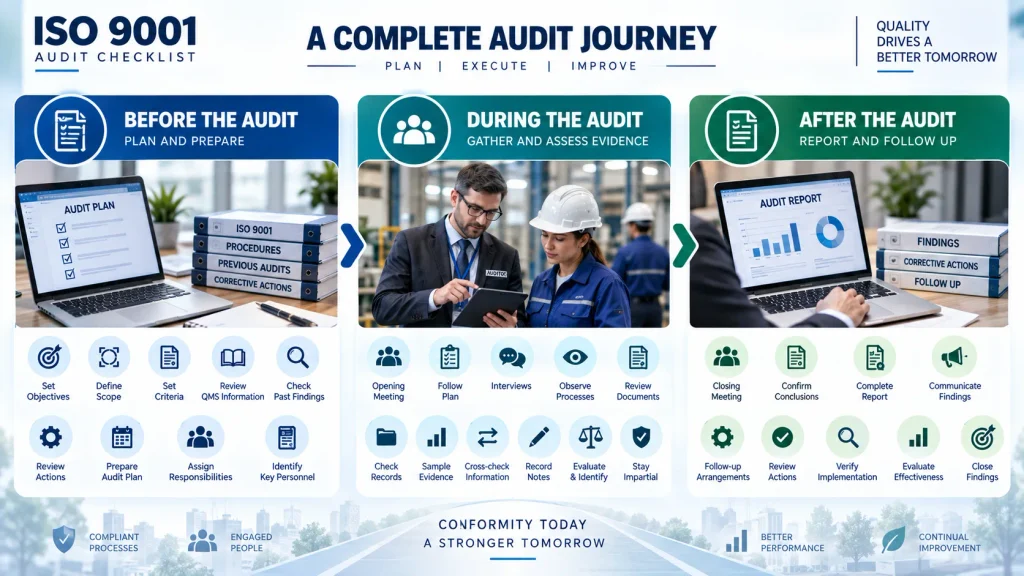
Before the Audit
- Define audit objectives.
- Confirm audit scope.
- Establish audit criteria.
- Review relevant QMS information.
- Review previous audit findings.
- Review relevant corrective actions.
- Prepare the audit plan.
- Assign audit responsibilities.
- Identify relevant personnel and processes.
During the Audit
- Conduct the opening meeting.
- Follow the audit plan.
- Interview relevant personnel.
- Observe processes.
- Review documented information.
- Examine records.
- Sample appropriate evidence.
- Cross-check information.
- Record factual audit notes.
- Evaluate evidence against criteria.
- Identify valid findings.
- Maintain impartiality and professional communication.
After the Audit
- Conduct the closing meeting.
- Confirm audit conclusions.
- Complete the audit report.
- Communicate nonconformities clearly.
- Establish appropriate follow-up arrangements.
- Review corrective-action evidence.
- Verify implementation where required.
- Evaluate effectiveness where applicable.
- Complete the audit follow-up process.
Internal Auditor vs Lead Auditor: What Is the Difference?
An internal auditor and a Lead Auditor may perform overlapping audit activities, but their responsibilities can differ according to the organisation and audit context.
An internal auditor may be responsible for conducting audits within their organisation’s QMS.
A Lead Auditor generally has additional responsibility for coordinating and leading an audit team and bringing audit evidence together into an overall conclusion.
| Area | Internal Auditor | Lead Auditor |
|---|---|---|
| Audit environment | Often internal | Can operate in different audit contexts |
| Primary role | Conduct assigned audit activities | Lead and coordinate audit activities |
| Team responsibility | May work individually or as part of a team | May coordinate an audit team |
| Planning | May contribute to planning | Often responsible for overall audit coordination |
| Reporting | Reports assigned findings | Coordinates overall audit conclusions |
| Leadership | Depends on assignment | Central element of the Lead Auditor role |
The exact responsibilities depend on the organisation, audit programme and applicable certification or conformity-assessment arrangements.
How ISO 9001 Lead Auditor Training Supports Professional Development
Aspiring auditors can benefit from structured training that connects ISO 9001 requirements with practical auditing techniques.
A suitable Lead Auditor course can help learners develop knowledge and skills related to:
- ISO 9001:2015 requirements.
- QMS auditing principles.
- Audit planning.
- Audit preparation.
- Evidence collection.
- Interview techniques.
- Process-based auditing.
- Audit findings.
- Nonconformity reporting.
- Audit communication.
- Corrective-action follow-up.
- Audit leadership.
The QualCert ISO 9001:2015 – Quality Management System (QMS) Lead Auditor Course is designed around the knowledge and practical competencies relevant to professionals who want to develop their understanding of ISO 9001 auditing and Lead Auditor responsibilities.
When choosing professional auditor training, learners should consider the course content, assessment approach, learning outcomes, practical relevance and how well the programme aligns with their professional objectives.
Career Opportunities for ISO 9001 Lead Auditors
Knowledge of ISO 9001 auditing can be relevant across many sectors because quality management systems are used in manufacturing, construction, healthcare, engineering, logistics, professional services, technology and other industries.
Potential roles may include:
- ISO 9001 Lead Auditor
- QMS Auditor
- Quality Auditor
- Internal Auditor
- Quality Assurance Professional
- Quality Manager
- Supplier Quality Auditor
- Management Systems Consultant
The exact responsibilities and entry requirements for these roles vary according to employer, sector, professional experience and applicable competency expectations.
Strong auditing skills can be particularly valuable for professionals who already work with quality systems, compliance, process management or organisational improvement.
Frequently Asked Questions About ISO 9001 Auditing
How do you conduct an ISO 9001 audit step by step?
An ISO 9001 audit typically involves defining objectives, scope and criteria, reviewing relevant QMS information, preparing an audit plan, conducting the opening meeting, gathering objective evidence, evaluating processes, recording findings, conducting the closing meeting, preparing the audit report and following up corrective actions.
What is objective evidence in an ISO 9001 audit?
Objective evidence is verifiable information relevant to the audit criteria. It can come from interviews, observations, documents, records, measurements, performance information and other reliable sources.
What questions should an ISO 9001 auditor ask?
Auditors should ask questions that help them understand how processes operate and identify supporting evidence. Useful questions include “Can you explain how this process works?”, “What happens when the expected result is not achieved?” and “Can you show me the record that demonstrates this activity?”
What does an ISO 9001 Lead Auditor do?
A Lead Auditor typically plans and coordinates audit activities, manages the audit team where applicable, communicates with the auditee, evaluates audit evidence, coordinates findings and leads the development and communication of audit conclusions.
How are ISO 9001 nonconformities identified?
A nonconformity is identified when objective evidence demonstrates that an applicable requirement has not been fulfilled. The auditor should verify the evidence and clearly connect the finding to the relevant audit criterion.
What should an ISO 9001 audit report include?
An audit report commonly identifies the audit objectives, scope, criteria, team, dates, areas assessed, findings, nonconformities, conclusions and applicable follow-up arrangements.
What skills does an ISO 9001 Lead Auditor need?
Important skills include ISO 9001 knowledge, analytical thinking, interviewing, active listening, observation, evidence evaluation, communication, report writing, time management, professional judgement, impartiality and audit leadership.
What training can help aspiring ISO 9001 Lead Auditors?
Structured ISO 9001 Lead Auditor training can help professionals understand QMS requirements and develop practical skills related to audit planning, evidence gathering, interviewing, findings, reporting and audit leadership.
Conclusion: Building Effective ISO 9001 Auditing Skills
Conducting an ISO 9001 audit effectively requires a structured and evidence-based approach.
The auditor must begin with clear objectives, scope and criteria, prepare appropriately, understand the organisation’s processes and gather reliable evidence. During the audit, effective questioning, observation, sampling and document review help establish how the QMS operates in practice.
The auditor’s responsibility does not end with identifying issues. Findings must be evaluated carefully, reported clearly and followed up according to the applicable audit process.
For aspiring Lead Auditors, the most important lesson is that effective auditing is not simply about checking documents or ticking boxes. It is about understanding processes, verifying evidence, applying professional judgement and communicating conclusions objectively.
Developing these capabilities through practical experience and structured professional training can help quality and management-system professionals build stronger auditing competence and contribute more effectively to the performance of Quality Management Systems.