
Financial Accounting vs Management Accounting: Key Differences Explained
Financial accounting and management accounting are two important areas of accounting that help organisations understand their financial performance, manage resources and make informed decisions. Although both use financial information, they serve different purposes and are designed for different users.
The main difference between financial accounting and management accounting is their purpose and audience. Financial accounting primarily focuses on preparing standardised financial information for external users such as investors, lenders, regulators and other stakeholders. Management accounting focuses mainly on providing detailed financial and operational information to internal decision-makers to support planning, budgeting, performance management and business decisions.
Understanding the difference between financial accounting and management accounting is important for accounting students, finance professionals, business owners and managers. It helps explain how businesses record financial activity while also using financial information to plan for the future.
This guide explains financial accounting and management accounting in detail, compares their key differences, provides practical examples and explains how both functions work together in modern organisations.

What Is the Difference Between Financial Accounting and Management Accounting?
Financial accounting is primarily concerned with recording, summarising and reporting a company’s financial transactions and performance, usually through formal financial statements. Its information is commonly used by people outside the organisation, including investors, lenders, regulators and other stakeholders.
Management accounting is primarily concerned with analysing financial and operational information to help managers plan, control operations and make business decisions. Its reports are generally prepared for internal users and can be tailored to the organisation’s specific needs.
In simple terms:
- Financial accounting asks: What has happened financially?
- Management accounting asks: What is happening, why is it happening, and what should the organisation do next?
- Financial accounting is mainly externally focused.
- Management accounting is mainly internally focused.
- Financial accounting commonly reports historical financial information.
- Management accounting can combine historical information with forecasts, budgets and future-oriented analysis.
However, these areas should not be viewed as competing forms of accounting. They are complementary functions that can work together to provide a more complete understanding of an organisation’s financial position and performance.
What Is Financial Accounting?
Financial accounting is the branch of accounting concerned with recording business transactions, maintaining financial records and preparing financial information about an organisation’s financial performance and position.
The information generated through financial accounting is commonly presented in formal financial statements. These statements provide stakeholders with a structured view of areas such as revenue, expenses, assets, liabilities, equity and cash flows.
Financial accounting is particularly important because businesses need reliable financial records to understand their financial position and communicate relevant financial information to stakeholders.

What Is the Main Purpose of Financial Accounting?
The main purpose of financial accounting is to provide reliable and structured financial information about an organisation.
Financial accounting can help users understand:
- How much revenue a business generated
- What expenses it incurred
- Whether it generated a profit or loss
- What assets it owns
- What liabilities it owes
- How much equity it has
- How cash moved through the organisation
- How its financial position has changed over time
This information can support financial analysis and help external stakeholders assess the organisation.
Who Uses Financial Accounting Information?
Financial accounting information is commonly used by external stakeholders, although internal management can also use financial statements.
External users may include:
- Investors
- Shareholders
- Banks and lenders
- Suppliers
- Creditors
- Government authorities
- Regulators
- Tax authorities
- Business partners
- Other stakeholders
For example, an investor may examine financial statements to understand a company’s profitability and financial position before making an investment decision.
A lender may analyse financial information to assess whether a business appears capable of meeting its financial obligations.
What Information Does Financial Accounting Provide?
Financial accounting generally provides information about the financial consequences of transactions and events.
This may include:
- Sales and revenue
- Operating expenses
- Assets
- Liabilities
- Equity
- Cash flows
- Receivables
- Payables
- Inventory
- Profit or loss
The information is usually organised into formal financial reports.
Common Financial Accounting Reports
One of the most recognisable features of financial accounting is the preparation of financial statements.
Income Statement
The income statement, also commonly referred to as a statement of profit or loss, summarises income and expenses over a particular accounting period.
It can help users understand whether an organisation generated a profit or loss during that period.
For example, a business might report:
- Revenue
- Cost of sales
- Gross profit
- Operating expenses
- Operating profit
- Finance costs
- Profit before tax
- Profit for the period
Balance Sheet or Statement of Financial Position
The statement of financial position provides information about an organisation’s assets, liabilities and equity at a specific point in time.
It can help answer questions such as:
- What does the organisation own?
- What does it owe?
- What is the residual interest of owners?
Assets may include cash, inventory, property and receivables.
Liabilities may include loans, trade payables and other obligations.
Equity represents the owners’ residual interest after liabilities are deducted from assets.
Cash Flow Statement
The cash flow statement provides information about cash inflows and outflows during an accounting period.
Cash flows are commonly classified into:
- Operating activities
- Investing activities
- Financing activities
Cash flow information can help stakeholders understand how an organisation generates and uses cash.
Statement of Changes in Equity
This statement explains changes in an organisation’s equity during an accounting period.
It may include movements arising from:
- Profit or loss
- Dividends
- New share issues
- Other changes in equity
Together, these financial statements provide a structured picture of an organisation’s financial performance and position.
What Is Management Accounting?
Management accounting is the process of collecting, analysing, interpreting and communicating financial and other relevant information to support internal management.
Unlike financial accounting, management accounting is not primarily designed to produce standardised information for external stakeholders.
Instead, management accounting focuses on helping managers answer practical business questions.
For example:
- How much does a product cost to produce?
- Which department is performing best?
- Why are actual costs higher than budget?
- Should the business increase production?
- What might happen if prices change?
- How much should the organisation budget for the next period?
- Which products or services generate stronger margins?
- Where can costs be reduced?
Management accounting can therefore connect accounting information with planning, operational control and strategic decision-making.

What Is the Main Purpose of Management Accounting?
The main purpose of management accounting is to provide useful information for planning, decision-making, performance management and control.
Management accountants may analyse both financial and non-financial information.
For example, a business may examine:
- Revenue
- Costs
- Profit margins
- Sales volumes
- Production quantities
- Labour costs
- Inventory levels
- Departmental performance
- Customer profitability
- Budgets
- Forecasts
- Key performance indicators
This information can help managers understand what is happening within the organisation and evaluate possible courses of action.
Who Uses Management Accounting Information?
Management accounting information is primarily used by internal users.
These may include:
- Senior executives
- Finance managers
- Department managers
- Operations managers
- Production managers
- Sales managers
- Project managers
- Business owners
- Strategic planning teams
For example, a production manager may need information about production costs and efficiency.
A sales manager may need information about sales performance and customer profitability.
A senior executive may need forecasts and performance reports to support strategic planning.
The information can therefore be tailored to the needs of each decision-maker.
What Information Does Management Accounting Provide?
Management accounting can provide detailed information designed around a particular management need.
Examples include:
- Budget reports
- Cost reports
- Variance reports
- Forecasts
- Profitability analysis
- Break-even analysis
- Product costing
- Departmental performance reports
- Cash forecasts
- Scenario analysis
- Key performance indicators
The flexibility of management accounting means that reports do not necessarily need to follow the same format as external financial statements.
Common Management Accounting Tools and Techniques
Management accounting uses various tools to help organisations plan and make decisions.
Budgeting and Budgetary Control
A budget is a financial plan for a future period.
Businesses may prepare budgets for:
- Sales
- Production
- Labour
- Purchases
- Operating expenses
- Cash flow
- Capital expenditure
Once actual results become available, managers can compare them with the budget.
This process can help identify areas where actual performance differs from expectations.
Financial Forecasting
Forecasting involves estimating future financial or operational outcomes using available information and assumptions.
For example, a company may forecast:
- Future sales
- Expected costs
- Cash requirements
- Profit
- Demand
- Resource requirements
Forecasting can support planning by helping managers consider possible future conditions.
Cost Analysis
Cost analysis involves examining the costs associated with products, services, departments, projects or activities.
It can help managers understand:
- Where money is being spent
- Which activities are expensive
- Which products generate stronger margins
- Where cost efficiencies may be possible
Variance Analysis
Variance analysis compares actual results with planned or budgeted results.
For example, if a department budgeted £50,000 for operating costs but actual costs were £56,000, management may investigate the £6,000 difference.
The objective is not simply to identify a difference but to understand why the difference occurred and whether action is required.
Break-Even Analysis
Break-even analysis examines the level of sales or output required for total revenue to cover total costs.
It can help managers understand the relationship between:
- Fixed costs
- Variable costs
- Sales volume
- Selling price
- Contribution
- Profit
This can be useful when evaluating pricing, production and sales decisions.
Profitability Analysis
Profitability analysis examines how much profit is generated by different areas of the organisation.
For example, a business might compare profitability by:
- Product
- Service
- Customer group
- Region
- Branch
- Department
This can provide useful information for resource allocation and performance management.
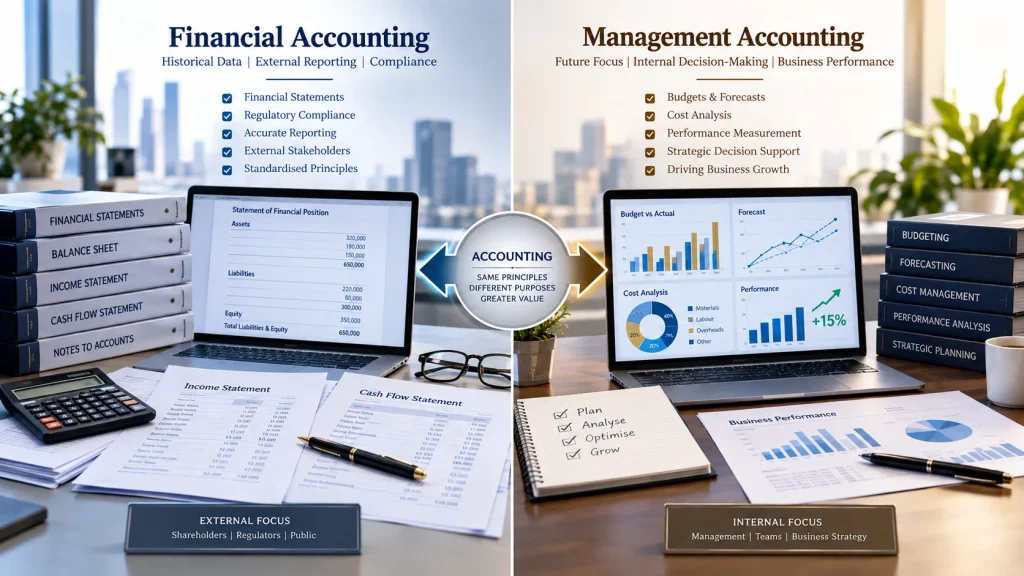
Financial Accounting vs Management Accounting: Key Differences
Although both areas involve accounting information, they differ in several important ways.
1. Purpose and Objectives
The primary objective of financial accounting is to produce financial information that communicates an organisation’s financial performance and position.
Management accounting aims to provide information that helps managers plan, control operations, evaluate performance and make decisions.
In simple terms, financial accounting is strongly focused on financial reporting, while management accounting is strongly focused on management decision support.
2. Internal vs External Users
One of the most important differences is the intended audience.
Financial accounting information is commonly designed for external stakeholders such as investors, lenders and regulators.
Management accounting information is mainly prepared for internal users such as managers and executives.
However, financial statements can also be used internally, and management accounting information may sometimes contribute to external reporting processes.
3. Historical vs Future-Oriented Information
Financial accounting primarily reports information about transactions and events that have already occurred.
Management accounting can use historical information, but it also commonly incorporates:
- Budgets
- Forecasts
- Estimates
- Scenarios
- Future assumptions
Therefore, management accounting can have a stronger future-oriented dimension.
4. Financial Reports vs Management Reports
Financial accounting generally produces formal financial statements.
Management accounting can produce many different reports depending on management requirements.
For example, management may request a report showing:
- Production costs by department
- Sales performance by region
- Budget variances
- Product profitability
- Forecast cash requirements
These reports can be customised for a specific purpose.
5. Regulation and Accounting Standards
Financial reporting is generally subject to applicable accounting requirements, regulations and reporting frameworks in the relevant jurisdiction.
The purpose of these requirements is to support consistency, comparability and reliability in financial reporting.
Management accounting is generally more flexible because its reports are prepared primarily for internal use.
The exact regulatory environment varies depending on the organisation, jurisdiction and reporting requirements.
6. Level of Detail
Financial accounting commonly presents information at an overall organisational level.
Management accounting can provide highly detailed information.
For example, financial accounting might report total operating expenses.
Management accounting might break those expenses down by:
- Department
- Product
- Project
- Location
- Activity
This level of detail can help managers investigate specific operational issues.
7. Reporting Frequency
Financial statements are generally prepared according to defined reporting periods.
Management accounting reports can be produced whenever management requires them.
A business may therefore prepare:
- Weekly sales reports
- Monthly budget reports
- Quarterly performance analysis
- Project-specific cost reports
- Daily operational dashboards
The frequency depends on the organisation’s needs.
8. Overall Business vs Specific Areas
Financial accounting generally provides information about the organisation as a whole.
Management accounting can focus on specific parts of the organisation.
For example, management may want to know the profitability of one product line or the performance of one department.
9. Decision-Making Role
Financial accounting provides information that can help stakeholders evaluate an organisation.
Management accounting has a more direct relationship with internal decision-making.
Managers may use management accounting information when deciding:
- Whether to increase production
- Whether to change prices
- Whether to reduce costs
- Whether to invest in equipment
- Whether to discontinue a product
- How to allocate resources
10. Confidentiality
Financial accounting information is often communicated to external stakeholders through formal reporting.
Management accounting information is generally internal and may contain commercially sensitive details.
For example, a company’s detailed product cost structure or internal pricing analysis may be restricted to management.
11. Flexibility
Financial accounting generally follows established reporting requirements.
Management accounting can be more flexible.
A manager can request a report specifically designed to answer a particular business question.
This flexibility is one of the reasons management accounting can be particularly useful for internal decision-making.
12. Type of Information
Financial accounting is predominantly concerned with financial information.
Management accounting can combine financial information with operational and non-financial information.
For example, management may consider:
- Sales revenue
- Production volumes
- Employee hours
- Customer numbers
- Defect rates
- Delivery times
- Cost per unit
Combining financial and operational information can provide a broader basis for business decisions.
Financial Accounting vs Management Accounting: Comparison Table
| Factor | Financial Accounting | Management Accounting |
|---|---|---|
| Main purpose | Financial reporting | Planning, control and decision support |
| Primary users | External stakeholders and other users | Internal management |
| Main focus | Financial performance and position | Business performance and decision-making |
| Time orientation | Mainly historical | Historical and future-oriented |
| Reports | Formal financial statements | Budgets, forecasts, analysis and internal reports |
| Regulation | Generally subject to applicable reporting requirements | Generally more flexible |
| Level of detail | Often broader organisational view | Can be highly detailed |
| Reporting frequency | Usually defined reporting periods | Whenever management requires |
| Business focus | Overall organisation | Departments, products, projects and activities |
| Information type | Primarily financial | Financial and operational |
| Confidentiality | Often externally communicated | Generally internal |
| Decision-making | Supports stakeholder evaluation | Directly supports internal decisions |
Financial Accounting Examples: How It Works in Practice
Consider a retail business operating several stores.
At the end of its financial year, the company needs to report its financial performance.
The financial accounting team may:
- Record sales transactions.
- Record operating expenses.
- Reconcile financial accounts.
- Calculate profit or loss.
- Prepare financial statements.
- Report assets and liabilities.
- Present information according to applicable reporting requirements.
The resulting financial statements can help stakeholders understand the company’s financial position and performance.
Management Accounting Examples: How It Works in Practice
Now imagine that the same retail company wants to decide whether to open a new store.
Management accounting may help analyse:
- Expected sales
- Rent
- Staffing costs
- Utilities
- Marketing expenses
- Inventory requirements
- Expected contribution
- Break-even sales
- Forecast cash flows
- Potential profitability
Management can use this information to evaluate whether the proposed store appears financially and operationally viable.
This illustrates an important difference: financial accounting can explain the company’s existing financial performance, while management accounting can help management evaluate future decisions.

Financial Accounting vs Management Accounting: A Practical Business Scenario
Imagine a manufacturing company produces three different products: Product A, Product B and Product C.
Management notices that overall revenue is increasing but profit margins are falling.
What Would Financial Accounting Analyse?
Financial accounting could provide information about:
- Total revenue
- Total expenses
- Profit
- Assets
- Liabilities
- Cash flows
The financial statements may show that profitability has declined.
However, management may need more detailed information to understand the reason.
What Would Management Accounting Analyse?
Management accounting could examine:
- Cost per product
- Labour costs
- Material costs
- Production efficiency
- Selling price
- Contribution margin
- Product profitability
- Budget versus actual costs
The analysis might reveal that Product C has high sales but a very low contribution margin because production costs have increased.
Management could then investigate whether to:
- Increase the selling price
- Reduce production costs
- Change suppliers
- Improve production efficiency
- Modify the product
- Reduce production
- Reallocate resources
This demonstrates how financial accounting and management accounting can address different aspects of the same business situation.
What Are the Similarities Between Financial Accounting and Management Accounting?
Despite their differences, financial accounting and management accounting share several characteristics.
Both Use Accounting Information
Both rely on financial information generated from business transactions and records.
Accurate accounting data is therefore important to both functions.
Both Support Business Performance
Financial accounting helps communicate financial performance, while management accounting helps managers analyse and improve performance.
Both Require Analytical Skills
Accounting professionals in both areas need to understand financial information and identify meaningful patterns.
Both Can Support Better Decisions
Although their audiences and purposes differ, both forms of accounting can contribute to better business decisions.
How Financial Accounting and Management Accounting Work Together
Financial accounting and management accounting should not be treated as completely separate activities.
Financial accounting creates a structured record of an organisation’s financial transactions and performance.
Management accounting can then use financial information, together with operational information, to investigate performance and support planning.
For example, financial accounting may show that operating costs increased during the year.
Management accounting can investigate:
- Which costs increased?
- Which department was responsible?
- Was the increase expected?
- Was it caused by higher production?
- Was it caused by higher supplier prices?
- Was the increase temporary or ongoing?
- What could management do about it?
In this way, the two functions can complement each other.
Which Is More Important: Financial Accounting or Management Accounting?
There is no universal answer because financial accounting and management accounting serve different purposes.
Financial accounting is essential for reliable financial reporting and communicating financial information to relevant stakeholders.
Management accounting is valuable for internal planning, performance management and decision-making.
A business may need both.
For example, a company could have accurate financial statements but still struggle to make good operational decisions if management does not have sufficient information about costs, budgets and future scenarios.
Similarly, detailed internal management reports are difficult to produce effectively without reliable underlying financial records.
The two functions therefore work best when viewed as complementary components of financial management.
Skills Needed in Financial and Management Accounting
Professionals working across accounting and finance can benefit from a broad range of technical and professional skills.
Financial Reporting and Analysis
Understanding financial statements and interpreting financial information is important for accounting and finance roles.
Budgeting and Forecasting
Budgeting and forecasting skills can help professionals support financial planning.
Cost and Profitability Analysis
Understanding how costs affect profitability is valuable for both accountants and managers.
Data Interpretation
Modern finance teams work with large amounts of financial and operational information. The ability to interpret data can therefore support better analysis.
Critical Thinking
Accounting professionals often need to investigate unusual figures, identify causes of variances and evaluate alternatives.
Attention to Detail
Accuracy is fundamental to accounting because errors can affect financial information and business decisions.
Communication
Accounting professionals must often explain financial information to people who do not have an accounting background.
Strong communication can therefore be an important professional skill.
Business Decision-Making
Understanding how accounting information connects with business strategy can help finance professionals contribute beyond basic record-keeping.

Career Applications of Financial and Management Accounting
Knowledge of financial and management accounting can be relevant to a wide range of accounting and finance roles.
Depending on qualifications, experience and professional requirements, individuals may work in areas such as:
- Financial accounting
- Management accounting
- Financial analysis
- Accounts preparation
- Budgeting
- Cost accounting
- Financial planning
- Business analysis
- Finance management
- Audit
- Corporate finance
The exact responsibilities of each role vary between organisations and industries.
For accounting and finance learners, understanding both financial reporting and internal management information can provide a broader view of how finance contributes to organisational performance.
Why Accounting Students Should Understand Both Areas
Accounting is not simply about recording numbers.
Modern organisations use accounting information to understand performance, manage resources, control costs and make informed decisions.
Students who understand the distinction between financial accounting and management accounting can develop a clearer understanding of how financial information moves through an organisation.
For example:
Transaction → Accounting Records → Financial Information → Analysis → Management Insight → Business Decision
This relationship demonstrates why accounting knowledge can be valuable across different areas of business.
A programme such as the Qualifi Level 5 Extended Diploma in Accounting and Finance can provide learners with an opportunity to develop knowledge across accounting and finance-related areas, depending on the specific units and curriculum delivered by the approved centre.
Financial Accounting and Management Accounting in the Pakistani Business Environment
Financial and management accounting are relevant to organisations operating in Pakistan as well as businesses internationally.
Businesses in Pakistan operate across sectors including:
- Manufacturing
- Banking and financial services
- Retail
- Telecommunications
- Construction
- Healthcare
- Education
- Logistics
- Technology
- Professional services
Organisations across these sectors need reliable financial information to monitor performance and manage resources.
For example, a Pakistani manufacturing business may use financial accounting to prepare financial reports while using management accounting to analyse production costs, budgets and departmental performance.
The specific accounting, tax, regulatory and reporting requirements applicable to an organisation depend on its legal structure, industry and jurisdiction.
For students and professionals in Pakistan, understanding both financial and management accounting can therefore help develop a broader understanding of organisational finance.
Financial Accounting vs Management Accounting: Common Misconceptions
Misconception 1: Management Accounting Is Only About Budgets
Budgeting is an important management accounting activity, but management accounting can involve much more.
It can include:
- Cost analysis
- Forecasting
- Variance analysis
- Profitability analysis
- Performance measurement
- Decision support
- Scenario analysis
Misconception 2: Financial Accounting Is Only for Accountants
Financial statements may be prepared by accounting professionals, but the resulting information can be relevant to many stakeholders.
Investors, lenders, managers and other users may need to understand financial information.
Misconception 3: Management Accounting Only Looks at the Future
Management accounting can use historical information as well as forecasts and estimates.
Historical data can be essential for understanding trends and developing future plans.
Misconception 4: Financial Accounting and Management Accounting Are Completely Separate
Although they have different purposes, they often rely on related accounting information and can work together.
How to Choose Between Financial and Management Accounting?
For students and professionals deciding which area interests them, the best starting point is to understand the nature of the work.
You may find financial accounting particularly interesting if you enjoy:
- Financial reporting
- Accounting records
- Financial statements
- Accuracy and compliance
- Historical financial analysis
- Structured reporting
You may find management accounting particularly interesting if you enjoy:
- Business analysis
- Budgeting
- Forecasting
- Cost analysis
- Performance measurement
- Problem-solving
- Supporting management decisions
However, many accounting and finance professionals encounter elements of both areas during their careers.
Frequently Asked Questions About Financial Accounting vs Management Accounting
What is the main difference between financial accounting and management accounting?
Financial accounting mainly focuses on recording and reporting financial information for external stakeholders and other users, while management accounting focuses primarily on analysing financial and operational information to support internal planning, control and decision-making.
What is financial accounting?
Financial accounting is the branch of accounting concerned with recording financial transactions and preparing financial information, including formal financial statements, to communicate an organisation’s financial performance and position.
What is management accounting?
Management accounting involves collecting, analysing and communicating financial and operational information to help internal management with planning, performance evaluation, control and decision-making.
Who uses financial accounting information?
Financial accounting information can be used by investors, shareholders, lenders, creditors, regulators, government authorities and other stakeholders. Management may also use financial accounting information.
Who uses management accounting information?
Management accounting information is mainly used by internal decision-makers, including managers, executives, finance teams, department heads and business owners.
Is financial accounting regulated?
Financial reporting is generally subject to applicable accounting standards, regulations and reporting requirements depending on the organisation and jurisdiction.
Is management accounting regulated in the same way?
Management accounting is generally more flexible because its reports are primarily designed for internal use. However, organisations may still have internal policies, governance requirements and professional expectations affecting management accounting practices.
Which type of accounting focuses more on future decisions?
Management accounting generally has a stronger future-oriented focus because it can use budgets, forecasts, scenarios and estimates to support planning and decision-making.
Which type of accounting focuses on historical information?
Financial accounting primarily reports financial transactions and events that have already occurred, although financial information may also be used for analysis and decision-making.
What reports are prepared in financial accounting?
Common financial accounting reports include the income statement or statement of profit or loss, statement of financial position, cash flow statement and statement of changes in equity.
What tools are used in management accounting?
Management accounting can use tools such as budgeting, forecasting, cost analysis, variance analysis, break-even analysis, profitability analysis and performance measurement.
Can an accountant work in both financial and management accounting?
Yes. Accounting professionals may develop knowledge and experience across different areas of accounting. The specific responsibilities depend on their role, employer, qualifications and professional experience.
Why are both financial accounting and management accounting important?
Both are important because they serve complementary purposes. Financial accounting provides structured financial information about an organisation, while management accounting helps internal decision-makers analyse information, plan activities and evaluate business options.
Is management accounting better than financial accounting?
Neither is universally better. Financial accounting and management accounting have different purposes. Financial accounting supports financial reporting and stakeholder information needs, while management accounting supports internal planning and decision-making.
Key Takeaways: Financial Accounting vs Management Accounting
The most important differences can be summarised as follows:
- Financial accounting focuses primarily on financial reporting.
- Management accounting focuses primarily on internal planning and decision-making.
- Financial accounting information is commonly used by external stakeholders.
- Management accounting information is primarily used by internal managers.
- Financial accounting generally focuses on historical financial information.
- Management accounting can combine historical data with budgets, forecasts and future scenarios.
- Financial accounting generally follows applicable reporting requirements.
- Management accounting offers greater flexibility in the design and frequency of internal reports.
- Financial accounting commonly presents an overall view of organisational performance.
- Management accounting can examine individual products, departments, projects and activities.
- Both functions depend on accurate and meaningful financial information.
- Both can contribute to stronger organisational financial management.

Conclusion
Financial accounting and management accounting are distinct but closely connected areas of accounting.
Financial accounting primarily focuses on recording, summarising and communicating an organisation’s financial performance and position, while management accounting focuses on analysing financial and operational information to support internal planning, control, performance management and decision-making.
The difference is therefore not simply about the type of numbers being used. It is also about who needs the information, why they need it, how detailed it needs to be and how it will be used.
Financial accounting provides a structured view of what has happened financially. Management accounting can build on financial and operational information to help managers understand performance, evaluate alternatives and plan ahead.
For accounting and finance students, understanding both areas is valuable because it provides a broader perspective on how accounting information supports organisations. Whether the goal is to work with financial reporting, budgeting, cost analysis, financial management or business decision-making, knowledge of these two accounting disciplines can provide an important foundation for professional development.
The Qualifi Level 5 Extended Diploma in Accounting and Finance is relevant to learners who want to develop broader knowledge across accounting and finance. When studying accounting, understanding the relationship between financial reporting and management decision-making can help learners see how accounting operates not only as a record-keeping function but also as an important part of business management.
Ultimately, financial accounting and management accounting are not alternatives to one another. They are complementary disciplines that help organisations understand their financial position, evaluate performance, manage resources and make informed decisions.