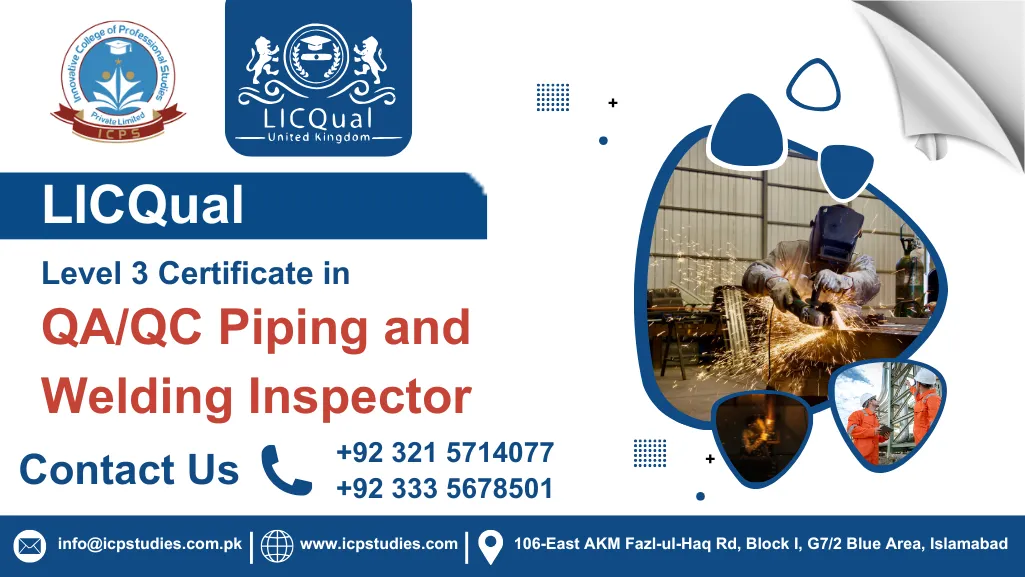
In every industrial project, there is a silent responsibility that decides whether a structure will last safely for years or fail within moments quality. The LICQual Level 3 Certificate in QA/QC Piping and Welding Inspector is built around this responsibility, turning technical awareness into practical understanding. It introduces learners to the real world of inspection where piping systems and welding work are not just installed, but carefully examined, tested, and approved with precision.
This certification brings the learner closer to the working environment of industrial sites where every weld, joint, and pipeline carries importance. It explains how inspection decisions are made, how welding quality is evaluated, and how piping systems are checked against defined standards. Instead of complex theory, the focus stays on clear, practical knowledge that reflects how quality control actually happens in engineering projects.
In industries like construction, oil & gas, and manufacturing, even a small inspection detail can change the outcome of an entire project. This certification helps build that inspection mindset, where attention to detail becomes a skill and quality becomes a habit. It shapes a clear understanding of how safe, reliable, and compliant engineering systems are created in real working conditions.
All About LICQual Level 3 Certificate in QA/QC Piping and Welding Inspector
Course Overview
The LICQual Level 3 Certificate in QA/QC Piping and Welding Inspector is a structured certification awarded by LICQual that introduces essential knowledge of quality assurance and quality control within piping and welding inspection environments. It focuses on developing understanding of inspection practices used in industrial settings where accuracy, safety, and compliance are highly important.
This certification is built around 6 total units that cover the core areas of QA/QC, piping systems, and welding inspection principles. The program is designed to present important technical concepts related to quality control and inspection processes used in engineering and industrial work environments.
With 24 total credits and 120 Guided Learning Hours (GLH), this certification provides a balanced and focused learning structure. The defined credits and learning hours ensure complete coverage of all six units, allowing learners to build a clear and organized understanding of QA/QC piping and welding inspection practices under the LICQual awarding body framework.
Admission Criteria
To enroll in the LICQual Level 3 Certificate in QA/QC Piping and Welding Inspector , learners are expected to meet the following entry requirements :
- Age Requirement: Learners must be at least 18 years old.
- Educational Requirements: A minimum of secondary school education or an equivalent level is recommended.
- English Language Proficiency: Basic proficiency in English is required.
- Work Experience:No formal work experience is strictly required.
Study Units
Learning Outcomes
By the end of this course, applicants will be able to:
1: Fundamentals of Quality Assurance and Quality Control
By the end of this unit, learners will be able to:
- Define the basic concepts and objectives of quality assurance and quality control.
- Explain the roles and responsibilities of QA/QC inspectors.
- Understand the importance of QA/QC in engineering and industrial projects.
- Identify basic quality procedures, documentation, and compliance requirements.
2: Basics of Piping Systems and Components
By the end of this unit, learners will be able to:
- Identify different types of piping materials and their uses.
- Describe common piping components including fittings, valves, and flanges.
- Interpret simple piping isometric drawings and symbols.
- Understand basic piping fabrication and installation processes.
3: Welding Processes and Techniques
By the end of this unit, learners will be able to:
- Explain various welding processes such as SMAW, GTAW, and GMAW.
- Identify different welding positions and joint types.
- Understand the role of electrodes, consumables, and equipment in welding.
- Recognize the purpose and content of WPS (Welding Procedure Specification).
4: Welding Defects and Visual Inspection
By the end of this unit, learners will be able to:
- Identify common welding defects and their causes.
- Perform basic visual inspection using standard tools.
- Apply relevant acceptance criteria to evaluate weld quality.
- Record and report inspection findings according to standard procedures.
5: Introduction to Non-Destructive Testing (NDT)
By the end of this unit, learners will be able to:
- Explain the purpose and principles of NDT methods.
- Identify basic techniques such as PT, MT, UT, RT, and VT.
- Understand when and how each NDT method is applied.
- Recognize basic safety precautions during NDT activities.
6: Codes, Standards, and Specifications
By the end of this unit, learners will be able to:
- Identify key international standards such as ASME, API, AWS, and ISO.
- Understand the application of standards in inspection and fabrication.
- Interpret relevant code sections for piping and welding work.
- Recognize the importance of regulatory compliance in QA/QC roles.
Ideal Candidate
The LICQual Level 3 Certificate in QA/QC Piping and Welding Inspector is designed for individuals who want to understand how engineering projects are inspected for safety, accuracy, and reliability before becoming operational. It introduces how welds and piping systems are evaluated in real industrial environments, helping learners develop a practical mindset where quality is treated as a key responsibility.
This certification is ideal for:
- Individuals interested in welding inspection and piping quality control processes
- Learners who want to understand how industrial systems are tested and approved
- People aiming to build a technical role in construction or engineering projects
- Site workers who want to move into inspection and quality-related responsibilities
- Individuals who enjoy working with structured procedures and technical standards
- Those looking to understand how safety and quality are maintained on industrial sites
- Technicians who want to strengthen their inspection and evaluation skills
- Beginners who want to start a career path in QA/QC environments
- Individuals interested in hands on industrial quality practices
- Anyone motivated to develop attention to detail in engineering work
FAQs LICQual Level 3 Certificate in QA/QC Piping and Welding Inspector