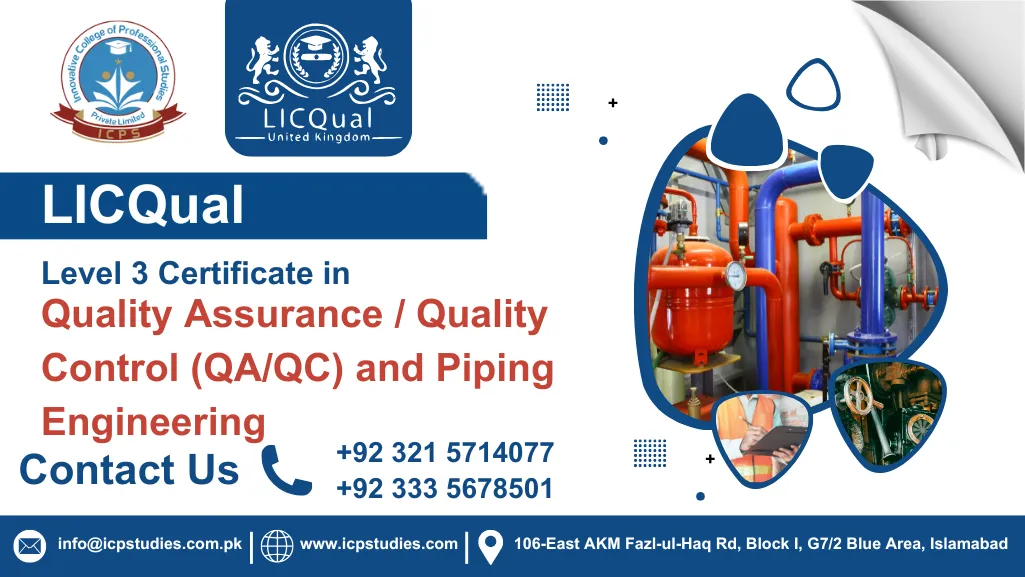
In the world of modern construction and energy projects, every pipe, weld, and joint carries a silent responsibility. A single error can affect safety, performance, and entire operations. This is where the discipline of Quality Assurance and Quality Control in piping engineering becomes essential. The LICQual Level 3 Certificate in Quality Assurance / Quality Control (QA/QC) and Piping Engineering is designed to introduce structured understanding of how quality is maintained across industrial piping systems, from design to final inspection in real working environments.
This certification focuses on building practical awareness of inspection techniques, material selection, welding standards, and documentation practices used in piping projects. It explains how QA/QC professionals monitor each stage of fabrication and installation to ensure compliance with international engineering requirements. Learners are guided through real-world quality procedures, helping them understand how errors are identified early and controlled before they impact project safety, cost, or performance.
It strengthens technical thinking and builds confidence in applying quality principles within piping engineering environments. The certification supports clear understanding of industry expectations and encourages a disciplined approach to quality, accuracy, and safety in every stage of piping work, making it a valuable step in technical career development.
All About LICQual Level 3 Certificate in Quality Assurance / Quality Control (QA/QC) and Piping Engineering
Course Overview
The LICQual Level 3 Certificate in Quality Assurance / Quality Control (QA/QC) and Piping Engineering is a structured certification awarded by LICQual, designed to provide focused knowledge of quality systems within piping engineering environments. This programme is developed with a clear academic structure that includes 6 units, 24 credits, and 120 Guided Learning Hours (GLH), ensuring a balanced distribution of learning across core technical areas.
The certification is built around essential QA/QC and piping engineering components, covering the fundamental principles of quality assurance and quality control as applied in industrial piping systems. Each unit is structured to support systematic understanding of how quality processes are planned, implemented, and monitored in engineering operations. The 24-credit framework ensures consistent academic weightage across all study areas.
With a total of 120 GLH, this LICQual certification provides a defined learning pathway that integrates theoretical concepts with structured technical study. The six-unit design supports progressive learning, allowing each stage to contribute to a complete understanding of QA/QC and piping engineering standards within a controlled academic framework.
Admission Criteria
To enroll in the LICQual Level 3 Certificate in Quality Assurance / Quality Control (QA/QC) and Piping Engineering, learners are expected to meet the following entry requirements :
- Age Requirement: Learners must be at least 16 years old.
- Educational Requirements: A basic secondary education or equivalent academic background is recommended.
- English Language Proficiency: Basic proficiency in reading, writing, and understanding English is required.
- Work Experience: Prior work experience is not mandatory.
Study Units
Learning Outcomes
By the end of this course, applicants will be able to:
1. Introduction to QA/QC and Piping Engineering – Learning Outcomes
By the end of this unit, learners will be able to:
- Understand the basic principles and importance of QA/QC in industrial projects.
- Identify key roles and responsibilities of QA/QC personnel.
- Describe the fundamental concepts of piping engineering and its applications.
- Recognize the role of quality control in the design, construction, and maintenance of piping systems.
2. Piping Materials, Components, and Fabrication – Learning Outcomes
By the end of this unit, learners will be able to:
- Identify different types of pipes, fittings, valves, flanges, and gaskets used in piping systems.
- Understand material selection criteria based on operating conditions.
- Interpret basic piping drawings and layout concepts.
- Describe the fabrication and installation processes of piping components.
3. International Codes and Standards – Learning Outcomes
By the end of this unit, learners will be able to:
- Recognize and apply key industry standards such as ASME, API, ASTM, ISO, and DIN.
- Understand the significance of codes in maintaining safety and quality.
- Interpret and follow engineering specifications and regulatory requirements.
- Ensure compliance with applicable international and project-specific standards.
4. Welding Processes and Visual Inspection – Learning Outcomes
By the end of this unit, learners will be able to:
- Understand common welding processes used in piping fabrication (SMAW, GTAW, GMAW, etc.).
- Identify weld joint types, welding positions, and welding symbols.
- Interpret Welding Procedure Specifications (WPS) and Procedure Qualification Records (PQR).
- Perform basic visual inspection of welds and identify common welding defects.
5. Non-Destructive Testing (NDT) Methods – Learning Outcomes
By the end of this unit, learners will be able to:
- Explain the purpose and importance of NDT in quality assurance.
- Identify and describe basic NDT methods including VT, PT, MT, RT, and UT.
- Select appropriate NDT techniques based on inspection requirements.
- Interpret basic NDT reports and understand defect acceptance criteria.
6. QA/QC Documentation and Reporting – Learning Outcomes
By the end of this unit, learners will be able to:
- Compile QA/QC dossiers and final project documentation for handover.
- Prepare and use QA/QC forms such as Inspection Test Plans (ITPs), checklists, and inspection reports.
- Maintain proper documentation for material traceability and inspection records.
- Identify and report non-conformities and assist in implementing corrective actions.
Ideal Candidate
A strong quality mindset often starts with people who notice details others overlook. The LICQual Level 3 Certificate in QA/QC and Piping Engineering is best suited for individuals who are curious about how industrial systems stay safe, precise, and reliable in real project environments. It aligns with those who prefer structured learning with practical technical understanding rather than theory alone.
This certification is ideal for:
- Individuals who are interested in piping systems, fabrication, and industrial engineering processes
- Those who want to understand how inspection and testing control real project quality
- People working or aiming to work in construction, oil and gas, or mechanical environments
- Learners who enjoy checking accuracy, precision, and technical standards in work
- Candidates who are comfortable learning technical procedures and site-based practices
- Individuals who want to understand how defects are identified and prevented in engineering work
- Those who prefer practical, hands-on style learning connected to real industrial settings
- People who are detail-focused and interested in structured engineering workflows
- Learners who want to understand documentation and quality tracking systems used on projects
- Individuals who are motivated to work in environments where safety and quality are critical priorities
FAQs LICQual Level 3 Certificate in Quality Assurance / Quality Control (QA/QC) and Piping Engineering