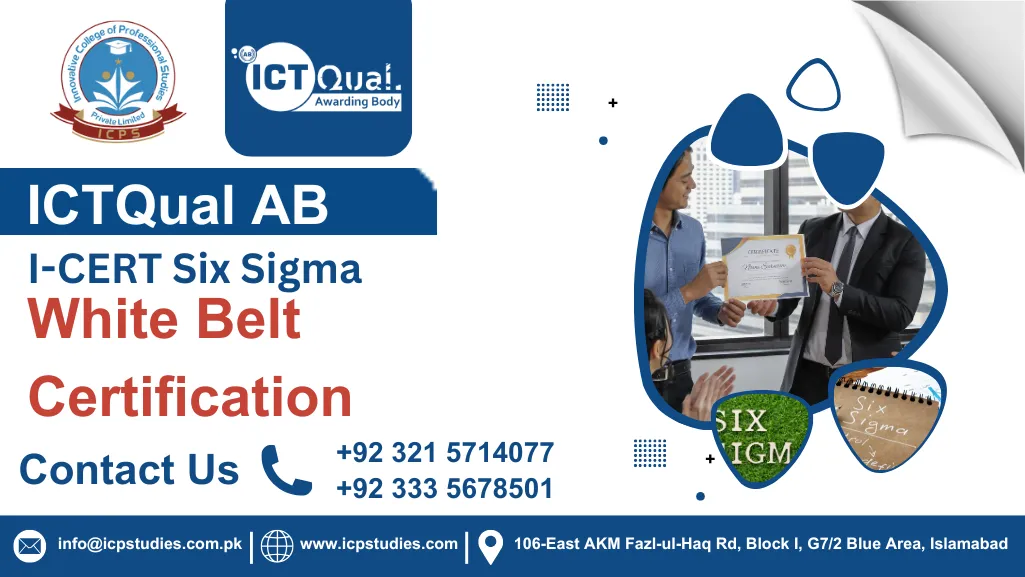
The I-CERT Six Sigma White Belt Certification is an entry level quality management programme designed to introduce learners to the fundamental principles of Six Sigma methodology, process improvement, and operational efficiency. This certification provides a clear understanding of how organisations identify defects, reduce variation, improve consistency, and enhance customer satisfaction through structured problem solving techniques. It is suitable for individuals seeking practical knowledge of continuous improvement concepts used across manufacturing, healthcare, logistics, information technology, finance, and service industries.
Throughout the course, learners gain knowledge of the DMAIC (Define, Measure, Analyse, Improve, Control) framework, basic quality management tools, process mapping, customer-focused improvement strategies, and the importance of data driven decision making. The programme also explains the roles of Six Sigma professionals, key terminology, and how teamwork contributes to achieving operational excellence. By combining theoretical concepts with practical applications, the certification helps participants understand how efficient processes can reduce waste, improve productivity, and support organisational performance.
The I-CERT Six Sigma White Belt Certification is recognised as a valuable foundation for organisations embracing Lean and Six Sigma practices. It strengthens awareness of quality standards, encourages analytical thinking, and promotes a culture of continuous improvement within the workplace. With globally relevant principles and industry focused content, this certification equips learners with essential knowledge that can be applied across a wide range of business environments, making it an excellent starting point for understanding modern quality improvement systems.
All About I-CERT Six Sigma White Belt Certification
Course Overview
The I-CERT Six Sigma White Belt Certification is a professional qualification awarded by ICTQual AB. It introduces the core principles of Six Sigma, quality management, and process improvement, helping learners understand how organisations achieve greater efficiency, minimise errors, and maintain consistent standards. The course is designed to provide a clear and practical foundation in globally recognised quality management practices.
The programme consists of 3 structured study units with an estimated completion time of 4–6 hours. It explores essential Six Sigma concepts, including process optimisation, waste reduction, quality control, and continuous improvement. Learners also gain an understanding of the basic Six Sigma framework and how systematic methods are used to improve productivity, operational performance, and customer satisfaction across a variety of industries.
Awarded by ICTQual AB, this certification reflects modern industry requirements for quality awareness and operational excellence. Its concise structure makes it an effective introduction to internationally recognised quality management principles, providing practical knowledge that can be applied to support efficient processes, consistent performance, and organisational success in today’s competitive workplace.
Admission Criteria
To enroll in the I-CERT Six Sigma White Belt Certification, learners are expected to meet the following entry requirements :
- Age Requirement: Learners must be at least 16 years old.
- Educational Requirements: A basic secondary school education or equivalent is recommended.
- English Language Proficiency: Learners should have a basic level of English language proficiency.
- Work Experience: No prior work experience is required.
Study Units
The I-CERT Six Sigma White Belt Certification includes 3 study units delivered over 4–6 hours, available in online self-paced or instructor-led formats.
Learning Outcomes
The I-CERT Six Sigma White Belt Certification provides participants with foundational knowledge in Six Sigma and process improvement. By completing these study units, learners will gain a clear understanding of Six Sigma principles, its history, applications, and complementary quality improvement methods, enabling them to contribute effectively to organizational projects and process optimization initiatives.
What Is Six Sigma?
- Understand the core principles and objectives of Six Sigma.
- Recognize the role of Six Sigma in improving business processes.
- Identify key Six Sigma terminology and concepts.
- Comprehend the benefits of implementing Six Sigma within organizations.
- Understand the basic framework for process improvement using Six Sigma.
Six Sigma History and Application
- Explain the origins and evolution of Six Sigma methodologies.
- Identify industries and sectors where Six Sigma has been successfully applied.
- Understand real-world applications of Six Sigma in operational improvement.
- Recognize the impact of Six Sigma on organizational efficiency and quality.
- Develop awareness of how Six Sigma supports data-driven decision-making.
Other Process Improvement and Quality Methods
- Identify other key quality management and process improvement methodologies.
- Understand how Lean principles complement Six Sigma approaches.
- Recognize tools and techniques used for workflow optimization.
- Comprehend the relationship between process improvement methods and organizational performance.
- Apply foundational knowledge of quality methods to support team projects and initiatives.
Ideal Candidate
The I-CERT Six Sigma White Belt Certification is recommended for individuals and organisations seeking a clear understanding of Six Sigma principles and quality improvement practices. It provides valuable knowledge of process optimisation, operational efficiency, and continuous improvement methods that are widely applied across multiple industries. The course is suitable for anyone looking to strengthen their awareness of internationally recognised quality management concepts.
This certification is ideal for:
- Individuals interested in understanding the fundamentals of Six Sigma methodology.
- Employees involved in quality assurance and process improvement activities.
- Team members supporting operational excellence and efficiency initiatives.
- Professionals working in manufacturing, healthcare, logistics, retail, finance, engineering, or service sectors.
- Staff responsible for monitoring quality standards and reducing process variation.
- Organisations introducing continuous improvement and quality management practices.
- Personnel contributing to workflow optimisation and customer satisfaction projects.
- Individuals seeking practical knowledge of DMAIC and basic quality management tools.
- Workplace teams aiming to improve process consistency and operational performance.
- Anyone wishing to develop a solid understanding of globally recognised Six Sigma concepts and quality management practices.
FAQs I-CERT Six Sigma White Belt Certification