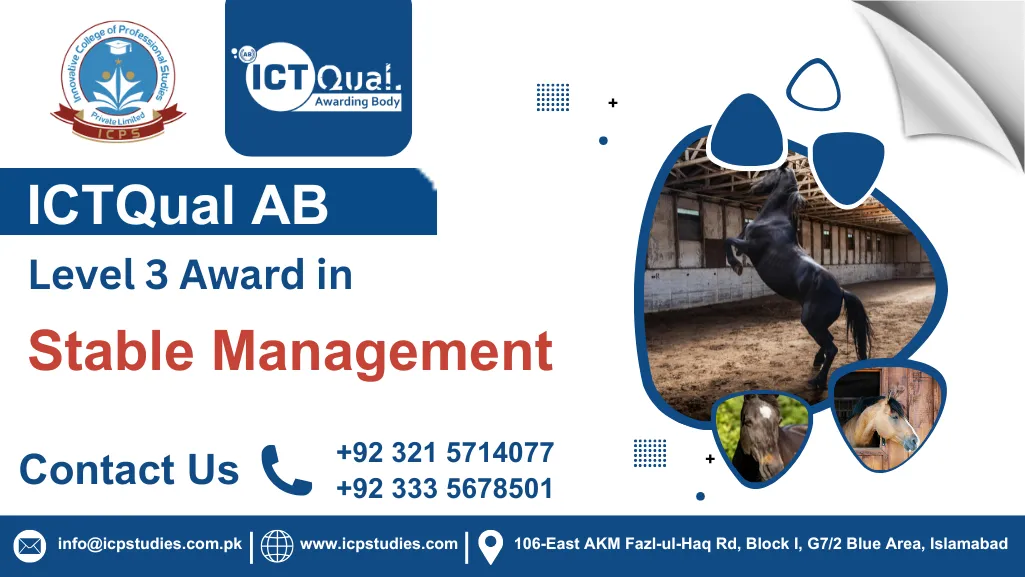
The ICTQual Level 3 Award in Stable Management is a UK-aligned vocational qualification designed to provide learners with essential knowledge and practical skills in equine care and stable operations. This course is ideal for individuals who are passionate about horses and want to build a career in equine management, stable supervision, or animal care industries. It offers a strong foundation in understanding how to manage stables efficiently and ensure high standards of horse welfare.
The programme covers key areas such as stable routines, horse health and welfare, feeding and nutrition, stable hygiene, handling and safety procedures, and basic equine management practices. Learners will develop the ability to care for horses responsibly, maintain clean and safe stable environments, and follow correct management procedures. The course also focuses on animal welfare standards and safe working practices in equine environments.
This qualification is suitable for stable hands, equine assistants, animal care workers, and individuals seeking entry into the horse care industry. The ICTQual Level 3 Award in Stable Management enhances career opportunities in equine centres, riding schools, stud farms, and animal care facilities. It equips learners with the practical skills and knowledge required to work confidently in UK and international equine and stable management environments.
All About ICTQual Level 3 Award in Stable Management
Course Overview
The ICTQual Level 3 Award in Stable Management is a focused vocational qualification designed to develop essential practical knowledge and skills required for working in equine and stable environments. The programme is structured into 8 mandatory units, each covering key aspects of horse care, stable operations, and animal welfare in line with UK equine industry standards.
This qualification is delivered as an intensive 3 day, 9 hour training programme, making it ideal for learners who want to gain practical stable management skills in a short period. It provides a clear and structured learning experience that helps participants understand daily stable routines, horse handling techniques, and safe working practices in equine settings.
The course covers important areas such as feeding routines, stable hygiene, health monitoring, and basic horse welfare management. It also develops awareness of safety procedures and responsible animal care practices. This qualification is suitable for beginners and entry level learners, providing a strong foundation for progression into higher educational levels in equine studies, animal care, and stable management careers in UK and international industries.
Entry Requirements
To enrol in the ICTQual Level 3 Award in Stable Management, learners must meet following requirements:
- Minimum Age: Learners must be at least 16 years old at the time of enrolment.
- Educational Background: A minimum of secondary school education (GCSE or equivalent) is recommended.
- Language Proficiency: Learners should have English language skills equivalent to IELTS 4.5 or above, or an equivalent level.
- Work Experience: No prior work experience is required.
Study Units
This qualification, the ICTQual Level 3 Award in Stable Management, consists of 8 mandatory units.
- Equine Anatomy and Physiology
- Stable Management Practices
- Healthcare and Veterinary Care
- Equine Behavior and Handling
- Nutrition and Feeding Management
- Exercise and Fitness Programs
- Equine Business Management
- Equine Welfare and Ethics
Learning Outcomes
Learning Outcomes for the Study Units:
Equine Anatomy and Physiology
- Demonstrate knowledge of the basic anatomy and physiological systems of horses, including skeletal, muscular, circulatory, and respiratory systems.
- Explain how anatomy and physiology influence horse health, performance, and stable care requirements.
- Identify common anatomical features to assist in equine healthcare, training, and handling practices.
- Assess the impact of exercise and nutrition on equine physiological functions.
- Apply anatomical and physiological knowledge to recognise early signs of health issues.
- Use this understanding to support decision-making in equine management and welfare.
Stable Management Practices
- Apply best practices for maintaining a clean, safe, and efficient stable environment.
- Develop routines for grooming, bedding, mucking out, and maintaining horse comfort.
- Manage resources effectively, including equipment, feed storage, and stable facilities.
- Implement biosecurity and safety measures within stable environments.
- Demonstrate organisational skills in scheduling daily, weekly, and seasonal stable operations.
- Evaluate stable conditions to ensure compliance with health, safety, and welfare standards.
Healthcare and Veterinary Care
- Recognise common equine health issues and understand preventive healthcare measures.
- Support veterinary professionals in routine procedures such as vaccinations, deworming, and dental care.
- Monitor and record health indicators including temperature, pulse, and respiration.
- Apply first-aid techniques for minor equine injuries and emergencies.
- Understand veterinary terminology and the importance of accurate health documentation.
- Promote proactive healthcare practices to reduce risks of illness and injury.
Equine Behaviour and Handling
- Explain the principles of equine psychology and behaviour.
- Identify common behavioural patterns in horses and interpret their meanings.
- Apply safe and humane handling techniques for different equine temperaments.
- Build trust and positive relationships between horses and handlers.
- Recognise and manage stress or anxiety in horses during handling and training.
- Promote ethical and respectful approaches to equine behaviour management.
Nutrition and Feeding Management
- Understand the nutritional needs of horses at different ages and activity levels.
- Plan balanced diets based on forage, concentrates, and supplements.
- Evaluate the quality of feed and water to ensure horse health and performance.
- Prevent common nutritional issues such as colic, obesity, or laminitis.
- Create feeding schedules tailored to individual equine needs.
- Monitor dietary intake and make adjustments for seasonal or workload changes.
Exercise and Fitness Programs
- Develop exercise routines to promote equine fitness, health, and performance.
- Understand the physiological effects of training on horses.
- Apply principles of progressive training to avoid overexertion or injury.
- Incorporate rest and recovery into fitness programmes.
- Monitor and evaluate equine fitness levels and performance progress.
- Adapt exercise regimes based on equine age, discipline, and health conditions.
Equine Business Management
- Understand the fundamentals of managing a stable or equine-related business.
- Apply financial management practices such as budgeting, pricing, and cost control.
- Develop marketing strategies to promote equine services and attract clients.
- Manage customer relations and ensure professional standards in service delivery.
- Evaluate business risks and apply management strategies to ensure sustainability.
- Incorporate legal and regulatory requirements in equine business operations.
Equine Welfare and Ethics
- Understand the principles of equine welfare and ethical responsibilities.
- Apply welfare standards in daily stable and equine management practices.
- Recognise ethical challenges in equine sports, training, and breeding.
- Promote humane treatment and respect for horses in all contexts.
- Assess welfare risks and implement measures to ensure equine wellbeing.
- Contribute to advancing equine welfare awareness in the wider community.
Ideal Candidate
The ICTQual Level 3 Award in Stable Management is designed for individuals who are passionate about horses and want to develop essential skills in equine care and stable operations. It is ideal for learners who are interested in working in stables, riding schools, stud farms, or animal care facilities.
This course is particularly suitable for stable assistants, equine enthusiasts, animal care workers, and beginners who want to enter the horse care industry. It helps them build practical knowledge of horse handling, feeding routines, stable hygiene, and animal welfare practices in a structured way.
Additionally, it is well-suited for school leavers and individuals seeking a career change into equine management or animal care. Whether starting fresh or gaining new skills, this qualification provides a strong foundation for progression into higher educational levels in equine studies and stable management careers in the UK and international sectors.
FAQs ICTQual Level 3 Award in Stable Management