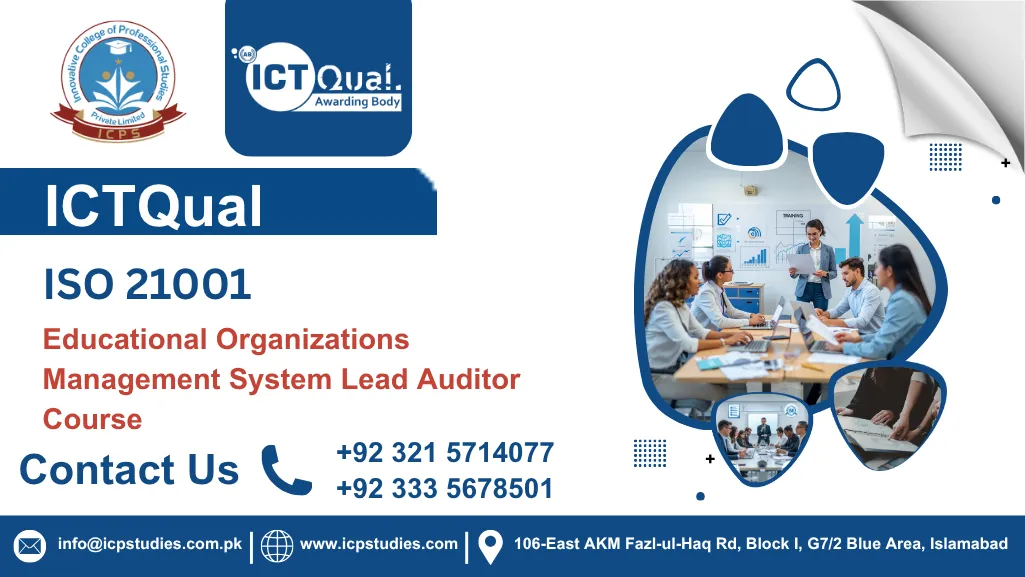
The ICTQual ISO 21001 Educational Organizations Management System (EOMS) Lead Auditor Course is a comprehensive and professionally designed training program aimed at developing expertise in auditing educational management systems in accordance with ISO 21001 standards. This internationally recognized course equips learners with the knowledge and practical skills required to plan, conduct, report, and follow up on audits within educational institutions, ensuring compliance with globally accepted quality management principles.
ISO 21001 focuses on enhancing the quality and effectiveness of educational organizations by aligning processes with learner needs and expectations. Through this course, participants gain a deep understanding of audit methodologies, risk-based thinking, and continuous improvement practices tailored specifically for the education sector. It covers key areas such as audit planning, audit execution, non-conformity reporting, and corrective action processes.
Ideal for professionals working in education, training, and quality assurance, this lead auditor course prepares learners to take on critical roles in maintaining and improving educational standards. Upon completion, participants will be capable of conducting first, second, and third-party audits, making them valuable assets for educational institutions seeking certification and operational excellence in line with ISO 21001 requirements.
All About ICTQual ISO 21001 Educational Organizations Management System Lead Auditor Course
Course Overview
The ICTQual ISO 21001 Educational Organizations Management System (EOMS) Lead Auditor Course is an intensive 5-day training program designed to provide a structured and in-depth understanding of auditing practices within educational organizations. Comprising 9 comprehensive study units, the course delivers a balanced combination of theoretical knowledge and practical application aligned with ISO 21001 standards.
This course is carefully structured to guide learners through the full audit lifecycle, from understanding the principles of ISO 21001 and educational management systems to mastering audit planning, execution, reporting, and follow-up activities. Each study unit focuses on key components such as audit principles, roles and responsibilities of auditors, risk-based auditing, evidence collection, and managing audit programs effectively.
Over the duration of five days, participants engage in interactive sessions, case studies, and practical exercises that simulate real-world audit scenarios. This approach ensures that learners not only understand the standard but are also confident in applying auditing techniques within educational institutions.
By the end of the program, learners will have developed the competence required to conduct professional audits, assess compliance, and support continuous improvement in educational organizations. The course is ideal for individuals seeking to enhance their auditing capabilities and contribute to maintaining high-quality education management systems in line with international best practices.
ICTQual ISO 21001 Educational Organizations Management System (EOMS) Lead Auditor Course has the following recommended entry requirements to ensure learners can effectively understand and apply the course content:
- Age Requirement:
Learners must be at least 18 years of age at the time of enrollment. - Educational Background:
A minimum of a high school diploma or equivalent qualification is required. However, a bachelor’s degree in education, management, quality assurance, or a related field is highly recommended for better understanding of course concepts. - Experience:
Prior experience in educational institutions, training organizations, quality management, or auditing is beneficial. Although not mandatory, familiarity with management systems or internal auditing processes will support effective learning and practical application. - English Language Proficiency:
Learners must have a good command of English, both written and spoken.
The ICTQual ISO 21001 Educational Organizations Management System (EOMS) Lead Auditor Course is designed for professionals and individuals who are involved in educational management, quality assurance, and auditing processes. This course is particularly suitable for:
Education Professionals
Teachers, trainers, academic coordinators, and administrators seeking to understand and implement effective educational management systems.
Quality Assurance Managers and Officers
Individuals responsible for maintaining and improving quality standards within educational institutions and training organizations.
Internal and External Auditors
Professionals looking to specialize in auditing educational organizations against ISO 21001 standards.
Compliance and Regulatory Professionals
Those involved in ensuring that educational institutions meet regulatory and accreditation requirements.
Consultants and Advisors
Professionals providing consultancy services in education management systems, quality assurance, and ISO standards implementation.
Institution Owners and Decision-Makers
School owners, directors, and senior management aiming to enhance organizational performance and learner satisfaction.
Aspiring Lead Auditors
Individuals who want to build a career in ISO auditing and gain internationally recognized auditing skills specific to the education sector.
This course is ideal for anyone seeking to improve educational quality, ensure compliance, and develop professional auditing competencies aligned with ISO 21001 standards.
Study Units
This qualification, the ICTQual ISO 21001 Educational Organizations Management System Lead Auditor Course, consists of 9 mandatory units.
- Introduction to ISO 21001
- Understanding Educational Organizations Management Systems
- ISO 21001 Requirements
- Implementation of ISO 21001
- Auditing Principles and Practices
- Audit Planning and Preparation
- Conducting the Audit
- Audit Reporting and Follow-Up
- Continuous Improvement and Feedback
Learning Outcomes:
Learning Outcomes for the Study Units:
- Introduction to ISO 21001
- Understand the purpose and scope of ISO 21001.
- Explain the benefits of implementing ISO 21001 in educational organizations.
- Identify key principles and concepts underlying ISO 21001.
- Understanding Educational Organizations Management Systems
- Define educational organizations management systems.
- Recognize the characteristics of effective management systems in educational settings.
- Explain how ISO 21001 aligns with the management systems of educational organizations.
- ISO 21001 Requirements
- Describe the requirements outlined in ISO 21001.
- Interpret specific clauses and requirements of ISO 21001.
- Apply ISO 21001 requirements to various types of educational organizations.
- Implementation of ISO 21001
- Develop strategies for implementing ISO 21001 within educational organizations.
- Create policies, procedures, and processes aligned with ISO 21001 requirements.
- Integrate ISO 21001 with existing management systems and practices in educational settings.
- Auditing Principles and Practices
- Explain fundamental auditing principles, processes, and techniques.
- Understand the roles and responsibilities of auditors in auditing educational organizations management systems.
- Apply auditing practices specific to educational settings.
- Audit Planning and Preparation
- Develop audit objectives, scope, and criteria for auditing educational organizations management systems.
- Create audit plans, checklists, and documentation.
- Prepare for the execution of audit activities effectively.
- Conducting the Audit
- Execute audit activities, including opening meetings, document reviews, interviews, and site visits.
- Gather and evaluate audit evidence in accordance with ISO 21001 requirements.
- Communicate and interact with auditees professionally and effectively during the audit process.
- Audit Reporting and Follow-Up
- Prepare comprehensive audit reports, findings, conclusions, and recommendations.
- Document audit results and nonconformities accurately and effectively.
- Implement follow-up activities, including corrective actions and verification of their effectiveness.
- Continuous Improvement and Feedback
- Recognize the importance of continual improvement in educational organizations management systems.
- Utilize audit findings and feedback to drive improvements in educational settings.
- Monitor and measure the effectiveness of the management system over time, incorporating feedback for enhancement.
FAQs ICTQual ISO 21001 Educational Organizations Management System Lead Auditor Course