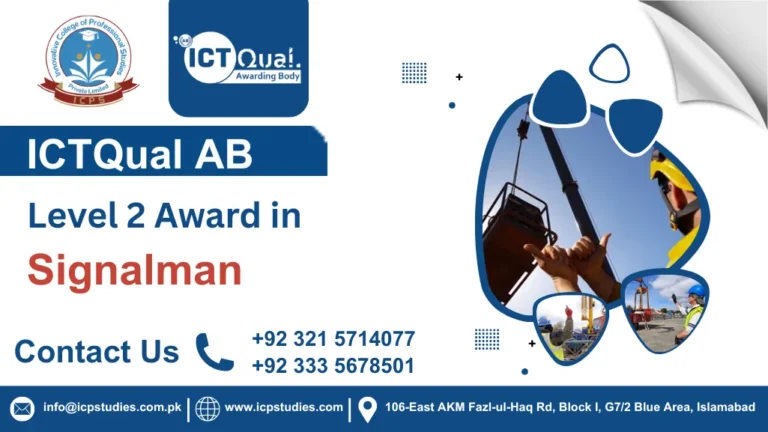
The ICTQual AB Level 3 Award in Slinger is a professionally designed training program aimed at individuals seeking to develop advanced skills in lifting operations and slinging techniques within the construction and industrial sectors. This course provides in-depth knowledge of safe lifting practices, load handling, and the correct use of lifting equipment, ensuring compliance with international health and safety standards. It is ideal for those who want to enhance their competence and take on greater responsibility in high-risk work environments.
Through a structured and industry-relevant curriculum, learners gain practical understanding of planning lifting operations, selecting appropriate lifting accessories, and communicating effectively with crane operators and site teams. The course emphasizes risk assessment, hazard identification, and adherence to safety regulations, enabling participants to minimize workplace accidents and improve operational efficiency.
The ICTQual AB Level 3 Award in Slinger is highly valued across construction, logistics, and heavy industries, making it a strong addition to any professional portfolio. Whether you are an experienced worker aiming to formalize your skills or an aspiring professional looking to enter the field, this qualification enhances employability and opens pathways to supervisory roles. It reflects a commitment to safety, precision, and professional excellence in lifting operations.
All About ICTQual AB Level 3 Award in Slinger
Course Overview
The ICTQual AB Level 3 Award in Slinger is a focused and intensive training program designed to deliver advanced knowledge and practical skills in lifting and slinging operations within a short timeframe. This qualification is structured as a 3-day training course, offering up to 9 hours of guided learning, making it ideal for professionals who want to upskill quickly without compromising on quality and industry relevance.
The course is divided into 6 comprehensive study units, each carefully developed to cover critical aspects of safe and efficient lifting operations. These units include planning lifting activities, selecting and inspecting lifting equipment, understanding load dynamics, applying correct slinging techniques, and ensuring clear communication with crane operators and site teams. Learners will also gain a deeper understanding of health and safety regulations, risk assessment procedures, and industry best practices that are essential for minimizing hazards on-site.
This qualification combines theoretical knowledge with practical insights, enabling participants to perform lifting tasks with greater confidence, accuracy, and responsibility. The flexible and concise structure ensures that learners can quickly apply their skills in real-world environments. Upon completion, candidates will be better equipped to handle complex lifting operations and contribute to safer and more efficient workplace practices across construction, engineering, and industrial sectors.
To enroll in the ICTQual AB Level 3 Award in Slinger, candidates are expected to meet the following entry requirements to ensure they can successfully complete the training and apply the skills in a professional environment:
- Age Requirement:
Applicants must be at least 18 years old at the time of enrollment, as the course involves responsibilities related to safety-critical lifting operations. - Educational Background:
There are no strict formal qualifications required; however, a basic level of education (such as secondary school or equivalent) is recommended. Learners should have the ability to read, understand, and communicate effectively in English to follow instructions and safety guidelines. - Experience:
It is recommended that candidates have prior experience in construction, lifting operations, or a related field. This course is designed at Level 3, so a basic understanding of slinging practices or previous exposure to site operations will be beneficial. Individuals with relevant Level 1 or Level 2 qualifications in slinging or lifting operations will have an added advantage. - English Language Proficiency:
Learners must have a good command of English, both written and spoken.
The ICTQual AB Level 3 Award in Slinger is designed for individuals who are involved in or planning to work in lifting operations and want to enhance their skills to a more advanced level. This course is particularly suitable for:
- Experienced Slingers and Riggers who want to upgrade their knowledge and gain a recognized qualification.
- Construction Workers and Site Operatives involved in lifting, loading, and material handling activities.
- Crane Operators and Assistants who need a better understanding of slinging techniques and load coordination.
- Supervisors and Team Leaders responsible for overseeing lifting operations and ensuring safety compliance on-site.
- Health and Safety Personnel aiming to strengthen their understanding of lifting risks and safe working practices.
- Individuals with Level 1 or Level 2 Slinger Qualifications who want to progress to a higher level and improve career opportunities.
- New Entrants with Basic Industry Experience who are looking to specialize in lifting operations and build a professional career in construction or industrial sectors.
This course is ideal for anyone seeking to improve workplace safety, increase job responsibilities, and enhance employability in high-risk and safety-critical environments.
Study Units
This qualification, the ICTQual AB Level 3 Award in Slinger, consists of 6 mandatory units.
- Advanced Slinging and Load Stability Techniques
- Rigging Methods for Complex Lifts
- Load Control and Movement Strategies
- Environmental Considerations in Lifting Operations
- Supervisory Responsibilities in Slinging Operations
- Incident Investigation and Reporting in Lifting Accidents
Learning Outcomes:
Here are the learning outcomes for each study unit:
Advanced Slinging and Load Stability Techniques
- Apply advanced slinging techniques to ensure the stability and security of loads during lifting operations.
- Assess load weight distribution and centre of gravity to minimise shifting and instability.
- Select and use appropriate lifting accessories for complex loads and varied operational conditions.
Rigging Methods for Complex Lifts
- Implement specialised rigging techniques for non-standard and multi-point lifting operations.
- Evaluate load attachment methods to ensure compliance with safety standards and efficiency in lifting.
- Coordinate with crane operators and rigging teams to execute complex lifts safely and effectively.
Load Control and Movement Strategies
- Develop strategies for controlling load movement during lifting, lowering, and transportation processes.
- Identify potential hazards associated with swinging, tilting, and uncontrolled load motion.
- Apply corrective measures to maintain load stability in dynamic lifting environments.
Environmental Considerations in Lifting Operations
- Assess the impact of environmental factors such as wind, temperature, and ground conditions on lifting activities.
- Implement risk mitigation strategies to adapt lifting operations to adverse weather and site conditions.
- Ensure compliance with environmental regulations and sustainability practices in lifting operations.
Supervisory Responsibilities in Slinging Operations
- Oversee and manage slinging operations to ensure adherence to health and safety standards.
- Provide guidance and instruction to lifting teams to maintain efficiency and compliance in operations.
- Conduct pre-lift planning and risk assessments to prevent accidents and equipment failures.
Incident Investigation and Reporting in Lifting Accidents
- Identify root causes of lifting-related incidents through systematic investigation techniques.
- Document and report lifting accidents in accordance with industry regulations and company policies.
- Develop corrective action plans to prevent recurrence of similar incidents and enhance safety measures.
FAQs ICTQual AB Level 3 Award in Slinger