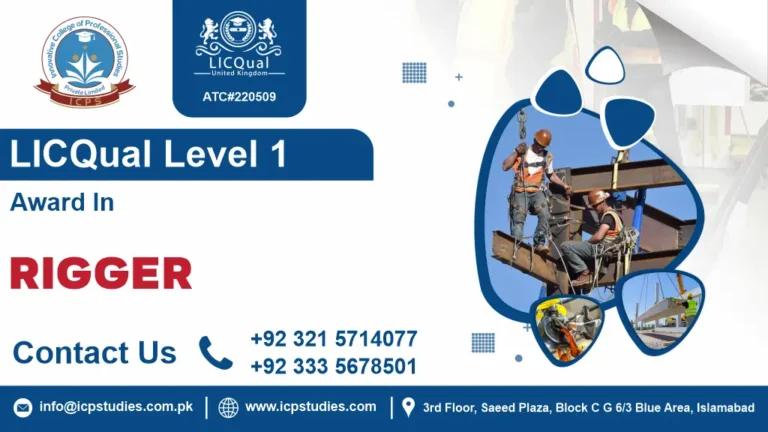
The ICTQual AB Level 3 Award in Rigger is an advanced professional qualification designed for experienced individuals working in construction, engineering, and industrial lifting operations. This course is aimed at those who already possess foundational and intermediate rigging knowledge and are looking to develop higher-level technical skills, supervisory capability, and advanced operational competence in rigging practices.
Participants will gain in-depth expertise in complex lifting and rigging operations, including advanced load planning, slinging techniques, and the selection and inspection of lifting equipment. The course also emphasizes critical safety principles such as risk assessment, hazard control, and strict compliance with industry regulations to ensure safe and efficient lifting operations in high-risk environments.
This Level 3 Award is ideal for senior site operatives, experienced riggers, and team leaders who are responsible for overseeing or supporting lifting activities on construction and industrial sites. It provides nationally recognized certification that validates advanced competence and enhances career progression opportunities.
Through a blend of theoretical instruction and practical application, learners will develop the ability to manage lifting tasks with greater independence, communicate effectively with site teams, and apply industry best practices. Completing the ICTQual AB Level 3 Award in Rigger demonstrates a high level of professional capability and prepares learners for leadership roles in rigging and lifting operations.
All About ICTQual AB Level 3 Award in Rigger
Course Overview
The ICTQual AB Level 3 Award in Rigger is a short but intensive 3-day training program designed to enhance advanced rigging knowledge and practical competence. Delivered over up to 9 hours of structured training, the course is organized into six focused study units that strengthen technical expertise for experienced professionals in construction, engineering, and industrial lifting operations.
The curriculum covers advanced rigging principles, complex load calculations, lifting plan interpretation, and the correct selection and inspection of specialized lifting equipment. Each study unit is designed to improve accuracy, efficiency, and decision-making when managing more challenging rigging tasks in real-world environments.
A strong emphasis is placed on health and safety compliance, including advanced risk assessment, hazard identification, and implementation of safe systems of work. Learners also develop the ability to apply industry regulations effectively while maintaining safe and controlled lifting operations on-site.
Through practical, scenario-based training, participants refine coordination and communication skills with crane operators and site teams. Upon completion, the ICTQual AB Level 3 Award in Rigger provides a nationally recognized qualification that supports career progression into senior, supervisory, and specialist rigging roles.
To enroll in the ICTQual AB Level 3 Award in Rigger, candidates must meet the following entry requirements to ensure they are prepared for this advanced-level training:
- Age Requirement:
Applicants must be at least 18 years old - Educational Background:
A minimum of a Level 2 qualification in Rigging, Banksman, or Slinger (or an equivalent certification) is recommended. Learners should also possess basic literacy and numeracy skills to understand technical materials, safety documentation, and lifting calculations. - Experience:
Candidates should have practical experience in rigging, lifting operations, or construction site work, ideally with prior exposure to load handling, lifting equipment, and on-site coordination tasks. - English Language Proficiency:
Learners must have a good command of English, both written and spoken.
The ICTQual AB Level 3 Award in Rigger is designed for experienced professionals who want to advance their expertise in rigging and take on more senior responsibilities in lifting operations. This course is suitable for:
- Experienced riggers, slingers, and banksmen seeking to progress into advanced or supervisory rigging roles.
- Construction and industrial workers involved in complex lifting operations and load management.
- Site supervisors and team leaders responsible for planning or overseeing lifting activities.
- Skilled operatives with Level 2 rigging qualifications looking to upgrade their technical and safety competencies.
- Professionals aiming to strengthen compliance knowledge in lifting regulations and advanced safety practices.
By completing this Level 3 Award, learners gain a nationally recognized qualification that validates advanced rigging skills, improves employability, and prepares them for leadership roles in high-risk lifting environments across construction and industrial sectors.
Study Units
This qualification, the ICTQual AB Level 3 Award in Rigger, consists of 6 mandatory units.
- Principles of Mechanical Advantage in Rigging (Credits: 1)
- Advanced Load Lifting and Hoisting Techniques (Credits: 1)
- Environmental and Weather Considerations in Rigging (Credits: 1)
- Emergency Procedures and Incident Management (Credits: 1)
- Compliance with International Rigging Standards (Credits: 1)
- Supervision and Team Coordination in Rigging Operations (Credits: 1)
Learning Outcomes:
Here are the learning outcomes for each study unit:
Principles of Mechanical Advantage in Rigging
- Explain the concept of mechanical advantage and its application in rigging operations.
- Identify different types of lifting equipment and their mechanical advantage principles.
- Calculate load forces and determine the most efficient rigging configurations.
- Evaluate the impact of pulley systems and leverage on lifting operations.
Advanced Load Lifting and Hoisting Techniques
- Demonstrate proficiency in advanced lifting techniques for complex loads.
- Select and use specialised hoisting equipment for different rigging scenarios.
- Apply dynamic lifting principles to ensure load stability and safety.
- Assess the risks associated with advanced hoisting methods and implement control measures.
Environmental and Weather Considerations in Rigging
- Analyse the effects of environmental conditions on rigging safety and performance.
- Implement strategies to mitigate risks posed by adverse weather conditions such as wind, rain, and extreme temperatures.
- Adapt rigging techniques to accommodate environmental challenges in various work settings.
- Ensure compliance with weather-related safety protocols and industry best practices.
Emergency Procedures and Incident Management
- Identify potential rigging-related emergencies and develop appropriate response strategies.
- Demonstrate knowledge of emergency communication protocols and rescue procedures.
- Implement immediate corrective actions in the event of rigging failures or accidents.
- Conduct post-incident evaluations to improve safety measures and prevent recurrence.
Compliance with International Rigging Standards
- Interpret and apply international regulations governing rigging operations.
- Ensure rigging practices align with health, safety, and legal requirements.
- Maintain accurate records and documentation in accordance with regulatory standards.
- Evaluate the impact of non-compliance on safety, operations, and legal liability.
Supervision and Team Coordination in Rigging Operations
- Develop effective leadership and communication skills for rigging supervision.
- Coordinate rigging teams to ensure efficient workflow and safety compliance.
- Implement best practices for teamwork and collaboration in lifting operations.
- Monitor and assess team performance to enhance productivity and safety.
FAQs ICTQual AB Level 3 Award in Rigger