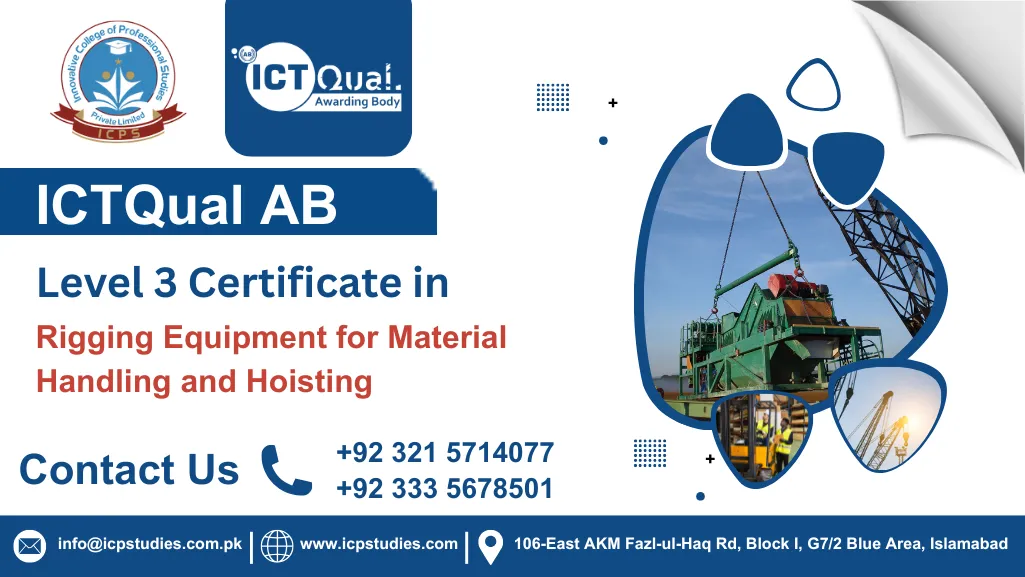
The ICTQual Level 3 Certificate in Rigging Equipment for Material Handling and Hoisting is a professionally designed qualification aimed at developing advanced knowledge and practical competence in rigging operations across industrial environments. This course is ideal for individuals seeking to enhance their expertise in the safe selection, inspection, and use of rigging equipment used in material handling and hoisting activities.
This internationally relevant programme provides comprehensive training on a wide range of rigging equipment, including slings, shackles, hooks, lifting beams, and associated hoisting gear. Learners will develop a strong understanding of load dynamics, lifting principles, equipment capacities, and safe rigging configurations required for complex lifting operations.
The course also emphasizes compliance with international safety standards, risk assessment procedures, and regulatory requirements governing rigging and hoisting activities. Participants will gain essential skills in hazard identification, load calculation, inspection techniques, and safe rigging practices to ensure efficient and accident-free operations.
The ICTQual Level 3 Certificate in Rigging Equipment for Material Handling and Hoisting is suitable for riggers, lifting supervisors, construction personnel, and industrial workers involved in lifting operations. By completing this qualification, learners enhance their technical capability, improve workplace safety performance, and strengthen their career prospects in construction, oil and gas, manufacturing, logistics, and heavy engineering sectors.
All About ICTQual Level 3 Certificate in Rigging Equipment for Material Handling and Hoisting
Course Overview
The ICTQual Level 3 Certificate in Rigging Equipment for Material Handling and Hoisting is a comprehensive 15-day training programme designed to develop advanced technical knowledge and practical skills in rigging operations used across industrial lifting environments. Structured into 6 detailed study units, this qualification provides a systematic approach to mastering rigging equipment selection, configuration, and safe application in material handling and hoisting activities.
This course covers essential areas such as types and functions of rigging equipment, load handling principles, and safe working load calculations. Learners will gain in-depth understanding of slings, shackles, hooks, lifting beams, spreader bars, and other rigging accessories used in complex lifting operations. The programme also emphasizes correct rigging configurations to ensure stability, efficiency, and safety during lifting tasks.
A strong focus is placed on inspection procedures, defect identification, maintenance requirements, and compliance with international safety standards and regulations. Participants will also learn advanced risk assessment techniques, hazard control measures, and best practices for coordinating safe hoisting operations in high-risk environments.
By the end of this 15-day training programme, learners will be equipped with the competence and confidence to safely plan and execute rigging operations. This qualification is ideal for riggers, lifting supervisors, construction professionals, and industrial workers seeking to advance their careers in lifting, rigging, and heavy material handling sectors.
To enrol in the ICTQual Level 3 Certificate in Rigging Equipment for Material Handling and Hoisting, learners are expected to meet the following entry requirements to ensure they can fully benefit from the course content and practical training.
- Age Requirement:
Candidates must be at least 18 years of age at the time of enrolment. This ensures learners have the maturity and responsibility required for working in high-risk lifting and rigging environments. - Educational Background:
No formal academic qualifications are required. A basic level of literacy and numeracy is recommended to understand training materials, safety instructions, and operational procedures. - Experience:
It is recommended that learners have prior experience in construction, lifting operations, rigging, warehousing, or industrial environments. While not mandatory, familiarity with lifting equipment and basic workplace safety practices will be highly beneficial for understanding advanced rigging concepts covered in this course. - English Language Proficiency:
Learners must have a good command of English, both written and spoken.
The ICTQual Level 3 Certificate in Rigging Equipment for Material Handling and Hoisting is designed for individuals working in or aspiring to join professional lifting and rigging environments where advanced knowledge of rigging equipment and hoisting operations is required.
This course is suitable for:
- Professional riggers involved in complex lifting and hoisting operations
- Lifting supervisors and foremen responsible for planning and overseeing rigging activities
- Construction site personnel working with heavy lifting and material handling equipment
- Crane operators and lifting teams seeking advanced rigging knowledge
- Health and safety officers monitoring lifting operations and compliance
- Maintenance and inspection personnel responsible for rigging equipment safety checks
- Industrial workers in oil and gas, manufacturing, logistics, and heavy engineering sectors
- Technicians and operatives aiming to upgrade their skills in rigging and lifting operations
- Individuals seeking career progression into advanced lifting and supervisory roles
This qualification is ideal for anyone who wants to strengthen their technical expertise in rigging equipment, improve operational safety, and progress into more responsible roles within lifting, construction, and industrial sectors.
Study Units
This qualification, the ICTQual Level 3 Certificate in Rigging Equipment for Material Handling and Hoisting, consists of 6 mandatory units.
- Introduction to Rigging Equipment and Material Handling
- Principles of Load Weight Estimation and Balance
- Inspection and Maintenance of Rigging Equipment
- Safe Lifting Practices and Risk Management
- Regulatory Standards and Compliance in Rigging Operations
- Effective Communication in Lifting and Hoisting Operations
Learning Outcomes:
Here are the learning outcomes for each study unit:
Introduction to Rigging Equipment and Material Handling
- Identify different types of rigging equipment used in material handling and hoisting.
- Understand the functions and applications of various rigging tools and accessories.
Principles of Load Weight Estimation and Balance
- Calculate load weight and determine the centre of gravity for safe lifting.
- Apply load balancing techniques to ensure stability during hoisting operations.
Inspection and Maintenance of Rigging Equipment
- Conduct pre-use inspections of rigging equipment to identify defects.
- Implement proper maintenance procedures to extend the lifespan of rigging tools.
Safe Lifting Practices and Risk Management
- Apply best practices for safe lifting and hoisting operations.
- Identify potential hazards and implement risk control measures in rigging activities.
Regulatory Standards and Compliance in Rigging Operations
- Understand industry regulations and safety standards related to rigging and hoisting.
- Ensure compliance with legal and workplace requirements for lifting operations.
Effective Communication in Lifting and Hoisting Operations
- Demonstrate effective communication techniques for coordinating lifting activities.
- Use standard hand signals and verbal commands to enhance workplace safety.
FAQs ICTQual Level 3 Certificate in Rigging Equipment for Material Handling and Hoisting