
How Education Managers Can Plan, Allocate and Monitor Team Work
Effective education management requires more than organising lessons, preparing timetables and overseeing administrative activities. Education managers must also ensure that team members understand their responsibilities, have sufficient resources, meet deadlines and contribute towards shared organisational objectives.
Knowing how to plan, allocate and monitor team work is an essential management skill for school leaders, academic coordinators, training centre managers, departmental heads and education professionals. When these responsibilities are managed effectively, educational organisations can improve staff coordination, maintain consistent teaching standards, reduce unnecessary workload and provide a better learning experience.
Education managers can plan, allocate and monitor team work by setting clear objectives, identifying priorities, assessing staff capacity, assigning responsibilities according to skills and experience, establishing realistic deadlines and reviewing progress against agreed performance standards. Regular communication, constructive feedback and appropriate adjustments help ensure that work remains on schedule without placing unreasonable pressure on individual team members.
For example, a training centre manager preparing for a new course intake might coordinate trainers, admissions staff, assessors and administrative personnel. By establishing a shared schedule, assigning specific responsibilities and monitoring important milestones, the manager can ensure that learner enrolment, course preparation, teaching resources and assessment arrangements are completed on time.
This article explains how education managers can apply practical team management strategies to improve planning, work allocation, performance monitoring and continuous improvement in educational settings.
What Does Planning, Allocating and Monitoring Team Work Mean in Education?
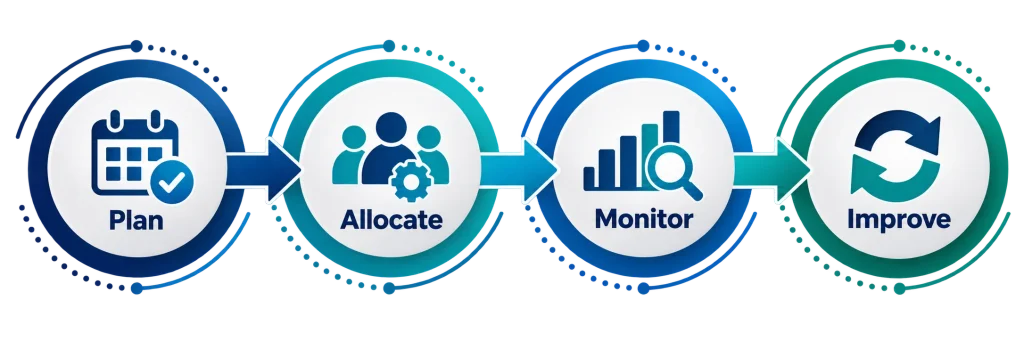
Planning, allocating and monitoring team work are interconnected management activities that help educational organisations achieve their objectives. Education managers use these processes to coordinate responsibilities, manage resources, maintain standards and ensure that tasks are completed on time.
1. Planning Team Work
Planning involves identifying objectives, determining the activities required, setting priorities and establishing realistic deadlines. It helps education managers coordinate teaching schedules, assessment activities, staff development, Learner support and administrative responsibilities.
An effective work plan should identify:
- Clear objectives and expected outcomes.
- Activities required to achieve the objectives.
- Staff members responsible for each task.
- Required resources, equipment and information.
- Deadlines and important milestones.
- Standards for evaluating successful completion.
- Arrangements for reviewing progress and resolving problems.
Effective planning reduces conflicting priorities, duplicated work and missed deadlines while helping team members understand their responsibilities.
2. Allocating Team Work
Work allocation involves assigning tasks to suitable team members according to their skills, experience, competence and availability. Managers should also consider existing workloads and opportunities for professional development when distributing responsibilities.
For example, an experienced assessor may review assessment decisions, an administrative coordinator may manage Learner records, and a subject specialist may prepare teaching materials.
When allocating work, managers should consider:
- Staff qualifications, knowledge and experience.
- Current responsibilities and workload capacity.
- The complexity and urgency of each task.
- Availability of appropriate resources and support.
- Opportunities to develop staff skills.
- Fair distribution of responsibilities across the team.
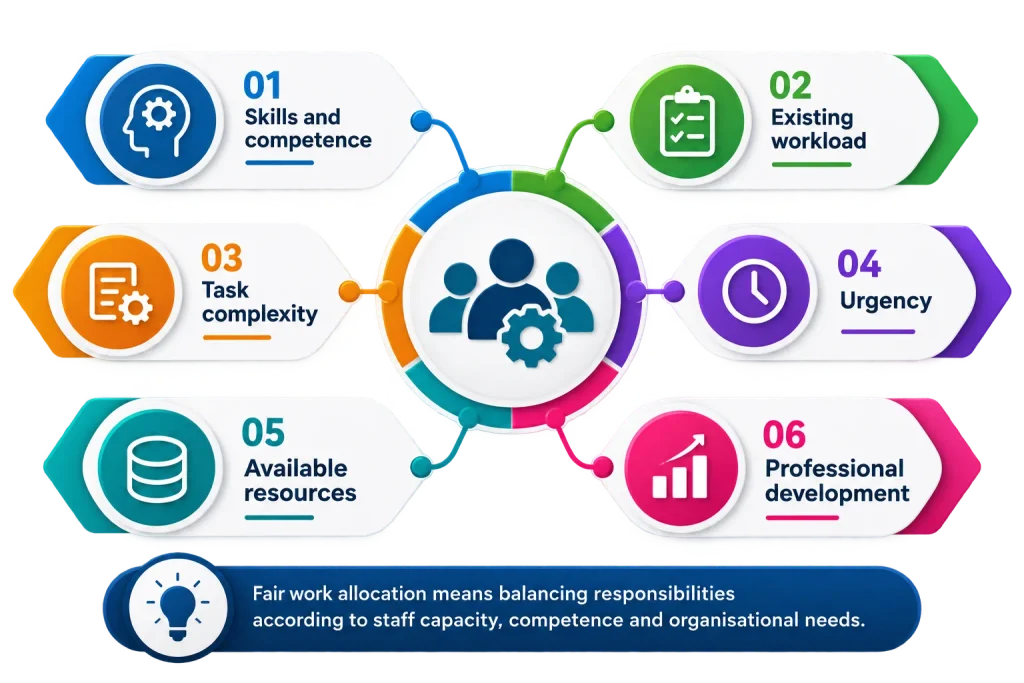
The aim is not necessarily to give everyone the same number of tasks, but to distribute work fairly and appropriately according to individual capacity and organisational requirements.
3. Monitoring Team Work
Monitoring involves reviewing progress to determine whether tasks are being completed according to the agreed plan. Regular monitoring helps education managers identify delays, recognise achievements, provide support and adjust priorities when circumstances change.
Managers can monitor team performance by reviewing:
- Progress against agreed deadlines and milestones.
- Preparation of teaching materials and learning activities.
- Completion of assessments and Learner feedback.
- Quality and accuracy of administrative records.
- Completion of Learner support activities.
- Outstanding tasks and potential risks.
- Staff feedback and additional support requirements.
Monitoring should be proportionate to the task and based on clear expectations. By providing constructive feedback and addressing problems promptly, education managers can strengthen accountability, improve performance and support continuous improvement without creating unnecessary pressure or excessive supervision.
Why is Effective Team Work Management Important for Education Managers?
Education managers must balance teaching quality, Learner progress, staff wellbeing, administrative responsibilities and organisational objectives. Effective teamwork management helps coordinate these activities, improve productivity and ensure that responsibilities are completed efficiently.
Improved Teaching and Learning Quality
Clear responsibilities allow trainers and teaching staff to focus on their professional duties. A well-organised assessment schedule, for example, helps ensure that assignments are prepared, assessment decisions are reviewed and feedback is provided within agreed timescales.
Effective planning also helps managers identify gaps in teaching resources, Learner support and assessment arrangements.
Key benefits include:
- Clear allocation of teaching and assessment responsibilities.
- Better coordination of learning activities.
- Timely assessment and Learner feedback.
- Early identification of gaps in teaching resources.
- More consistent educational quality.
Better Use of Staff Time and Resources
Educational organisations often operate with limited staffing, budgets, equipment and preparation time. Managers must prioritise essential activities and distribute resources according to organisational needs.
A shared timetable and workload plan can help identify scheduling conflicts, reduce duplicated work and ensure that staff time is used effectively. Workforce planning principles, including those reflected in UK Department for Education guidance for schools and trusts, can also inform staffing decisions in educational settings.
Managers can improve resource management by:
- Reviewing staff availability and existing workloads.
- Prioritising activities according to organisational objectives.
- Reducing unnecessary duplication of tasks.
- Identifying resource shortages before they affect delivery.
- Reviewing whether resources are being used efficiently.
Greater Accountability
Effective work management establishes clear expectations for individual responsibilities. When each task has an assigned owner, deadline and expected outcome, managers can monitor progress and identify where support or corrective action is needed.
Accountability should be supported by clear communication and realistic expectations rather than unnecessary pressure.
Managers should ensure that:
- Every task has a clearly identified owner.
- Deadlines and quality standards are communicated.
- Progress is reviewed at appropriate intervals.
- Staff can report difficulties and request assistance.
- Corrective actions are agreed when problems arise.
Improved Staff Morale and Wellbeing
Unclear responsibilities, repeated urgent requests and uneven workloads can contribute to frustration and work-related stress. Education managers can reduce these risks by consulting staff, prioritising essential activities and considering the impact of new initiatives before implementation.
Practical approaches include:
- Discussing workload concerns with team members.
- Distributing responsibilities fairly.
- Setting realistic deadlines and expectations.
- Reviewing unnecessary administrative demands.
- Providing appropriate guidance and resources.
- Encouraging open communication about workplace challenges.
These measures help create a supportive working environment while enabling staff to maintain professional standards.
Stronger Teamwork and Communication
A clear work plan gives team members a shared understanding of organisational priorities and individual responsibilities. Regular discussions help colleagues exchange information, coordinate activities and address problems before they affect wider operations.
This is particularly important when multiple departments contribute to shared objectives, such as introducing a new qualification, conducting an internal quality review or organising Learner assessments.
Education managers can strengthen collaboration by:
- Holding regular team meetings to review progress.
- Sharing updates about deadlines and changing priorities.
- Clarifying dependencies between departments.
- Encouraging staff to share ideas and solve problems.
- Recording decisions and assigning follow-up actions.
By improving coordination, communication and accountability, education managers can build more effective teams and support the consistent delivery of educational services.
How Education Managers Can Plan Team Work Effectively
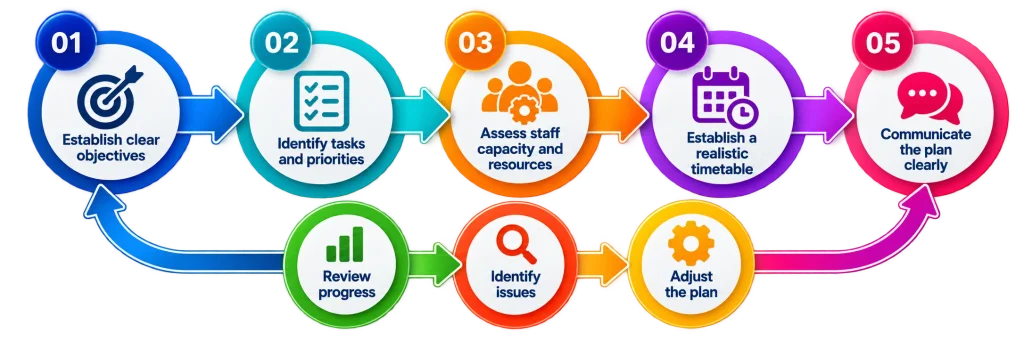
Effective teamwork begins with a realistic plan that defines organisational objectives, required activities, available resources and individual responsibilities. Education managers should consider staff capacity, deadlines and priorities before allocating work to ensure tasks are completed efficiently and to the required standard.
Step 1: Establish Clear Objectives
Managers should define clear, measurable objectives that guide team activities and support progress monitoring. These objectives should align with organisational priorities, including teaching quality, Learner achievement, compliance and operational efficiency.
For example, instead of simply aiming to improve assessment administration, a manager could set an objective to complete an internal review of assessment records by an agreed deadline, resolve documentation gaps and record corrective actions.
Effective objectives should:
- Define the expected outcomes.
- Establish measurable targets where appropriate.
- Identify relevant deadlines.
- Support organisational priorities.
- Provide a basis for reviewing progress.
Step 2: Identify Tasks and Priorities
Once objectives are established, managers should divide the required work into manageable tasks. This helps team members understand their responsibilities and enables managers to identify dependencies and prioritise activities.
For example, preparing for a new training intake may involve:
- Confirming course schedules and trainer availability.
- Reviewing enrolment records and Learner information.
- Preparing teaching materials and learning resources.
- Confirming assessment arrangements.
- Issuing joining instructions to Learners.
- Checking classroom or online learning arrangements.
- Reviewing outstanding actions before the course begins.
Managers should determine which activities are urgent, important or dependent on other tasks. For instance, joining instructions may need to wait until the final timetable has been confirmed.
Step 3: Assess Staff Capacity and Available Resources
Before allocating responsibilities, education managers should assess staff availability, existing workloads, skills and the resources required. Assuming that employees have spare capacity without discussing their current responsibilities can lead to unrealistic deadlines and reduced performance.
Managers should consider:
- Contracted working hours and existing responsibilities.
- Current assignments and upcoming deadlines.
- Staff qualifications, experience and competence.
- Annual leave and other availability constraints.
- Equipment, technology and budget limitations.
- Training requirements and access to support.
- Dependencies on colleagues or external organisations.
Workload discussions can reveal competing priorities and hidden tasks. Where resources are insufficient, managers may need to redistribute work, adjust deadlines, revise priorities or request additional support.
Step 4: Establish a Realistic Timetable
A timetable organises tasks into a clear sequence and establishes when each activity should begin and finish. Managers should allow sufficient time for preparation, communication, quality checks and unexpected problems.
For example, an internal quality review may involve collecting assessment records, examining evidence, discussing findings with assessors and completing corrective actions. Each activity requires adequate time to maintain quality.
A practical timetable should include:
- Task start and completion dates.
- Milestones for longer assignments.
- Progress meetings and review points.
- Dependencies between activities.
- Time for checking and correcting work.
- Contingency arrangements for foreseeable disruptions.
Education managers can also review annual calendars to identify periods when several deadlines or activities may place additional pressure on staff.
Step 5: Communicate the Plan Clearly
A work plan is effective only when team members understand their responsibilities and the expected outcomes. Managers should communicate deadlines, quality standards, reporting arrangements and the purpose of each activity.
Useful communication methods include:
- Team meetings to explain priorities and responsibilities.
- Shared calendars to coordinate deadlines and availability.
- Task trackers to monitor progress and outstanding actions.
- Written action plans to record responsibilities and decisions.
- Regular updates to identify delays and emerging problems.
Staff should also have opportunities to ask questions, raise concerns and identify practical difficulties before work begins. Clear communication reduces misunderstandings, supports coordination and helps the team work towards shared objectives.
How to Allocate Work Fairly and Effectively
Effective work allocation involves balancing organisational priorities with staff competence, existing workloads and professional development needs. Education managers should assign responsibilities fairly, ensuring that tasks are completed efficiently without placing unnecessary pressure on individual team members.
Match Responsibilities to Skills and Experience
Managers should consider each team member’s knowledge, experience and abilities before assigning responsibilities. Matching tasks to individual competence helps maintain quality, minimise errors and improve productivity.
For example, an experienced assessor may be responsible for reviewing assessment decisions, while a staff member with strong administrative skills may coordinate records and schedules.
Managers should also provide opportunities for less experienced colleagues to develop their skills through suitable tasks, guidance and supervision.
Consider Existing Workloads
Fair allocation does not mean giving every team member the same number of tasks. Responsibilities vary in complexity, urgency and the time required for completion.
Managers should review workloads regularly to identify imbalances and ensure deadlines remain realistic. They should consider:
- The complexity and urgency of assigned tasks.
- Existing responsibilities and overlapping deadlines.
- Whether urgent work is repeatedly assigned to the same individuals.
- Opportunities to redistribute tasks without affecting quality.
- Staff training needs and available support.
- Tasks that could be simplified or removed.
This approach helps prevent excessive workloads, improve efficiency and maintain staff wellbeing.
Delegate Responsibilities Appropriately
Delegation means assigning responsibility for a task while maintaining appropriate managerial oversight. Managers should explain the expected outcomes, available resources, decision-making authority and deadlines.
Effective delegation involves:
- Selecting a suitable person for the responsibility.
- Providing clear instructions and expectations.
- Ensuring access to necessary resources and authority.
- Agreeing progress reviews and completion deadlines.
- Allowing staff to take ownership of their work.
- Providing guidance when challenges arise.
For example, a training manager may delegate the preparation of a Learner induction schedule to an experienced coordinator while retaining responsibility for approving the final arrangements.
Managers should avoid assigning tasks beyond an individual’s competence without suitable support. They should also trust staff to make appropriate decisions rather than intervening unnecessarily in every detail. This encourages accountability, confidence and professional development.
Use a Responsibility Allocation Table
A responsibility allocation table provides a simple record of who will complete each activity.
| Task | Responsible person | Support required | Deadline | Success measure |
|---|---|---|---|---|
| Prepare the course timetable | Academic coordinator | Trainer availability | Agreed date | Timetable approved and shared |
| Review learner enrolment records | Admissions officer | Current application records | Agreed date | Required records checked |
| Prepare teaching materials | Course trainer | Learning resources | Before course delivery | Materials ready for use |
| Review assessment arrangements | Assessment coordinator | Assessor input | Before assessment begins | Arrangements confirmed |
| Check outstanding preparation tasks | Training manager | Updates from task owners | Before intake | Outstanding actions resolved or escalated |
This table is an illustrative example rather than a prescribed regulatory template. Educational organisations should adapt it to their size, procedures and responsibilities.
Provide Resources and Support
Education managers should ensure that team members have the resources, information and guidance needed to complete their tasks effectively. Inadequate support can cause delays, errors and reduced productivity.
Managers should provide:
- Relevant documents, equipment and digital systems.
- Clear instructions and realistic deadlines.
- Appropriate training, coaching and mentoring.
- Access to specialist advice and necessary approvals.
Managers should also identify skill gaps and provide suitable support where needed. This approach improves performance, strengthens teamwork and supports staff development.
How Education Managers Can Monitor Team Work and Performance
Monitoring team work is an essential responsibility of education managers because it helps them determine whether activities are progressing according to plan, whether expected standards are being achieved and whether additional support is required. Effective monitoring promotes accountability, improves coordination and enables managers to identify potential problems before they affect educational activities.
Education managers should establish clear performance expectations, review progress regularly and use appropriate monitoring tools. The aim is to maintain quality, support staff development and ensure that responsibilities are completed efficiently without unnecessary supervision.
Set Clear Performance Indicators
Performance indicators help education managers assess progress using relevant and measurable evidence. These indicators should reflect the nature of the work, the expected outcomes and the quality standards established by the organisation.
Examples of useful performance indicators include:
- Task completion: The percentage of assigned activities completed within agreed deadlines.
- Teaching preparation: Whether lesson plans, learning materials and other required resources are ready on time.
- Assessment feedback: Whether learners receive assessment feedback within the expected timescale.
- Record management: The accuracy and completeness of learner records and assessment documentation.
- Corrective actions: The number and status of outstanding actions identified during quality reviews.
- Staff development: Completion of agreed training and professional development activities.
- Stakeholder feedback: Feedback received from learners, colleagues and relevant stakeholders.
- Quality improvement: Evidence that identified problems have been addressed effectively.
Performance indicators should be realistic, relevant and proportionate to the responsibilities being monitored. Managers should also consider factors such as staff availability, resource limitations and unexpected operational challenges before drawing conclusions about individual performance.
Conduct Regular Progress Reviews
Regular progress reviews help managers understand whether work is progressing as expected and whether any adjustments are necessary. The frequency of reviews should reflect the complexity, duration and importance of the assigned activities.
For example, routine administrative tasks may require occasional updates, whereas a major curriculum development project may need several progress reviews and formal milestone checks.
During progress reviews, education managers should:
- Identify tasks completed since the previous review.
- Confirm which activities remain outstanding.
- Compare actual progress with the agreed timetable.
- Identify new risks, delays or dependencies.
- Discuss whether additional resources or support are required.
- Agree on the actions to be completed before the next review.
These discussions should encourage open communication and practical problem-solving. When staff can raise concerns early, managers have a better opportunity to resolve difficulties before they affect wider organisational objectives.
Use Appropriate Tools to Monitor Team Work
Monitoring tools help education managers organise information, track responsibilities and maintain visibility of team progress. The choice of tool depends on the organisation’s size, working practices and operational requirements.
Commonly used tools include:
- Shared calendars: Record deadlines, staff meetings, assessments and important organisational events.
- Task trackers: Identify task owners, completion dates, current progress and outstanding activities.
- Spreadsheets: Organise workload plans, progress reports and action logs.
- Project management systems: Coordinate complex activities involving several departments or interdependent tasks.
- Learning management systems: Provide relevant information about course delivery, learner engagement and assessment activity, depending on the system’s capabilities.
- Quality assurance records: Document review findings, corrective actions and follow-up checks.
Managers should select tools that provide useful information without creating excessive administrative work. They should also ensure that staff understand how information is recorded, who can access it and how it will be used.
Provide Constructive Feedback
Constructive feedback helps staff understand their performance, recognise strengths and identify areas requiring improvement. Education managers should provide feedback that is specific, evidence-based and focused on agreed responsibilities.
For example, if an assessor repeatedly submits incomplete assessment records, the manager should explain which requirements have not been met, discuss the reasons and agree on appropriate corrective action. The discussion may reveal unclear instructions, insufficient preparation time, a training need or another issue affecting performance.
Effective feedback should involve the following practices:
- Recognise good performance and acknowledge completed work.
- Explain performance gaps using specific examples.
- Discuss possible causes without making premature assumptions.
- Agree on realistic improvement actions and timescales.
- Provide guidance, training or resources where necessary.
- Review progress to determine whether the agreed actions have worked.
Feedback should focus on observable performance rather than personal criticism. Managers should also invite staff to share their perspectives because team members may identify inefficient procedures, unrealistic deadlines or resource problems that are not immediately visible to senior management.
Address Delays and Underperformance Promptly
When work falls behind schedule or fails to meet expected standards, education managers should investigate the underlying reasons before deciding on the appropriate response. A delay does not necessarily indicate poor performance; it may result from circumstances beyond an individual’s control.
Common causes of delays and performance difficulties include:
- Conflicting priorities and competing deadlines.
- Unexpected staff absence or reduced availability.
- Insufficient resources, equipment or information.
- Unclear responsibilities or instructions.
- Delays in receiving information from other departments.
- Tasks that are more complex than originally anticipated.
- Gaps in knowledge, skills or experience.
- Technical problems affecting workplace systems.
Once the cause has been identified, managers should select an appropriate response. This may involve redistributing responsibilities, providing additional guidance, revising deadlines, simplifying unnecessary processes or escalating significant risks to senior management.
Where performance concerns continue, managers should follow the organisation’s relevant procedures, maintain appropriate records and provide suitable support or formal action when necessary.
By combining clear performance indicators, regular reviews, appropriate monitoring tools and constructive feedback, education managers can maintain accountability while supporting staff development. This balanced approach helps teams complete their responsibilities effectively, address problems promptly and contribute to continuous improvement within educational organisations.
Practical Example: Managing Team Work in a Training Centre
Consider a training centre preparing to deliver a new professional qualification. The manager must coordinate several activities, including course administration, teaching preparation, learner communication and assessment arrangements. Without effective planning and clear responsibilities, staff may duplicate tasks, miss deadlines or misunderstand their roles.
To prevent these problems, the manager introduces a structured approach that covers four essential stages: planning, work allocation, progress monitoring and evaluation.
1. Planning Team Work
The manager establishes the main objective of ensuring that all course preparation activities are completed before the agreed start date. The required tasks are identified, priorities are established and a realistic timetable is prepared.
Key planning activities include:
- Identifying the tasks required before course delivery.
- Establishing deadlines and important milestones.
- Identifying dependencies between different activities.
- Confirming the resources and information required.
- Preparing a schedule to track progress.
2. Allocating Responsibilities
The manager assigns tasks according to each team member’s skills, experience and availability. Clear responsibilities help prevent confusion and ensure that all essential activities have an assigned owner.
For example, the manager allocates responsibilities as follows:
- Admissions officer: Checks learner enrolment records and required documentation.
- Academic coordinator: Confirms the course timetable and teaching schedule.
- Course trainer: Prepares teaching materials and learning resources.
- Assessment coordinator: Confirms assessment arrangements and relevant documentation.
- Training centre manager: Oversees preparation, resolves problems and reviews overall progress.
The manager also ensures that team members understand their responsibilities and have access to the resources needed to complete their tasks.
3. Monitoring Progress
The manager arranges progress reviews before important deadlines to identify outstanding activities and resolve potential problems. During one review, the task tracker shows that the teaching materials are ready, but assessment arrangements remain unconfirmed because a required document has not been received.
The manager takes the following actions:
- Identifies the outstanding document and the reason for the delay.
- Contacts the relevant team member to clarify the issue.
- Agrees on the necessary action and a revised completion date.
- Updates the task tracker to reflect the current position.
- Checks that the assessment arrangements are confirmed before the course begins.
This approach enables the manager to address the problem promptly rather than allowing it to disrupt course delivery.
4. Evaluating Results and Improving Future Practice
After the course begins, the manager reviews the preparation process to identify what worked well and what could be improved. The team recognises that the assessment arrangements could have been confirmed earlier if the required documentation had been requested during the initial planning stage.
To prevent similar delays in future, the manager:
- Updates the course preparation checklist.
- Adds an early deadline for requesting assessment documentation.
- Clarifies responsibility for following up outstanding information.
- Reviews the effectiveness of the revised process during the next course intake.
This practical example demonstrates how education managers can combine planning, fair work allocation, regular monitoring and evaluation to coordinate team activities effectively. By learning from experience and improving procedures, training centres can reduce avoidable delays, strengthen staff accountability and support smoother course delivery.
Common Mistakes Education Managers Should Avoid
Effective team management requires clear communication, realistic workload planning and consistent performance monitoring. Even experienced education managers can encounter challenges when organising responsibilities, delegating tasks or managing staff expectations. Recognising common mistakes helps managers improve efficiency, maintain staff morale and create a more productive working environment.
Common Team Management Mistakes and How to Avoid Them
Education managers should recognise the following mistakes and take practical steps to prevent them:
- Setting unclear objectives: Vague instructions can confuse staff and lead to incomplete work. Managers should communicate clear objectives, deadlines and quality expectations.
- Allocating work without checking capacity: Assigning additional responsibilities without reviewing existing workloads can create unnecessary pressure. Managers should assess staff availability and adjust priorities before allocating new tasks.
- Delegating without providing authority: Staff may struggle to complete tasks if they lack the necessary resources, information or decision-making authority. Managers should clarify responsibilities, provide appropriate support and explain when approval is required.
- Monitoring too frequently: Excessive supervision can interrupt work and weaken professional trust. Managers should establish reasonable review intervals based on task complexity, risk and staff experience.
- Ignoring staff feedback: Team members may identify practical problems that managers overlook. Regular discussions and opportunities to share concerns can help improve workload distribution and working practices.
- Failing to review completed work: Completing a task does not automatically mean that the process was effective. Managers should evaluate outcomes, identify lessons learned and make improvements where necessary.
Strategies for Avoiding These Mistakes
Preventing management mistakes requires a balanced approach that combines accountability with trust, flexibility and staff involvement. Education managers should establish clear expectations from the beginning and review responsibilities whenever organisational priorities or working conditions change.
To strengthen team management practices, managers should:
- Communicate expectations clearly before work begins.
- Discuss workloads regularly to identify capacity issues.
- Match tasks to staff members’ skills and experience.
- Provide the resources and authority needed to complete responsibilities.
- Monitor progress without unnecessary interference.
- Encourage honest feedback and constructive discussion.
- Review completed activities to identify opportunities for improvement.
By applying these practices consistently, education managers can reduce misunderstandings, manage workloads more effectively and strengthen collaboration. Avoiding common management mistakes supports better team performance while helping create a positive, organised and supportive educational environment.
How Education Managers Can Improve Team Work Continuously
Continuous improvement involves regularly reviewing management practices, identifying areas for improvement and implementing changes that enhance team performance. Education managers should evaluate existing processes, listen to staff feedback and use evidence to determine whether their working methods are effective.
A structured improvement cycle helps managers make informed decisions and maintain consistent standards. This approach involves four key stages:
- Plan: Identify objectives, required tasks, available resources and measurable success criteria.
- Implement: Allocate responsibilities, communicate expectations and provide the necessary support.
- Review: Evaluate progress, workload distribution, work quality and feedback from team members.
- Improve: Address identified problems, update procedures and apply lessons learned to future activities.
For example, if a training centre experiences repeated delays in assessment administration, the manager can review the process with assessors and administrative staff. This review may reveal duplicated data entry, unclear deadlines or unnecessary approval stages. Addressing these issues can simplify procedures, clarify responsibilities and improve efficiency.
To make continuous improvement successful, education managers should:
- Involve staff in identifying problems and developing practical solutions.
- Communicate the reasons for proposed changes and explain their expected benefits.
- Review existing procedures to identify unnecessary tasks and inefficiencies.
- Monitor the results of implemented changes using relevant performance indicators.
- Encourage staff to share feedback and suggest improvements.
- Adjust management practices when evidence shows that further changes are needed.
By encouraging collaboration, reviewing outcomes and applying lessons learned, education managers can develop more effective working practices. Continuous improvement helps strengthen teamwork, improve resource utilisation and create a productive environment that supports staff performance and educational objectives.
Developing Education Management Skills Through Professional Learning
Planning, delegation, workload management and performance monitoring are essential skills for professionals responsible for managing educational activities. Developing these competencies enables education managers to coordinate teams effectively, allocate resources appropriately and ensure that organisational objectives are achieved.
Professional learning helps education managers strengthen their leadership abilities, improve decision-making and understand how to manage staff responsibilities in different educational settings. It also supports continuous improvement by encouraging managers to evaluate their practices, identify development needs and implement more effective working methods.
Key Skills Developed Through Professional Learning
Education managers can strengthen their management capabilities by developing the following skills:
- Planning and organisation: Setting clear objectives, establishing priorities and preparing realistic work schedules.
- Delegation and accountability: Assigning responsibilities according to staff members’ skills, experience and capacity.
- Workload management: Distributing tasks fairly and ensuring that deadlines remain achievable.
- Performance monitoring: Reviewing progress, evaluating results and identifying areas requiring improvement.
- Communication and teamwork: Providing clear instructions, encouraging collaboration and resolving workplace challenges.
- Problem-solving and decision-making: Identifying operational difficulties and selecting appropriate solutions.
- Continuous professional development: Reflecting on management practices and identifying opportunities to improve professional competence.
How Professional Learning Supports Effective Education Management
Structured learning and professional development can help education managers translate organisational objectives into practical actions. By improving their understanding of team coordination, resource allocation and performance evaluation, managers can establish clearer responsibilities and create more organised working environments.
Relevant professional learning opportunities may include management training, leadership workshops, mentoring, workplace learning and recognised professional qualifications. The most suitable option depends on an individual’s existing experience, career objectives and professional development needs.
Before choosing a learning opportunity, prospective participants should consider:
- The relevance of the learning outcomes to their current responsibilities.
- The knowledge and skills they want to develop.
- The assessment methods and practical learning activities involved.
- The entry requirements and expected level of commitment.
- The potential relevance of the learning to their future career goals.
- The recognition and acceptance of any qualification by relevant employers or institutions.
Ultimately, investing in professional learning enables education managers to strengthen their leadership skills, improve team performance and respond more effectively to changing organisational needs. Regular reflection, practical application and ongoing development can help managers build the confidence and competence required to coordinate educational activities successfully.
Conclusion
Effective education management depends on careful planning, fair work allocation and regular performance monitoring. By setting clear objectives, delegating responsibilities appropriately and maintaining open communication, education managers can improve teamwork, manage workloads efficiently and achieve organisational goals.
Continuous professional development further strengthens management skills, enabling education professionals to address challenges, support staff and improve working practices. By reviewing progress, learning from experience and making necessary adjustments, education managers can create a productive working environment that supports both staff performance and quality education.